THE BLINDBOXIFICATION OF EVERYTHING
JOSH LUBER
with
JESSE EINHORN
3 FEBRUARY 2026
FOREWORD
Ten years ago, everyone wanted to be like sneakers. How do we do drops? How do we create limited editions? Today, everyone wants to be like trading cards. How do we do blind boxes? How do we create repacks?
The New York Times called 2016 The Year of the Drop. The way things are going, I’m calling it here first: 2026 is The Year of the Blind Box (if 2025 wasn’t already).
Either way, I want in on the action, so I’m dropping mine here:
This white paper, itself, is a blind box.
With over 38,000 words, I won’t make you search: Footnote 39 is the chase. There are 17 different versions of footnote 39, each written by a different guest author. Every other word of this paper is identical. Every time you refresh this web page, it will serve you one of the 17 footnotes. You can see which one you ‘pulled’ in Appendix 1.
Here is the checklist but, remember, just like a box of cards, not all hits are equally valuable:
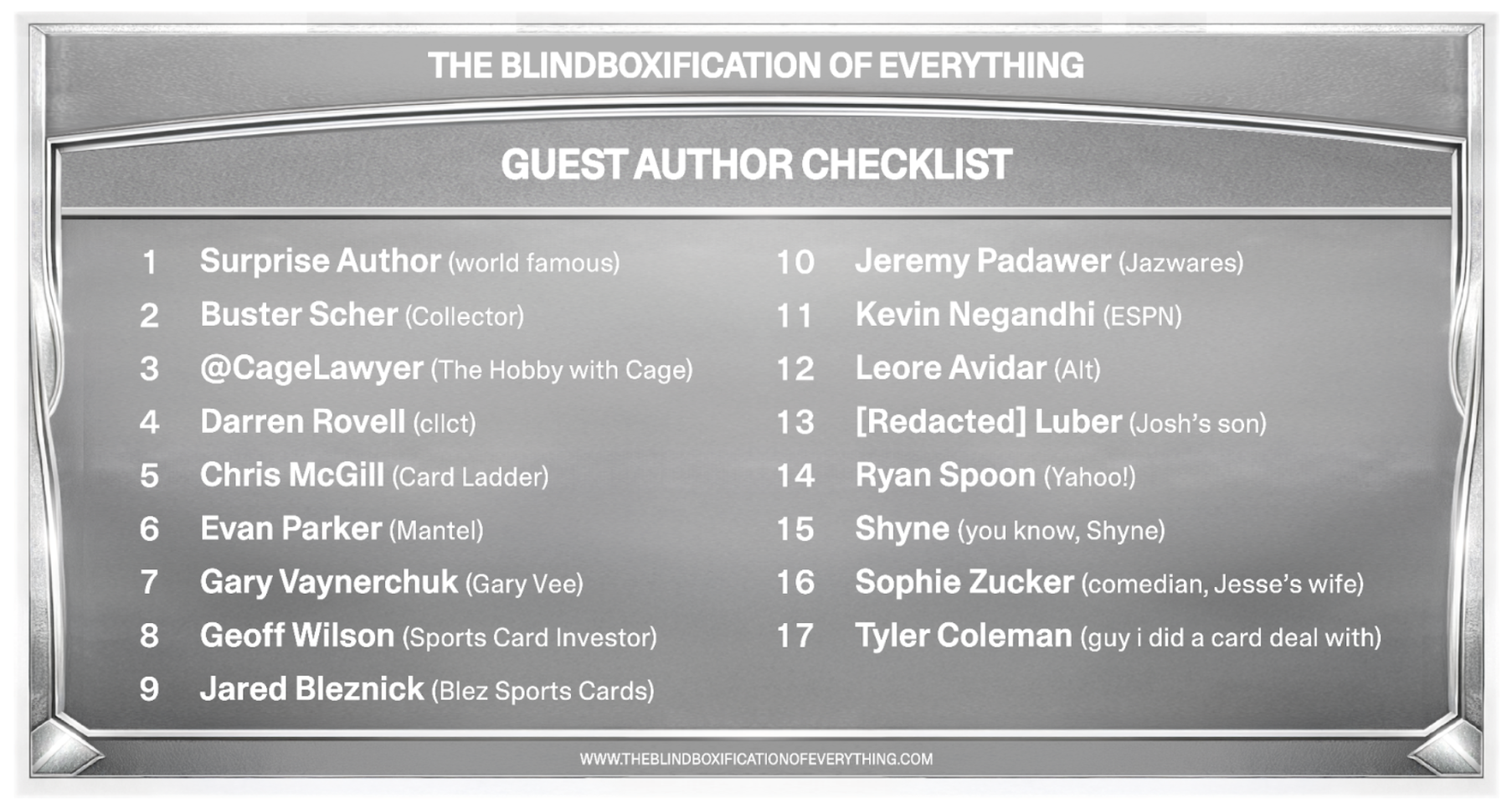
With that, I bid you happy hunting and peaceful reading, and will tease one of the central learnings from this paper: a blind box doesn’t guarantee value any more than a drop does.
I guess that’s my legal disclaimer. Which is to say that I wrote this paper for the same reason I wrote the last one - because I like cards and I like to write and it made me happy. If you find this paper interesting or helpful, I’ll be happy about that, too.
INTRODUCTION
I want you to put the word out. Like Barksdale and Backstreet, the Hobby is back up.
After several years of stagnation, the card market is booming again - overall volume has never been higher. This rally has a distinctive form. On the secondary market, there is a generational bull market for high-end singles, with new record sales coming every week.
At the same time, we’re seeing an explosion in the repack business. Repacks aren’t just a new product. They’re a fundamentally new way of buying cards - a disruption of the collector experience itself.
Finally, there’s also a boom in products that look and act like cards. Blind boxes aren’t just for collectibles these days. Toys, sneakers, hats, cookware, cosmetics, food - everything is being sold in an opaque box. Everything is getting repacked; everything is getting gamified.
At first glance, these might seem like separate stories. But they’re actually one big story playing out in different markets. And the key to understanding them is a single sentence, written almost four hundred years ago.
***
“The pleasure of the hunt is greater than the pleasure of the capture.”
***
Those words belong to Blaise Pascal — a 17th-century mathematician, philosopher, theologian and polymath. It is sometimes shortened more colloquially as: the thrill of the hunt.
But what exactly does it mean?
In his book, Pensées, Pascal observes that man exists in a state of existential restlessness.
“Our nature consists in motion; complete rest is death.” (Pensées 129)
Yet rather than finding ways to quell that restlessness, we seek out ways to divert ourselves. We play games. We fight wars. We place bets. We hunt. In Pascal’s time, it was billiards and fox hunts; stock-jobbing and colonial crusades. Today it’s basketball, Call of Duty, and Polymarket.
And here’s the crucial part. The enjoyment of these games does not come from their successful conclusion. It comes only in the experience of doing them.
“The struggle alone pleases us, not the victory.” (Pensées 135)
And if the struggle ever concludes, it only makes us MORE restless - propelling us to seek out bigger games and more challenging hunts. Pascal concludes:
“What people want is not the easy peaceful life that allows us to think of our unhappy condition, nor the dangers of war, nor the burdens of office, but the agitation that takes our mind off it and diverts us. That is why we prefer the hunt to the capture.” (Pensées 136)
Pascal wrote those words more than 100 years before the United States was born. And, yet, when it comes to the Hobby, and the entire collectibles industry, and indeed the whole goddamn economy - well, it’s more relevant today than it’s ever been.
***
This paper is about blind boxes - and BLINDBOXIFICATION. But when we use these terms, we aren’t talking about physical packaging. We’re talking about something broader - the experience it creates.
The experience can unfold with the opening of a physical box. Or a physical pack, pallet, crate, capsule, or bag.
But as we’ll see, it can take many other forms beyond that. A slot machine. A sneaker drop. A Beanie Baby retirement. A clearance sale. Even live-shopping, if it’s done right.
A blind box isn’t a box. A blind box is Pascal’s chase.
***
Before we get any further, allow me to reintroduce myself:
My name is Josh. I am an entrepreneur. I’ve co-founded many companies but the two you may know are StockX (2015) and Fanatics Collectibles (2020).1 Now I run a collectible toy brand called ghostwrite.
I am a collector. Trading cards, sneakers, clothing, toys - but especially cards. Like a lot of people, I collected cards as a kid, got back into the Hobby in 2019, and have been buying and selling ever since.
I am also a writer, speaker and accidental economist.
In 2015, I gave the world’s first TED Talk about sneakers, ”Why Sneakers are a Great Investment” - and then launched StockX four months later.
In 2021, I wrote the (then) world’s longest white paper about trading cards, ”Trading Cards Are Cool Again” - and then launched Fanatics Collectibles three months later.
Now I’m writing this. Or more accurately, we’re writing this. This paper is one part personal essay, one part co-authored article. And my co-author (Jesse Einhorn) is also a co-founder of the startup that goes with it: ghostwrite.2
So yes: I’m writing a blind box paper, while also building a blind box company, which you’ll hear about more at the end. And yes: that means the stakes are rather high. StockX and Fanatics Collectibles were both pretty successful, which means that ghostwrite - and this paper - have some pretty big (unicorn-sized) shoes to fill.
Lucky for me, it’s my third time around. Same for Jesse, who helped write the last white paper, and also worked at the last two companies. Practice makes perfect, right? Right??
But let’s not put too much pressure on ourselves. At the very least, don’t try to parse when or why we use ‘I’ or ‘we’. Just assume it’s me (Josh), occasionally using the royal ‘we’.3
Also, don’t stress about the length; this paper has way more pictures than the last one.
***
Whenever I’ve written about these subjects before, I’ve taken a cold and rationalist approach. I focus on objective factors like prices; logical laws like supply and demand. I use a lot of charts.
This will be a different kind of essay. There will still be charts. There will still be economics. But mostly, we will concern ourselves with the dynamics of the psyche. In honor of our friend Pascal, this will be a meditation on the experience of collecting - and how that experience has changed. Also, how that experience has changed the broader, global economy.
The current market boom; the rise of breaks and repacks - they tie back to this evolving experience.
The internet-breaking virality of Labubu; the sneaky-shocking resurgence of GameStop; the ever-increasing convergence of collectibles, consumer goods, and gambling - they tie back to this experience, too.
You think live-shopping is a big deal? You think prediction markets are taking over the world?
These are just subsets of the blind box experience. Variations of Pascal’s never-ending hunt.
THE BLINDBOXIFICATION OF EVERYTHING, aka the gamification of commerce, is the second most disruptive economic force in the world today.4
This paper is our attempt to explain what’s going on - and to prepare you for what’s to come.
PART I: TRADING CARDS
CHAPTER 1: TRADING CARDS ARE COOL AGAIN, AGAIN
I published “Trading Cards Are Cool Again” in November of 2021. At the time, we were just months removed from some of the highest highs in Hobby history and the market was in freefall.
In the paper, we made the case for optimism. This was a correction, not a crisis. It might take some time, but the market would eventually recover.
And guess what? We were right.
Why were we right? Why did the market recover? In the simplest possible terms: companies caught up with prices. Fanatics has taken a Neil-Armstrong-level first step towards properly marketing the Hobby5, bringing in thousands (millions?) of new collectors. PSA has matured from a raw and bumbling mid-round prospect into the franchise player it was always meant to be. And with those two titans holding down the core, hundreds of new entrepreneurs and startups are innovating on the periphery and pulling the Hobby into the future.
In fact, by some measures, 2025 has actually exceeded the heights of 2021. And while the aggregate metrics are compelling, the anecdotal ones are downright spooky.
Mark Twain says: history doesn’t repeat itself - but it often rhymes. Here in 2026, the rhymes of Hobby history are hitting harder than bars from The Chronic.
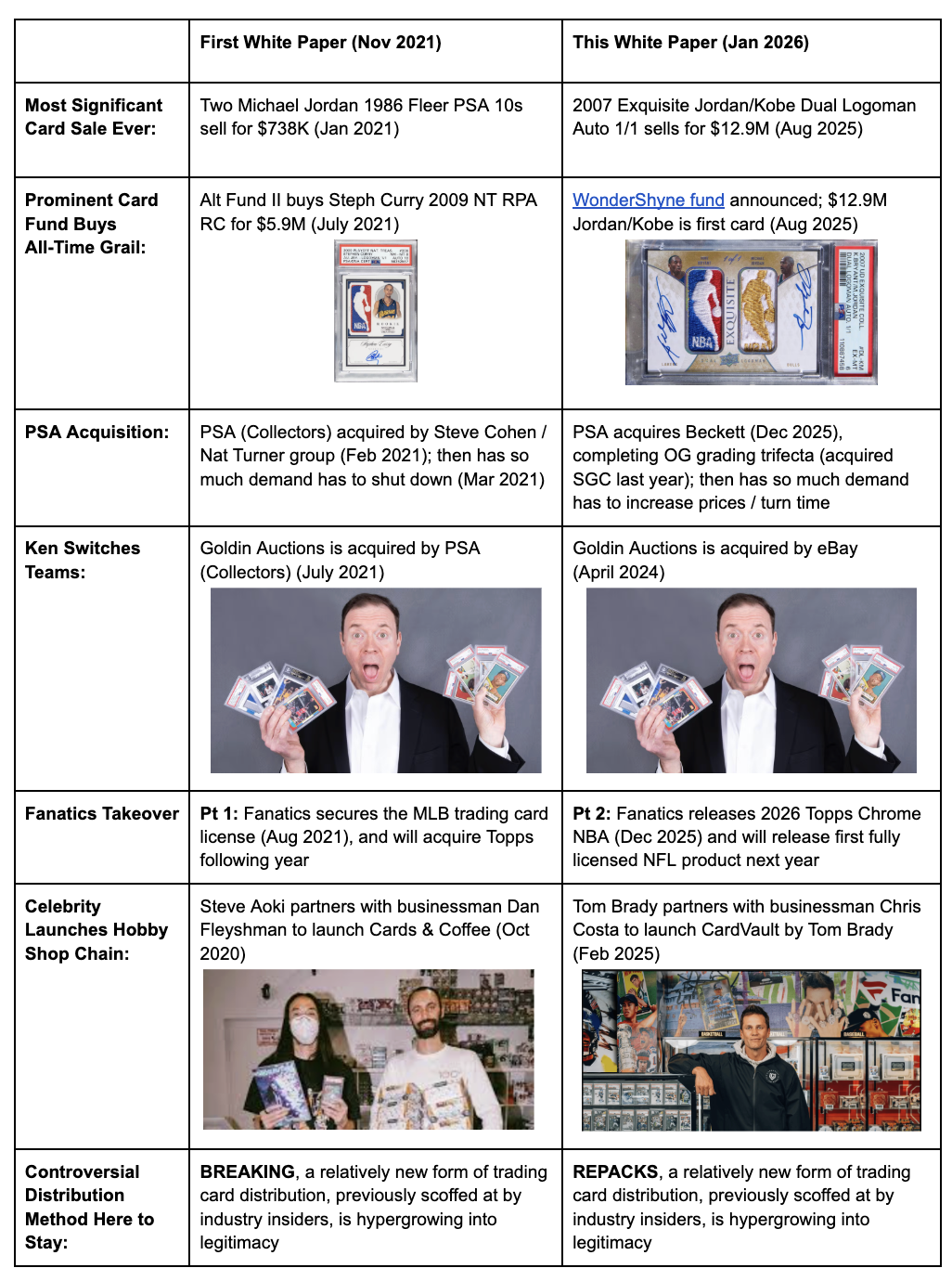
AND YET...
As much as 2026 resembles 2021, there are some important differences this time around.
1.1 - THE MYSTERY OF THE BIFURCATED BOOM
In 2020 and 2021, the boom in the singles market was omnidirectional. Indiscriminate. “Polymorphously perverse”, to quote Woody Allen in Annie Hall. “Everything everywhere all at once” to quote Everything Everywhere All at Once.
Cards of every sport, every athlete, and most importantly, every price point all experienced the same hockey-stick explosion.
The high-end moved in tandem with the low-end. Blue chip grails boomed right alongside high-pop base cards. The 2018 Prizm Luka PSA 10 base went up 10x in one year, selling for $2,000 at its peak. Remember that? I sure do. My wallet still hurts.
Why did everything go up across the board? In part, it was a function of irrational exuberance. But it also reflected a rational view of the fundamentals:
The industry is growing. TAM is growing. So the singles market - the ENTIRE singles market - should grow proportionately.
A 10x increase in the number of collectors should lead to a 10x increase in demand for ALL cards - and that demand should be spread out evenly across the price spectrum.
Put another way:
Sure, there may be 20,000 plus Luka 2018 Prizm PSA 10 base cards . . . but American Airlines Arena holds 20,000 people; the population of Slovenia is 2.1 million; Luka has 10 million-plus IG followers . . . the point is clear, right? The number of people who might want to own a Luka rookie is WAY greater than even the highest pop counts.
So I bought everything, everywhere all at once.
And the price of everything went up.
Until it went down.
And I was left holding hot dogs.
***
Now we’re in a second boom. But this time, it’s more like a controlled explosion than a global thermonuclear war. Demand for high-end cards is through the roof, and prices are going to the moon. But demand for low-end cards is essentially flat:
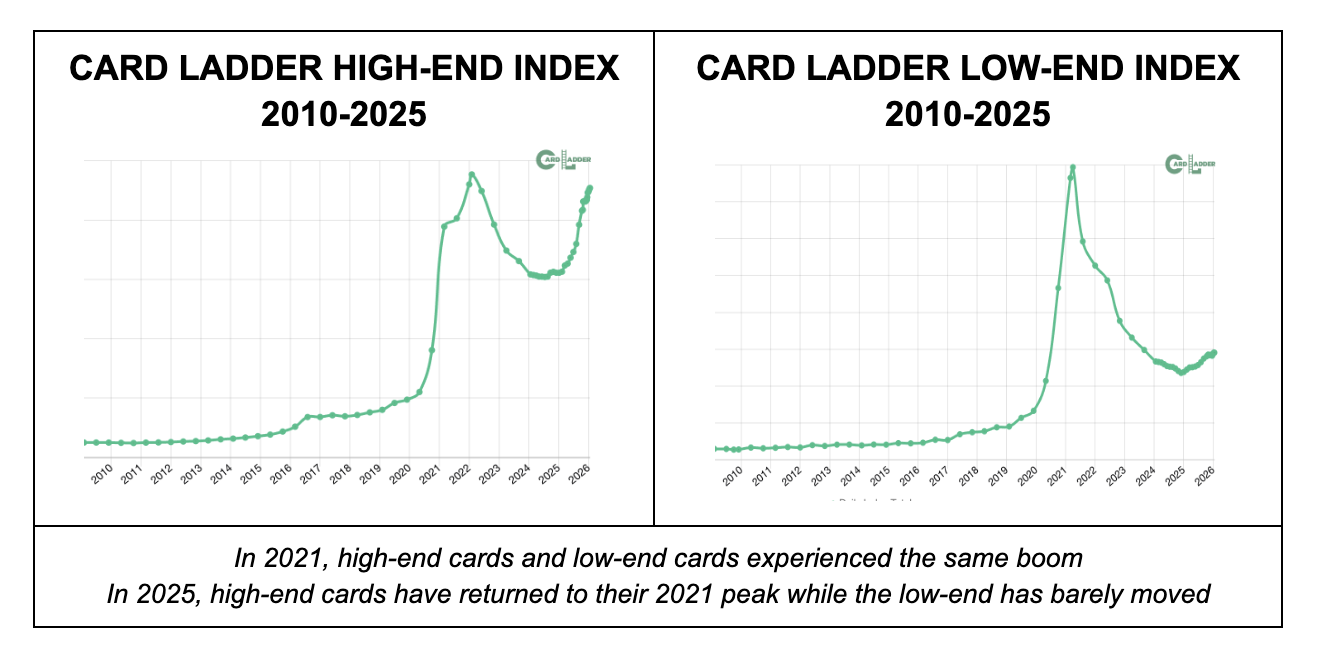
Let’s consider an example of a low-end card that isn’t booming: the 2018 Prizm Luka PSA 10 base card that I mentioned earlier. In August of 2021, at the height of the last boom, I bought 50 copies for $1100 each. It was a steal at the time - the market value was $2250 - but it sure isn’t a steal now. Today, the market value is $180 - exactly what it was in 2019, two full booms ago.
So the low-end stagnation is concerning on a personal level. But it’s concerning on a macro level, too. The singles market is a proxy for overall Hobby health, just like the S&P 500 is a barometer for the larger economy. And the fact that so much new demand is concentrated on high-end cards has a lot of people asking questions:
“Are high-end singles propping up the market?”
“Is the Hobby becoming an exclusive playground for rich people?”
“Is a boom like this sustainable?”
“Dude, where’s my car?”
***
I understand why people are asking these questions. But the thing is, they’re the wrong questions (except for the last one, which is evergreen).
When you look closely at the singles market right now, “high-end vs low-end” is only one part of the story. There are MULTIPLE ways in which the current boom is bifurcating.
For starters, look at the markets for different athletes. Cards belonging to undisputed GOATS like Curry and Mahomes are going to the moon. Whereas cards belonging to “mere all-time-greats” are basically stagnant.
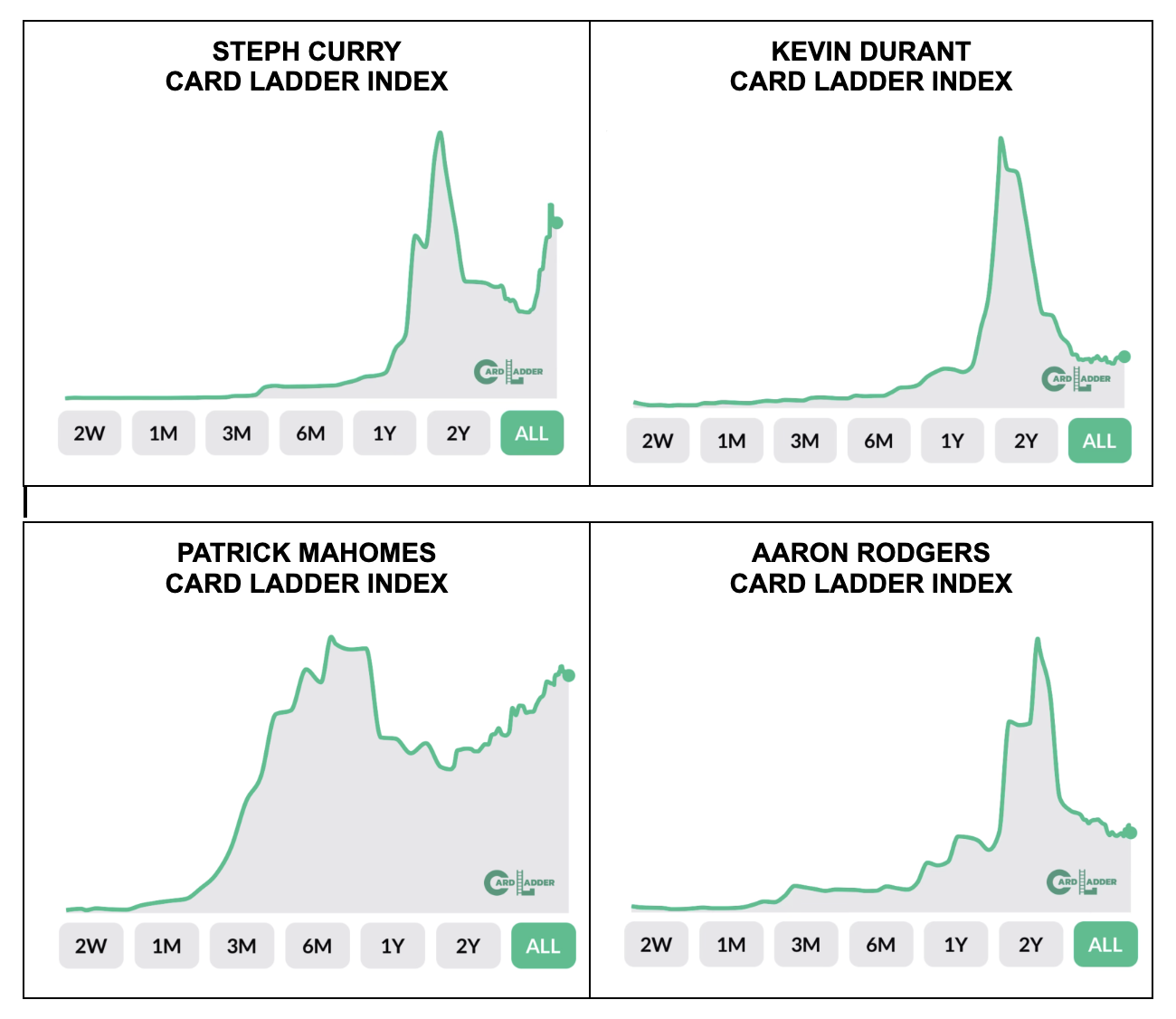
This isn’t just a story of “GOAT cards are more valuable”, because duh, dude - that’s always been the case. What matters here is that new demand is going to GOATS - pushing the high values even higher - and not to anyone else. This is the exact opposite of the 2021 boom, when all players rose together.
***
Ok, so maybe instead of a high-end story, this boom is a true scarcity story.
GOAT players, of course, are the definition of truly scarce - “greatest” is singular; “greats” are plural. And when you look under the hood of the GOAT indexes above, the cards driving the boom are the truly scarce ones. So maybe it’s as simple as that.
Except it’s not.
Pop quiz, hotshot: What is the exact opposite of “true scarcity” in the Hobby?
Answer: The Junk Wax Era, of course.
So why is Ken Griffey Jr. 1989 Upper Deck PSA 8 - literally the most populous card of all time - boomin’ harder than Leland Tyler Wayne? And why are other iconic Junk Wax cards, like the 1984 Donruss Don Mattingly, heading into orbit with it? If the story is all about scarcity, why are these Junk Wax poster children going to the moon?
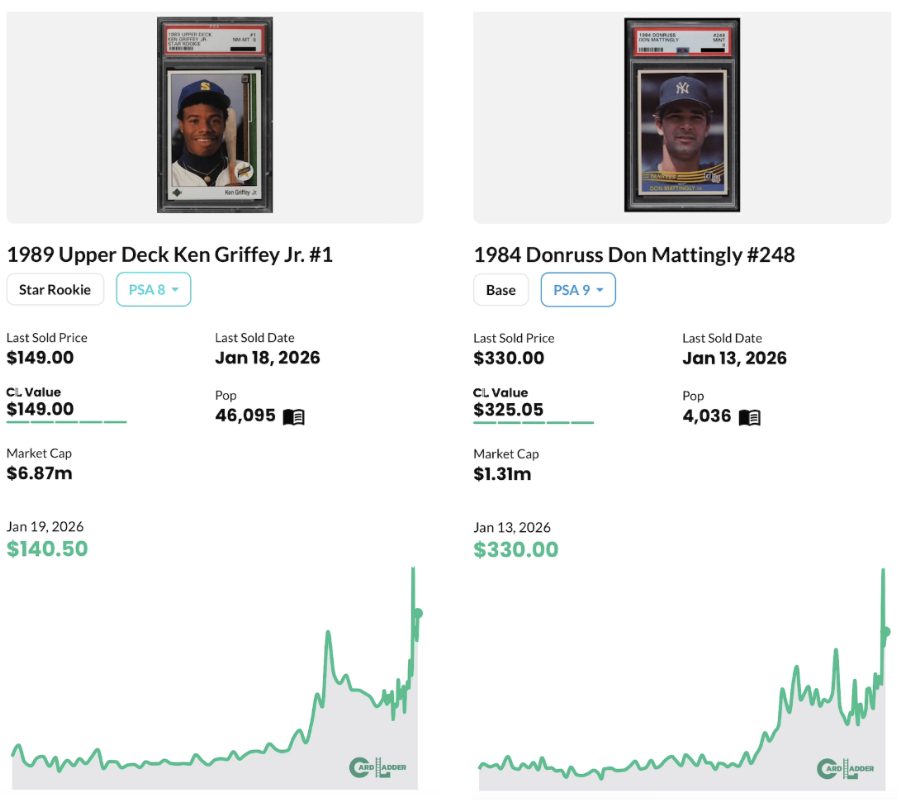
These cards aren’t scarce, and they certainly aren’t “high end” So what the heck is going on?
1.2 - A TYPOLOGY OF TWO CARDS
The bifurcated boom is nuanced and complicated, for sure, but the singles market is telling us a story. It’s a story about GOATS and grails; about the truly scarce and the high-pop icons. It’s a story that defies easy explanation, but at the very highest level, we find our first nod to Pascal:
Not all cards are experienced the same
There are two types of cards.
There is one group of cards that really matter - because the experience of hunting and finding and winning and buying them feels different.
And then there’s everything else.
What should we call these two groups of cards? In the course of writing this paper, we considered several different alternatives:
UNIQUE vs PEDESTRIAN
RARE vs COMMON
CHASE vs BASE
Each of these have merit, but none really capture the essence of the distinction.
At one point we landed on GRAILS vs CARDS - and we actually wrote several versions of this paper with that as the nomenclature - but then we decided to abandon that, too. GRAILS is a nice word, but not exactly accurate. Also, it’s so overused it’s become almost meaningless.6
In the end, we decided to go with something that matched the blind box experience itself:
HITS vs FILLER
This typology is provisional; as our discussion continues, we’ll learn that there is actually a THIRD category of card called “Truly Collectible Cards” or TCCs (be patient, we'll get there). But as a starting point, the provisional distinction will suffice.
HITS vs FILLER has the benefit of being intuitive. But even more important, it corresponds perfectly to our current collector experience. It captures the terms of the modern-day hunt.
When a new wax product comes out, what’s the first thing we ask? Is it “how do I collect it?” Or “what HITS am I chasing?”
When we buy into a break, what kinds of cards are we hoping to hit?
It’s not that FILLER cards are worthless. Viewed from one angle, they’re just as important as HITS. They establish the terrain of the hunt. They let us toggle the difficulty settings of the game. For the probabilistic gambler, the FILLER is essential - the all-important denominator of the experience.
But a HIT is something different. If the FILLER is the negative space in a painting, a HIT is what makes it art.
A HIT is a trophy.
A HIT is a flex.
A HIT feels like a HIT.
Maybe because it’s valuable and rare. Maybe because it features a GOAT player. Or maybe because of its iconic history, like the ‘84 Donruss Mattingly.
You see what I’m getting at here?
A hunter doesn’t flex a 2-point buck in their trophy room, and a fisherman doesn’t pose for photos with a minnow - not even if the fight to bag those prey was extraordinarily difficult or time-consuming. The hunt is only meaningful if the odds are low and the prize is special. Even better if it’s immediately recognizable as rare and special - like when we see Jules’ wallet.7
So even though HITS and FILLER are the same physical thing (cards), and even though their values can overlap, their function in the experience is totally different.
***
On some level, of course, all of this is obvious. Everyone who’s been in the Hobby for more than five minutes knows that not all cards are created equal; that traditional “collecting” is a thing of the past; that the only thing that matters now are HITS.
Yeah, sure: there are still young kids who enjoy the simple game. They love to collect for the sake of collecting, and they treasure their little binders full of hometown hero base cards. Bless their little cards.
And yeah, sure: there are still set collectors out there, pursuing their quixotic missions. The last of the ambulatory Silent Generation, in their overalls and Peck & Snyder fitted caps, pulling from the card show dollar-bins like grumpy old fishermen pull fish from a river.
And just as God loves all his children, they love the FILLER as much as the HITS. So bless their grumpy hearts, too.
But let’s not confuse the past with the future. And let’s not confuse the traditional collecting experience with the experience that exists today.
What does today’s experience look like? Glad you asked.
CHAPTER 2: REPACKS
For most of my life, the experience of ripping wax (and therefore, of collecting cards) went something like this:
I’d buy a box of cards, sit down at my card table, alone, and savor the process. I’d rip pack after pack after pack, sorting the cards into different-sized piles. The largest pile, of course, was commons. Then, in decreasing pile size: stars, rookies, inserts, and (hopefully), a few hits.
I’d buy another box, rip more packs, and the piles would grow higher. At some point, the table would be overrun and I’d move the piles to their appropriate homes: A 5000-count commons box; a binder; top loaders or grading prep.
I guess you could call that a hunt. Sometimes it felt like a slog. But it was always an experience - a simple and primitive Pascalian experience. And one I’ve always loved. For most of my life, that was the experience. Living with those piles afterwards as a permanent part of my life - that’s what it felt like. The feeling of being a card collector.
But over the last ten years, and especially over the last five, that experience has been phased into unplanned obsolescence. Sure, I can still choose to buy a box of cards if I want - and I do - but for so many people in the Hobby, a radically different experience has taken its place.
It started with the rise of breaking. By fractionalizing ownership, breaking lowered the cost and accelerated the hunt. By allowing collectors to chase specific teams and players, it narrowed our focus on the experience of the HIT. And because it happened online, free from the slog of the physical, breaks stripped out the extraneous friction (we’ll sort those piles for you!), so we could keep ripping and chasing, ripping and chasing, in a perfect, uninterrupted loop.
When breaking took off in 2020, we all understood the enormity of the change. What we didn’t know then, but we do know now, is that breaks were just one big step along an evolutionary progression. And that the next big step - repacks - was right around the corner.
2.1 - REPACKS 101
If you aren’t familiar with repacks, you can read about them here. Or here. Or here. But the simplest definition goes like this:
Repack (noun): a third-party card product made up of singles purchased on the secondary market that are resealed in “mystery” packs and then sold to buyers. The buyer isn’t purchasing a specific card so much as a curated gamble, with odds, chase cards, and price tiers set by the repack company rather than the original manufacturer.
Today, repacks are BY FAR the biggest source of energy and growth in the Hobby (notwithstanding the Topps Chrome basketball supernova of late). And just about every relevant player in the industry is engaged with repacks at some level. Fanatics Live created a repack product (Instant Rips) for its breakers, while many breakers (Blez, Layton, Backyard Breaks, etc.) have launched their own branded repacks. Geoff Wilson helped launch PSA’s Certified Repack Service with his Graded Grails, while GameStop transformed their business on the back of a repack partnership with PSA (more on this later).
Even though they’re booming now, repacks have been around for a long time in different forms.
Young entrepreneurs have been selling ‘mystery boxes’ at card shows for years. The simple repack hustle is a mirror image of the sneaker reseller gig-economy we saw last decade (and featuring many of the exact same kids). These ‘unknown’ repackers range from a dude at a show with ten cards in brown paper bags, to small businesses like my friends at OtiaRips.
Except, OtiaRips is hardly small. It’s one of the largest repack breakers on WhatNot. They sell their own branded repack product, Galaxy, which comes in about twenty different formats, ranging from $1 breaks to its $2500 Galaxy Whale Rip Pack: You get one card - $1K floor; $15K ceiling; physical-only; no digital buybacks; no checklist currently on the website.
Does this strategy work? Well, OtiaRips daily revenue ranges from $150K “on a bad day” to as much $500K per day. Every day. Seven days a week. And his only bottleneck is on-air talent.
Let me rephrase that last sentence: OtiaRips could sell more repacks if they could hire more people to physically open them.8
And this is just a ‘Repack 101’ business, selling physical-only products. The BIGGEST companies – the digital repackers like ArenaClub and Courtyard.io – are on some total 201 shit.
Digital Repacks
While still backed by physical cards, these companies allow you to “unbox” your repack digitally. Which means that if you don’t want to keep the card you just pulled, the company will buy it back at a guaranteed rate, usually 90% of market value!
The buyback happens instantly. The money goes straight into your digital wallet. And you can immediately turn around and buy another digital repack - which of course, everyone does.
And another. And another. And another. And another.
Don’t want to sell the card back? ArenaClub and Courtyard have a marketplace where you can list it, and a vaulting service where you can store it. And if none of that sounds appealing and you just want to take possession . . . well, that’s fine too. The mail still works.
Except most people don’t want to take possession. Because possession isn’t the point.
The point of the hunt is the experience, not the capture.9 And digital repacks have built the perfect flywheel where the experience never ends. In fact, you’re actually punished for ending it; you only pay sales tax if you physically take possession.
If breaking reduced the friction of the buy/rip loop, digital repacks turned it hypersonic.
***
Back in March of 2024, Courtyard had monthly sales volume of $243,000. In August of 2025, that number was $78M. And at least anecdotally, it sounds like ArenaClub is close behind. So you can see why the Hobby is taking notice. You can see why every single company within five miles of the industry is looking at repacks and saying “how the hell do we do that?”.
$243K to $78 MILLION? In EIGHTEEN MONTHS?? That isn’t a hockey stick, it's a goddamn y-axis. And when you look at the product, it’s easy to understand why.
At the end of the day, repacks are just a superior version of wax. They offer transparent checklist odds, guaranteed scarcity and value, and clearly defined ROI - all massive improvements over the traditional card product.
But even though those factors are important to their success, the real reason repacks are winning is the psychology that they serve. The Product-Pascal Fit, if you will. The move away from traditional collecting; the increased focus on HITS; the shift towards trophy-hunting and gaming and straight-up gambling - repacks offer a better “fit” than any other product.
2.2 - PREDICTION: HYBRID WAX IS COMING
If card manufacturers (like Fanatics) are already dipping into repacks . . . and if repacks expose the shortcomings of traditional wax . . . then how long before wax itself is forced to change? How long before wax starts behaving like a repack, if only in order to survive?
Not that long.
In fact I’ll make a prediction...
PREDICTION: Major card brands (ahem, Fanatics) will start creating hybrid repack products - a mix of old (repacked) cards and new ones - within two years.
To be clear, I make this prediction based on absolutely zero inside information. Cross my heart, hope to die, stick a needle in my Red Ohtani (see page Chapter 3.3). I’ve never had this conversation with Rubin or anyone over there. I’m just looking at the market and where things are headed.
I’m looking forwards, but I’m also looking back. Brands have been using buybacks for decades. Before repacks gave us a second definition, ‘buybacks’ were when a card manufacturer buys back previous years’ cards and reinserts them into the current years’ wax, often having them autographed. Upper Deck pioneered the practice in the late 90’s and continues to do it today.
But my prediction here is a full-on hybrid repack product. It will still have the new rookies, new hits, new autos and new designs. The market will always need to feed this beast. But they’ll also have a Courtyard-like repack dimension, complete with a checklist of PSA-graded, market-valued cards. It’s the only way the brands can compete with pure repack products and offer a guaranteed and controllable ROI.
Interestingly, a hybrid product may also be the solution to the industry’s unsolvable problem: Runaway Parallelism.10 People have been ranting against parallel expansion for as long as there have been parallels. But the elephant in the room is that there’s no alternative. Everyone knows that the only way for a card company to make more wax is to increase the number of parallels (and inserts and autographs, etc.) - see, e.g., Topps Chrome NBA and their 62 parallels. And industry growth is directly serviced by an increase in flagship wax.
So when does it stop? The answer is never . . . unless brands figure out a different way to guarantee a certain number of hits per box.
However we get there, there’s only so long that brands like Topps can sell products with expected value in single digits while the market is flooded with repackers offering breakeven Expected Value (EV) plus 90% buybacks!
I know that statement seems silly today; I’m writing this sentence in the wake of the 2025 Topps Chrome basketball release - for sure the most hyped wax product I’ve seen since returning to the Hobby seven years ago. But come talk to me when they get to Topps Shoebox Treasures or whatever. Also, Chrome is a once-in-a-score11 release with the return of the NBA license plus an all-time rookie class (Flagg, VJ, Kon, Dylan Harper, Queen, Ace, etc).
Consider, instead, 2025 Panini Prizm Basketball Hobby boxes, currently selling for $530 on DACA. What’s the absolute best rookie hit in that product? Reed Sheppard Black Prizm 1/1? Alex Sarr? Not quite the same, is it.
The rookie class each year is, of course, the primary determinant of wax value. Card companies, however, have no control over that. This is another reason why a hybrid product makes sense. They could toggle the value of the repack part to balance the quality of the rookie class and basically make every year have the same EV.
The final step, of course, would be to add buybacks for the new hybrid wax - the repack definition, not the Upper Deck 90’s definition - and now you’re on a collision course with fully digital products. Perhaps Spinotron was right (of course he was) and we should have been buying Panini Blockchain cards from the jump.
At the very least, this can’t stay the same:
On Courtyard’s AppStore description it says: “Each card has an expected value equal to its pack price.”
On the box of Topps NBA I bought last week it says: “TOPPS DOES NOT, IN ANY MANNER, MAKE ANY REPRESENTATION, AS TO WHETHER ITS CARDS WILL ATTAIN ANY FUTURE VALUE.” (CAPS in the original).
Something has to give.
2.3 - MARGOT ROBBIE EXPLAINS REPACKS
Perhaps the most interesting thing about the booming repack market is how it drives - indeed, how it structures - demand on the singles market. People who are actively involved in the Hobby already know this, but it’s worth saying out loud:
Today, most singles are bought by repackers, not collectors.
A recent article in The New York Times details the symbiotic relationship between repack demand and card show supply. It’s worth quoting in full:
The first thing that happens is the buyers for the repacks purchase the most valuable cards, typically before the show is even fully open, by purchasing early admission credentials.
[Card show dealer Evan] Mittwaly says the buyers at shows trying to assemble repacks are a dream for the dealers who are set up at the show.
“The dealer is hoping that a normal person at the show will pay them 95 percent of the value of the card…But the buyer for the break comes in and pays 100 percent, no problem, because they need that card for the break.”
Mittwaly says buyers for repacks are the first on the floor and “cherry-picking $5,000-and-up cards [....]” And they pay whatever it takes to get inventory for their break, typically even a 10 percent bonus on hard-to-find cards.
The repackers are buying FILLER (the product doesn’t work without it), but their real demand is for HITS. That includes expensive cards ($5,000 and up), but it also includes the GOAT cards and iconic vintage.
The 1984 Donruss Don Mattingly was the seminal HIT card of the mid-1980s. At a time when every card from every set had the exact same supply, this was the one that every collector wanted. Why? Because the set was rare - or at least we thought it was. The same thing with 1989 Upper Deck Ken Griffey Jr. - the last demand-driven HIT of the Junk Wax Era. We thought the set was special, and so we imbued extra value to its best card.
Both cards carry that aura of HITNESS all the way to our present. And both cards, as we’ve seen, are now booming. The ‘84 Mattingly isn’t very valuable - a PSA 9 is less than $300. But as an iconic card with a storied history, it brings decades of brand value to a repack.
In this light, the bifurcated singles boom is starting to look a lot less mysterious. It is driven, at least in part, by repacker demand for HITS.
And if my hybrid wax prediction comes true . . . well, then the original primary market will soon become part of the same, circular organism. Demand from repackers; demand from hybrid wax manufacturers (Fanatics); and demand from collector/investors - they’ll all converge on HITS.
What this means, to borrow a metaphor from Landman, is that the entire Hobby - singles and wax - is transmogrifying into one big massive oil pipeline. Topps and Panini are crude oil from the soil, and repacks are the Pascalian refineries that turn it into jet fuel.
***
Or maybe an oil refinery isn’t the best metaphor. Maybe the best metaphor is a mortgaged-backed security.

Margot Robbie voice:
Just like Goldman Sachs and Citibank bundle tranches of mortgages to create new financial products, ArenaClub and Courtyard bundle different types of cards to create repacks. The banks and repackers then make massive profits - not on the underlying assets, but on the velocity of the trades (rips). ArenaClub and Courtyard profit off the compulsive unboxings, trades, and vaulting (plus interest on the wallet balances!), regardless of whether the underlying cards increase in value.
I know, I know. The analogy might be a little scary, even coming from Margot Robbie in a bubble bath. And yet we can’t deny that there are some eerie echoes between the repack boom of 2025 and the mortgage-backed security crisis of 2008.
Are people even looking at the checklists? Does it matter? There are certainly many repack products out there that literally don’t have checklists - just the promise of a floor value for FILLER, and a ceiling value for the HITS. A few bad actors could unleash a crisis of confidence that upends the entire system - not unlike 2008.
Or maybe it's actually the reverse. Maybe if Bear Stearns and Lehman Brothers had just sprinkled in a few AAA rated mortgages amongst the Bs and Cs - some clearly-defined HITS with a clearly-defined ceiling - then the meltdown wouldn’t have happened in the first place!
LOL. OK. Maybe not.
***
Maybe there’s an even better metaphor here. Not an oil refinery. Not a mortgage-backed security. Maybe the metaphor is the modern sportsbook.
We used to watch sports because we cared about winning. We’d root for teams to win, and sometimes we’d bet on them winning, but winning the game was what mattered.
Now, we have the ability to track and bet on every possible outcome. Point spread for the second quarter? Bet. Super Bowl prop on the Gatorade color? Take yellow/green/lime at +120! Or if you really want value, just take a parlay of Terry Rozier unders!
Wins and losses have become incidental. The game is just raw material for a million derivative probabilities for us to gamble on - and this was all before prediction markets!
Just as sports betting has changed sports, repacks are changing collecting. If you sit in front of your computer for three hours opening hundreds of repacks in a row . . . accepting buyback after buyback on an infinite loop . . . never taking possession (because possession isn’t the point)12 . . . well, should we even call that collecting anymore?
Or should we call it something else?
***
For some people, these metaphors have justifiably terrifying implications. A fossil fuel climate apocalypse. A Lehman Brothers market meltdown. The dead-eyed stare of Teddy KGB.
I’m not here to scare you and I’m not here to scold you. Oil refineries, mortgage securities and gambling all have their risks, but they’re also massive industries that aren’t going anywhere. And particularly for sports betting and repacks, you don’t need an Oreo to tell you about their ubiquity, so we might as well embrace the chaos.
2.4 - A REPACK THOUGHT EXPERIMENT
The hypergrowth of Courtyard and ArenaClub is astounding. Even more astounding is the degree to which they’ve already managed to vertically integrate the entire Hobby.
ArenaClub manufactures wax, in the form of digital repacks. They provide a live break experience, in the form of reveal. They’re a marketplace where you can buy and sell singles. They use internal and external data to operate a real-time price guide. And they’re a grading service to boot! And Courtyard is almost as prolific.
Now let’s imagine that this already-ongoing vertical integration of the Hobby is taken to its natural conclusion. Let’s imagine a world where EVERYTHING is digital, and every buyback and trade is recorded instantly in the same real-time digital price guide. (AI basically guarantees it).
Now let’s imagine the collector as a trophy-hunter. When the trophy-hunter pulls a HIT from a repack, he adds it to his collection - either because he loves the card, or because he thinks it will appreciate in value. But when he pulls a FILLER, he sells it back at 90% value.
In this scenario, the value of the FILLER cards will slowly degrade. As each 90% buyback is added to the price guide, the average value will go down. The FILLER card keeps going back into new repacks; it keeps getting bought back at 90%; and the price guide comp keeps degrading. Whereas the HITS get taken out of circulation, and their value keeps going up.
Sound familiar? Our hypothetical world sounds a lot like our real-world singles market, aka the bifurcated boom of HITS vs FILLER!!
According to Card Ladder, the current singles market is seeing ~$400M in monthly sales. And we know that ONE repack company (Courtyard) is doing $78M in monthly sales. So maybe this thought experiment isn’t an experiment. Maybe it’s just . . . life.
***
In that case, let’s take the thought experiment one step further. What if our subjects aren’t trophy-hunters at all? What if the repack buyers have a different psychological profile - the profile of a gambler?
For a gambler, HITS and FILLER aren’t qualitatively different cards; they’re just different color poker chips. The repack gamblers sell back their FILLER at 90% value. But they ALSO sell back their HITS at 90% value - pocketing the money as winnings.
In this new dystopia, EVERY card will slowly degrade in value - HITS and FILLER alike!
Oh fuck.
For reasons we’ll discuss in Chapter 4, I don’t think we’re anywhere near this world yet. As close as cards might come to gambling, there’s always going to be a difference between them. But there are undoubtedly repacks happening right now, where buyers are selling back their HITS - even the iconic PSA 10s and the GOATS.
So this thought experiment leads to an important question: is there a type of card that isn’t just a poker chip disguised as a trophy?
Is there such a thing as a TRULY COLLECTIBLE CARD?
CHAPTER 3: TRULY COLLECTIBLE CARDS (TCC)
What’s a TCC you ask? Let’s start by asking this guy:

Pop Quiz #2: What’s this guy’s name?
No. What’s his actual name?
It’s ain’t Cage. Or at least I don’t think it is.
The etymology of his IG handle, @CageLawyer, is due to a brief stint where he tried to represent UFC fighters - but I don’t know what his driver’s license says or even whether he still practices law.
I do know that he’s one of my favorite Hobby content creators, particularly since he adopted David Spade’s ‘Hollywood Minute’ rundown format, and co-opted the tagline from 1010 WINS (NYC all-news radio station) “You give us 22 minutes, we’ll give you the world”.
I also know he got his start selling Beanie Babies to fund Drew Bledsoe and Paul Molitor cards.
None of that is particularly relevant but when I told Cage about this paper he was concerned that I’d be making fun of the Hobby, so I had to get a few light jabs in there. Or maybe it’s just for his initial take on ghostwrite :)
Jokes aside, I’m genuinely a fan of his content and I want to share a particularly insightful post. Late last year, when most of Hobby IG was sharing their ‘card trees’, Cage posted this:
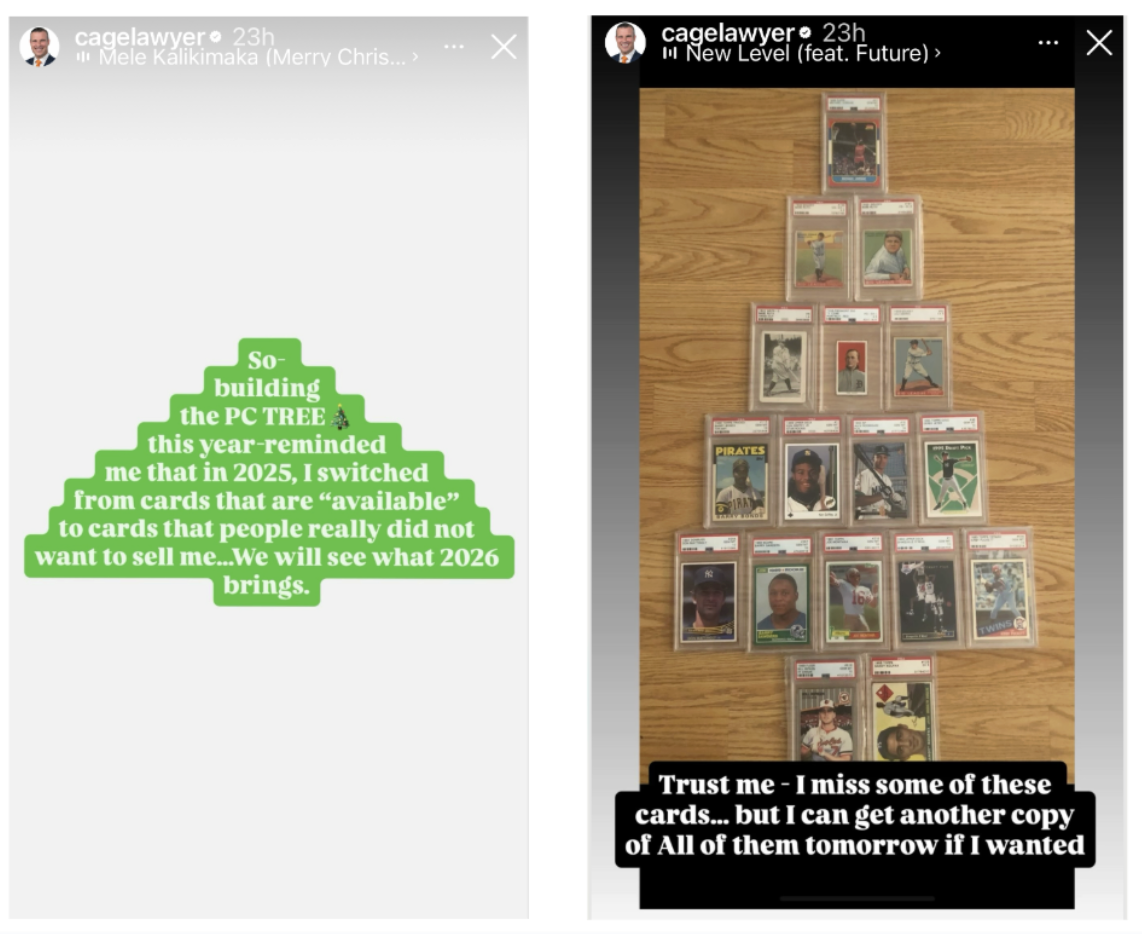
Prophetic and educational, visually appealing (and congruent), this is social media at its best.
More and more, collectors like Cage (and like me) are reorganizing their PCs along these lines - towards inaccessible cards. We don’t want cards that anyone can buy at any time; cards with so much liquidity that they’ve become an always-on widget: the kind that sits on eBay the same way a pair of shoes sits at Foot Locker.
This shift towards inaccessibility and true collectibility mirrors a broader consumer shift in the luxury economy.
People want Birkins because you have to be on a waitlist.
People want Ferraris because you have to be invited to purchase one.
People want a Patek Philippe watch because - in their clever framing - “you never actually own a Patek Philippe. You merely look after it for the next generation.”13 You aren’t a consumer of the watch; you’re a temporary custodian of it.
And this is exactly how TCCs function in the Hobby. We all know, down the line, our custodianship will end, and we’ll sell our TCC to someone else - even if we don’t really want to.
This is Cage’s new PC TREE. As you can see, it’s ALL TROPHIES, ALL RARITIES.
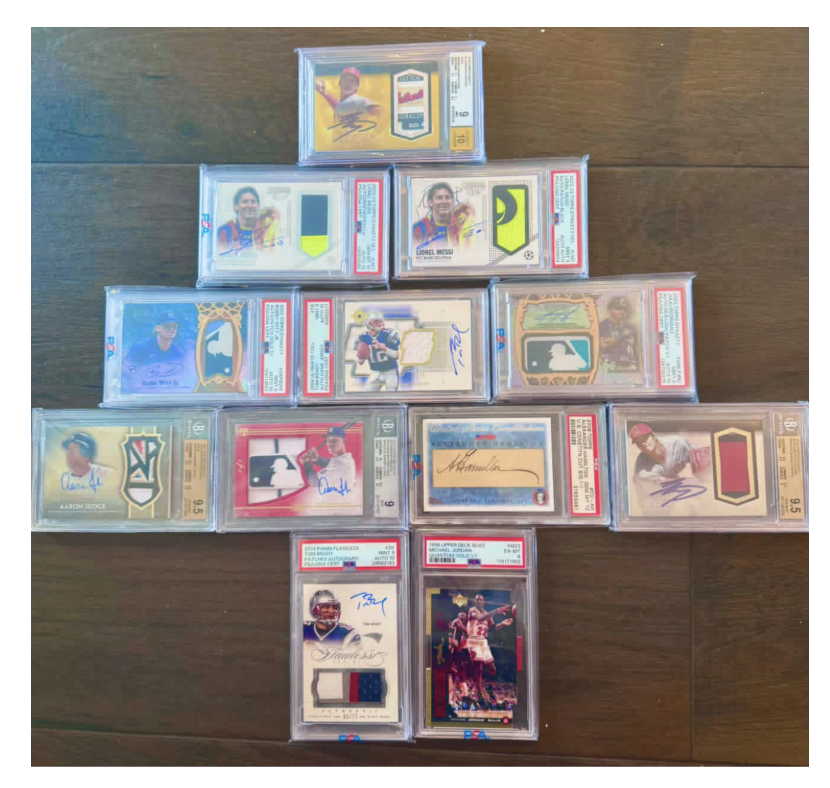
Or in his own words: it’s all “cards that people really did not want to sell me.”
***
To some extent, this is nothing new. True collectors have ALWAYS wanted trophies that are inaccessible and scarce and unique. From Bobbito Garcia’s sneaker collection (“Where’d You Get Those?”) to Thomas Crown’s art portfolio, everyone wants something that no one else has.
But the definition of what that thing is changes with time. With the rise of fully-liquid secondary markets; with the rise of instant shopping and 1-day deliveries; with the rise of vaulting, grading, and online auction houses - the things that used to be inaccessible are now just a click away.
Do you really want to own an ‘89 Upper Deck Griffey if everyone has one? If you can just buy an identical copy any day of the week? What’s the point?
In a repack product, that card might be treated as a HIT, but will the lucky owner sell it back, or keep it? And if they’re not keeping it, what are they keeping?
3.1 - ANATOMY OF A TCC
Let’s go back to 2020/2021, aka the Everything Everywhere All At Once boom.
Back then, collectors and collector/investors like me weren’t thinking in bifurcated terms. We treated the singles market the way Goldman bankers treat the stock market: more Adam Smith, less Blaise Pascal.
Sports Card Investor launched in 2019. Card Ladder launched the year after. These two businesses gave us the tools and the mindset to think about the singles market the way stock traders think about the NYSE. More than that, hearing Geoff and Chris and Josh talk so intelligently on the subject gave us permission to publicly talk about cards as investable assets, too - even though we’d been treating them as such behind closed doors forever.
Almost overnight, collections became portfolios; cards became assets. Even the most Excel-phobic collectors could analyze it all with on-demand charts. “Let me just check the Marvel Index,” said no one, ever, at the 2015 National. Fast forward to today and I’m not so sure this is actually a parody.
This created the foundation for “everything everywhere all at once”. If cards behave like financial assets, our investment decisions can be clocked accordingly. Different cards were just different-size units of the same, unitary demand. Investing in one card worth a million dollars (say, a Luka Prizm 1/1) should be the same as investing a million dollars in ten thousand $100 base cards (say, a Luka Prizm base PSA 9). And because both investments are of the same player and the same brand, the expected ROI should be identical.
This was an important and necessary evolutionary step. Yes, the singles market is driven by collector/investor demand. But we overindexed on the investment, and underindexed on the collector experience. We underindexed on the hunt.
***
Now, we’re starting to see things differently. While repacker demand is concentrated on HITS, collector/investor demand is concentrated on TCCs.
At the end of 2021, I made a fundamental shift in my PC and began chasing Black Prizm 1/1s (specifically, NBA True Black 2013-2021). Why? Because, by any definition, every Black Prizm is a TCC. The best card in the best set of the best sport. The Prizm brand is iconic. The 1/1 makes it inaccessible. And the process of acquiring even the least expensive of these cards isn’t just a purchase - it’s a hunt.14
I’ve hunted hundreds of Black Prizms on the singles market. Some were very expensive (six figures). Some were pretty cheap - like the 2020 Troy Brown Jr. that I bought on eBay for $455 last month. That might set the record for most expensive Troy Brown Jr. sale.
You’re welcome, Troy.
I’m just one person, of course. But even if they don’t use the term TCC (because I just invented it), everyone in the market agrees that Black Prizms are TCCs. Even Troy Brown Jr.
Black Prizm is one example, but there are plenty of other TCCs, most of which aren’t 1/1, most of which aren’t the six-figure cards that fill up the headlines. Any PMG (any year, any color) and about a dozen other 90s inserts are TCCs. Every Kaboom! Gold Prizm of every mid-level player and up. Every Logoman. Basically every card in Flawless. Mid to high grade vintage baseball (Mantle, Mays, Aaron, etc) and mid to high grade vintage basketball (Wilt, Russell, Alcindor, etc.). And it’s not just sports. Just thinking through my own collection, here are three non-sport TCCs that I love: 2014 Topps NBCSN Premier League Ted Lasso; 2009 Upper Deck Spectrum of Stars Kim Kardashian Autograph; 1965 Swedish Candy The Beatles and Cassius Clay.
These are iconic cards or brands or people. These are cards with true scarcity, even if not numbered. They will never have a fully liquid market. They will always be inaccessible.
In a fully-digital future, where physical ownership is a thing of the past; where you can buy (almost) every card at any moment of day - these are the cards that collector/investors will care about. This is the experience that will matter to them.
***
Inaccessibility is one aspect of that experience. Here are a few others:
We struggle to hunt TCCs
The experience of hunting a TCC on the singles market is singular. Psychologically. Existentially. It is pure, unadulterated Pascal.
Consider: the most common post on Hobby Instagram is a buyer flexing a TCC and thanking the seller for parting with it. Think about how wild that is. Even the Birkin-buyers don’t go on IG to publicly thank Hermès for taking their money. However grateful they feel for hunting down the bag, they aren’t going to give blessings to a faceless corporation.
But for a TCC...we always thank the seller, because we know their struggle. We know the pain and anguish they now feel because (more often than not) we had to sell a different TCC in order to fund the purchase of this one. And yes, as owners of TCCs we know our custodianship is always temporary, but that doesn’t make the loss any easier when it comes.
That pain . . . that sacrifice . . . this is why most TCCs rarely ever hit the market. And when they do, the hunt is always intense.
If you’re lucky, your TCC will show up at an auction. But then everyone is keyed in, and the hunt becomes “can I outbid these people without destroying my marriage”. That’s one kind of hunt. And that’s if you’re lucky.
Without luck, it takes some work.
First you gotta find the card (often impossible). Then you gotta convince someone to sell something they aren’t even trying to sell (often more impossible). And then you have to negotiate a reasonable - or at least not-unconscionable - price, despite having zero leverage (the definition of impossible).
I’ve taken more than my fair share of shots trying to convince people to sell - and have run the gamut of results, which fall into one of four quadrants:

Let’s start with one I wish I’d bought: 2018 Prizm Luka Doncic Black Gold /5 RC
In the summer of 2019, when I was buying every Luka I could get my hands on, I was at a card show in Washington D.C., and I met Sharon (aka BlackJadedWolf) for the first time. She had the Luka Prizm Black Gold /5 on display.
I said how much. She said it’s not for sale. I said, well it’s sitting in your case. So she turns it over and reveals a $15K sticker.
Holy shit, I say. That should be a $4K card. Maybe five.
“Like I said”, Sharon continues, “it’s not for sale. But if you wanna pay me 3x market, it’s yours.”
Well fuck a duck.
I had bought pretty much every Luka Prizm in the room that day. I was with Koonce and he had been encouraging me on what would be my first real shot at prospecting.
But then we got to Sharon, and even Koonce got squeamish. His exact words were, “What’s it going to go to? $25K?”
So I made the sensible decision. The rational decision.
And now that card is worth a million dollars. Fuck another duck.
The full version of this story appears in Morgan Jon Fox’s The Hobby - a documentary about the last card boom, starring . . . me. It was nominated for an Emmy. I guess the academy loves tragedy.
***
Here’s one I wish I hadn’t bought: 2018 Topps Update Juan Soto #US300 Platinum 1/1 RC
In October of 2021, right in the heart of the last boom, I was real-time reworking my collection towards TCCs. My new primary focus would be Black Prizm, but I was also looking for other big 1/1s. Unfortunately, my new hunt collided with the exuberance of the boom and memories of missing out on the Luka Black Gold . . . and I took a major L.
Through a series of private conversations, I tracked down the owner of the 2018 Platinum 1/1 - probably Soto’s third best card.
Juan Soto is obviously a superstar now but, at the time, he was the most hyped of a hype-fueled rookie class which included Fernando Tatis Jr., Ronald Acuna Jr., and Vladimir Guerrero Jr.15 At the time, everyone was hunting the next Luka or Mahomes - cards that might 10x if the player made a HOF jump - and so we were all overpaying for rising stars like Soto.
The card wasn’t for sale, so I didn’t have much leverage. He said no to all of my offers, then made a ridiculous counter offer - $400,000. Absolutely nuts. I think it should probably have been $150K, maybe $200K - even with the inflation from the boom.
Except that I didn’t see a $200K card. I saw the Luka Black Gold that I passed up two years earlier: the 50x return I had missed out on. I tried to get him down but eventually bit the bullet and paid his asking price.
Two years later, I sold the card for $38,500. Fuck. More. Ducks.
We mourn our failure to acquire TCCs
At times, the stakes of a TCC-hunt can feel impossibly high - especially in a bull market. Indeed, one of the great pleasures of a bull market is that rising prices prompt otherwise-reluctant sellers to open up their vaults, which in turn incent other collectors to move their TCCs in order to acquire a card they might never have a chance to buy again. So it’s great - that’s when you see the most TCCs come onto the market - but it’s ALSO when the competition is most fierce.
Negotiation is an essential part of the process, but it's balanced on a knife’s edge. There’s always another buyer waiting in line behind you, so you can’t push too hard. And if you falter, the loss can feel devastating.
The Luka Black Gold is the most public L I’ve taken, but there are countless others with a fresher sting. Just a few months ago, I had pole position on the Tom Brady 2013 Select Black 1/1 - an all-time personal grail (I’ve been collecting 2013 Select Black for years) and a market TCC (for obvious reasons). The seller was asking $400K, but I hesitated a day too long trying to negotiate a better price and poof, it was gone! I didn’t even have the chance to counter.
Odds are, I’ll never see that card again . . . except every single night when I wake up in a cold sweat of furious self-recrimination, and then I cry myself back to sleep.
But I’m fine. Really. I am. I’m completely comfortable living with my failures.
We tell stories of our conquests
Every TCC I’ve ever hunted and captured (or hunted and lost) has a story. But none is more legendary than the story of the greatest TCC I’ve ever captured, which happens to be the greatest card in the history of trading cards.16
The process took several weeks to complete. It ended up as a part trade / part cash deal involving thirteen different cards and $37K in cash. And involved three different people: a seller I’ve still never met (named Vince, I think); an intermediary I barely knew (named Tyler, I’m sure), and the buyer (me).
And here’s the kicker: The seller would only do the deal in-person, but he lived 4,000 miles away on an island-state in the middle of an ocean (Hawaii, obviously). So Tyler, who helped broker the deal, offered to go there for me.
That’s right. A kid I barely knew flew halfway across the world on the spur of the moment to close a high-stakes, six-figure card deal on my behalf. I gave Tyler nine cards to take to Vince (as trade), plus one card (as payment). Tyler gave ME one card to hold as collateral. And the deal hinged on me wiring money at an exact moment in time while working from a billionaire’s beach house in the Hampton’s. 10,000 air miles and three days later, Tyler came back and gave me the two cards I purchased - including my #1 TCC.
At the time, all those cards together were already worth several hundred thousand dollars. Today, they’re worth several MILLION dollars (and that’s just the two I bought).
Tell me that isn’t a movie!!! (More on this later)
3.2 - SCARCITY MYTHS, PROVENANCE LEGENDS
That last section had a lot of stories. And there’s a reason for that. Stories matter for TCCs. You might say that stories are everything for a TCC.
The stories of the hunt. The stories of the loss. The stories of the provenance.
Even the definition we started with - inaccessibility; true scarcity - is partly, if not wholly, a function of storytelling. Let me explain.
We’ll start with a discussion of two cards universally recognized at the best of the best - two apex predators of the TCC food chain; two undisputed toppers for any Hobby PC Christmas tree: the 1952 Topps Mickey Mantle and the T-206 Honus Wagner.
These are objectively, scientifically inaccessible cards. But to really understand what inaccessibility, in this context, means to collectors, we have to start with their origin stories.
Scarcity Myths
The T-206 Wagner has been around for over 100 years. The ‘52 Mantle has been around for over 70 years. But it was only in the last 40-50 years - starting in the 70s and 80s - that these two cards became TCCs, and the stories of their inaccessibility took shape.
The Hobby is a hobby, but more importantly, it’s a market. And the baseball card market didn't really exist until the 1970s - and didn’t become a market (e.g., the kind of thing that booms) until the 1980s.
The 1970s is when card shows became a thing; when ‘card dealer’ became an actual profession; and when rudimentary price guides became a form of shared media. The 1980s were when card shows went National, Beckett became Beckett, and regular citizens started looking around and saying “oh shit, this cardboard might actually be worth something.”17
Every collectible market, when it becomes a market, has to reach consensus on its Truly Collectible lodestars. The art world has Da Vinci’s Salvator Mundi. The old-school nerds have Action Comics #1. The next-gen nerds have Magic’s Black Lotus Alpha. And so at some point during the early-market Hobby period, the card collectors of the 70s and 80s decided on their lodestars. The T-206 Wagner and 1952 Mantle are the ones they picked.
These two cards became THE cards. The cards against which all collectibility is defined.
Part of this was the objective scarcity. As we’ll see in a moment, when we discuss the current pop reports, the Wagner and Mantle cards really are very rare when compared to their peers. But back in the 1970s (and 80s, and even 90s), no one really knew if that was true.
There were no pop reports back then. No GemRate dashboards. People had a general sense that certain cards were harder to get than others, but nobody knew how many of each card existed - much less what condition each one was in.
It was the 70s. Nobody knew anything!
***
Card collectors back then were living in the ‘demand-side’ era. A time when there was no (intentional) supply-side scarcity. (We’ll go deeper on this in Chapter 4).
The ‘52 Topps Mantle and T-206 Wagner are base cards. Every card prior to 1990 was a base card. Every card had the same supply as every other card in the set. There were no ‘hits’. There was no ‘chase’. Serial-numbering wasn’t a thing.
This doesn’t mean that all cards were equally scarce (or equally common). Even though there was no intentional scarcity, there were all kinds of post-production (or ‘accidental’) scarcity. And this made some cards more rare than others.
Mantle and Wagner were part of that group. They were objectively rare cards. No one knew HOW rare, but everyone knew there was some level of scarcity.
What made these cards really “scarce” - or rather, what made their scarcity “real” - were the stories. Because the best kinds of ‘accidental’ scarcity always came with stories.
***
The Wagner story was a real feel-good. It went like this: Honus Wagner hated cigarettes. He opposed big tobacco on moral grounds and thus forced American Tobacco Company (ATC) to remove his card from the set, shortly after it went to print. Because of this, every other player had millions of cards printed, while Honus only had a fraction.
The Wagner scarcity story is great, but the Mantle one is even better.
The Mantle card was part of the ‘52 high series - the last batch of Topps baseball that went to print for that season. By the time it came to market, late in the summer, kids were already turning their attention to football. The distributors didn’t want a bunch of already-irrelevant baseball cards from a brand-new brand (Topps’ first set was 195118). So what would they do with all those unwanted cards?
Sy Berger, the long-time and legendary Topps exec, tells the story like this. He rented two garage trucks and filled them up with hundreds of cases of ‘52 highs. The cards were then loaded onto a barge, sailed into the Atlantic, and dropped to the bottom of the ocean. He witnessed it himself, according to the story. His own personal Manhattan tea-party.
***
Today, we have pop reports, so we know exactly how scarce these cards actually are. For PSA pop, Mantle has had a total of 2,081 graded, while Willie Mays - the other star rookie from the ‘52 Topps set (who wasn’t part of the high series) - is at 3,759. So the Mantle pop is 55% of his peers. And Wagner pop is 10% compared to his T-206 peers - even more rare than Mantle.
Back in the old days, nobody knew those numbers. Nobody knew anything. The stories of the scarcity were what really mattered most - and the stories were fucking great.
From a pure literary perspective, the Wagner story was the Platonic ideal. Easy to remember. Easy to retell. A clear hero (Wagner) and a clear villain (big tobacco), and a nice, legible storyline to connect them. It was perfect.
But from a Pascalian perspective, the Mantle story takes the cake. Beyond the epic narrative, it also imprinted the perfect subliminal messaging on everyone who heard it. This isn’t just a baseball card. This is a buried treasure.
Anyone who heard the story (and everyone in the Hobby did hear the story) had this lodged deep in the bottom of their cerebral cortex. And so any time a collector went hunting for a Mantle, that was the feeling they got. You weren’t just looking to buy a card. You were Indiana Jones. You were Captain Ahab. You were Bill Paxton in Titanic.
The pleasure of the hunt is greater than the pleasure of capture, and hunting buried treasure is the greatest hunt there is.19
Two-Sided Collectability
The stories worked. Mantle and Wagner became the first two ‘rare’ cards in the entire ‘demand-side’ era (and therefore history of the Hobby). These were the two cards that everyone agreed were truly inaccessible - truly rare. Not because everyone knew or had the pop reports, but because everyone heard the stories.
And the consequences were profound.
The post-production scarcity of Mantle and Wagner fundamentally changed the very nature of these cards as economic instruments. They were no longer ‘demand-side’ only cards; they became ‘supply & demand’ cards.
I bolded the previous paragraph so that I could say this: please take special note, re-read it; really think through what it means.
Opening up the other half of the Econ 101 equation (supply & demand) doesn’t just double the opportunity for collectability. It increases exponentially.
This is a highly nuanced concept that requires (and is worthy of) much more time than we are giving it here20, but for now consider where we are today:
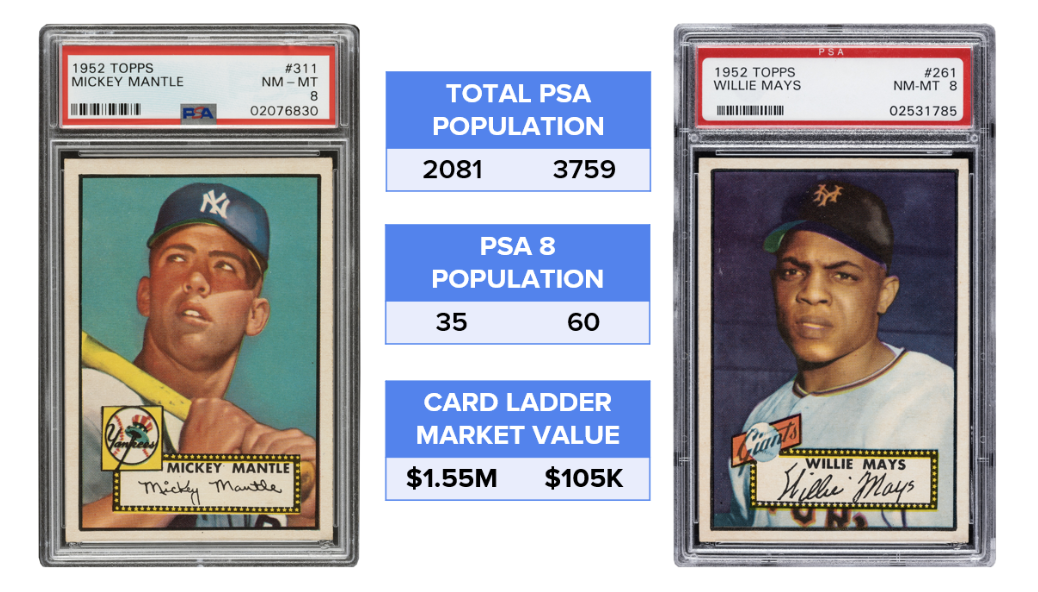
Mantle vs. Mays. This is ‘supply & demand’ vs. ‘demand-side’. This is the difference between single-sided collectability and dual-sided. It does not double. It compounds exponentially.
History is clear: Mays was a better player than Mantle – maybe the best ever! So even if we give Mantle greater cultural relevance, the difference in PSA 8 pop is only 1.7x! So, hell, let’s round that up to 2x and give Mantle 5x on cultural relevance (which is obviously total bullshit because card collectors love Mays almost as much as Mantle today). Even with those totally insane assumptions, the value difference should only be 10x! But the actual difference is 15x!
You follow?
You can’t even get to 15x by the math.
That’s nutters.
15x is the function of SEVENTY-FOUR YEARS of two-sided collectability compounding.
If I lost you on the whole two-sided collectability thing, I give you permission to abandon it. Allow me to restate the last sentence like this:
15x is the function of SEVENTY-FOUR YEARS of the Pascalian story compounding - the story that these cards are chase worthy. The story of buried treasure.
For most of the past 74 years, the story was all people had.21 But...
What if the whole thing had never started? What if the scarcity story hadn’t been compounding for decades? What if collectors never thought the Mantle and Wagner were rare?
I’m saying, what if the stories of the chase were actually just myths?
***
I don’t know the proper etiquette to break news. Especially news that will impact millions of people (financially, emotionally and historically). And I’m pretty sure it’s not done 40 pages into a white paper that only my father will read. Regardless, we’re going for it:
BREAKING NEWS: THE MANTLE AND WAGNER STORIES NEVER HAPPENED!
In truth, we’re not ‘breaking’ this news at all. All of these facts are out there for everyone to find (thanks to incredible work done by others). But we didn’t know any of them before writing this paper so I guess you could say we’re breaking this news to ourselves.
Here are the facts:
1952 Topps Mickey Mantle #311
It’s true that Sy Berger struggled to sell the high series in 1952. And it’s true that he had to find alternate ways to ‘get rid of’ the product. But it’s almost certainly NOT true that all those cards got dumped into the ocean like so much buried treasure. So where did they go?
Dave Hornish lays out the archival evidence in painstaking, incredible detail. It is a truly impressive feat of historical research, and I urge you to read it all (here and here especially). But the short version is this:
Some of the cards were shipped outside the US - to Canada, military bases, and especially to Venezuela. Baseball was crazy popular in Venezuela in the ‘50s, and it was a cheap and easy way to unload unwanted cards. Hornish provides archival evidence that ‘52 highs were shipped to Venezuela, and we also spoke to a veteran Hobby journalist who’s working on a similar story (he also has sources confirming this Caracas Connection).
Venezuela, as you might know, is a very damp place. There’s a lot of moisture and a lot of mold. So most of the cards that Topps sent down there (‘52 included) didn’t survive that long. For all intents and purposes, they were taken out of circulation by humidity. No different than being taken out by barge - but far less cinematic.
In addition, some of the ‘52 high series ended up at Card Collectors Company, run by Woody Gelman (who was himself part of the Topps Executive Cinematic Universe). This is also confirmed by archival evidence. The CCC cards were sold individually as singles, though once the market values started rising, they were likely hoarded by insiders.
Here’s where it gets interesting. In 1975, there was a fire at the CCC warehouse that destroyed much of their old inventory. And the very first time Sy Berger told the barge story - or at least the very first time it appears in any historical document - was precisely THREE WEEKS after that fire took place.
Maybe that was because some of the cards got destroyed in the fire, and Sy wanted to come up with a better story. Or maybe (more likely) it’s because that’s when the CCC guys started taking an inventory of the ‘52 highs that weren’t destroyed, and wanted a cover story to pull them from the market.
There are other red flags in the Berger Barge tale - like the fact that Topps management was relentlessly waste-averse (why throw away cards that could be sold in Venezuela?) and notorious tightwads (why spend extra money to rent trucks and a barge?!). Not to mention the inconsistencies in Sy’s story from telling to telling; or the fact that no one heard him mention the barge until decades after it supposedly happened.
Is it possible that the barge story is still true? Maybe some of the cards went to Venezuela, some went to CCC, and some ALSO got dumped in the ocean. Anything is possible.
But when we spoke to Hornish, he put the odds at 10%. With a 90% chance that the Berger Barge is baloney.
***
As for the Wagner scarcity story . . . this one is both easier and harder to debunk.
It’s easier because Honus, far from being some crusading anti-smoking advocate, clearly loved tobacco products! As Tim Wiles, former research director at the Baseball Hall of Fame, writes in this HOF blog post, “The Honus Is On You”:
This (story) is simply not true, as Wagner enjoyed smoking cigars and chewing tobacco – in fact, two companies issued cigar brands named after him. He lent his name to several tobacco advertisements throughout his career, and his 1948 Leaf baseball card shows him with a cheek-full of chaw and a pouch in his hand.
It’s also harder to debunk because all this shit happened 100 years ago and everyone is long dead. But a far more plausible theory for the Wagner short print is that Honus was simply trying to negotiate a better contract. Occam's razor: the simplest explanation (greed) is always best.
***
If we could time-travel back to the 1970s, and wipe the scarcity myths from Hobby memory with MIB Neuralyzers, the Mantle and Wagner cards would have a totally different status today. Their present value and reputation comes from the compound interest of 74 years of storytelling.
74 years of lies.
74 years of myths.
The “Gretzky/McNall” Wagner PSA 8 (pop 1)
Scarcity is one kind of storytelling. Provenance and authenticity is another.
Today, we don’t think about provenance as mere storytelling. Just as we trust the PSA pop reports, we also trust the PSA authentication process. As we should. Today’s PSA is a mature and modern company with real professionalism. But this wasn’t always the case.
This brings us back to the T-206 Wagner. Specifically, the PSA 8 Wagner which, it should be noted, was the very first card EVER GRADED BY PSA.
Today, we know that less than 70 copies exist of the T-206 Wagner. PSA has graded 37, and most of those are a very low grade. Only one single copy of the card has received a PSA 8 (the next closest copy got a PSA 5 - a huge drop off). And that PSA 8, I repeat, was literally the FIRST card graded by a totally new, totally untested startup. But put a pin in that for now.
In addition to having a sexy authentication story, the PSA 8 has an even sexier provenance story. In 1991, it was part of a legendary Sotheby's auction - an event that would set the tone for the entire Hobby going forward. Over 800 collectors attended. Bidding was frenzied and fierce. And several card sales blew way past their presale estimates.22 But the one that really stole the headlines was the eye-popping, mouth-dropping $451,000 sale of the T-206 Wagner - the highest price that had ever been paid for a piece of cardboard at that point.
The winning bid came from an anonymous bidder but their identity was soon. Wayne Gretzky and Bruce McNall - two of the most famous people on the planet.
The greatest hockey player of all time - literally The Great One - buys the greatest copy of the greatest card of the greatest player of the greatest era of the greatest sport.
This is an incredible story!
Too bad it's mostly horseshit.
**
The Gretzky/McNall is an absolutely beautiful card! In fact, the 8 is so much nicer than the 5 (and every other Wagner on planet Earth), that it’s almost hard to believe it exists. And that, of course, is because the card doesn’t actually exist. It’s been trimmed and likely doctored in other ways.
And we all know this. We’ve known this forever.
Keith Olberman, ESPN SportsCenter OG icon, is a widely respected card collector and vintage card scholar. His 2012 post “FBI: “The” Honus Wagner Was Trimmed” in his blog, Baseball Nerd, provides some excellent information (and fun prose).
Olberman’s friend, Matt Federgreen, was asked to examine the card by Bruce McNall prior to him and Gretzky buying it at the historic auction on March 22, 1991. Here’s what Matt said:
The card looked brand new. It bore no earmarks of being a clever counterfeit. But it also bore no signs of nearly 92 years of aging. Unless somebody was standing at the printing press when the card was finished drying, and stuffed it between the pages of a book, and kept the book in a climate-controlled room from the opening days of the Presidential administration of William Howard Taft, and had only taken it out after the inauguration of George H.W. Bush, something seemed wrong.
Oldbermann explained that he and Federgreen agreed it was trimmed. Matt told McNall, but McNall wanted to buy it anyway. Olbermann and Federgreen found some old photos of the card and discussed their analysis:
Between his photos and mine we were looking at before-and-after shots of the same card. Before and after somebody with the guts of a burglar and the skills of a circumcision specialist had trimmed the thing.
In its previous state the Wagner was an anomaly. It had very large white borders, and the card was thus perhaps 10% bigger than the average T-206. It looked like it had been hand-cut from a sheet of cards, and not done by a machine. Some of the corners were stubbed and worn from age. But the “face” of the card, the player’s image, the bright yellow background, the lettering, were shiny and virtually perfect. It had been handled, and handled an appropriate amount, since 1909. But whoever had done the handling had been very, very careful not to touch the face.
And then somebody bought it and actually cut away all the damage on the sides. It’s not a fake. But it’s also not an original.
Even in 1991, a lot of people were dubious of the provenance. But luckily for the parties involved in the auction, a brand new authentication service had just launched. In their very first act as a newborn startup, they gave this questionable card their unequivocal slab of approval.
“PSA 8.” The legend was sealed.
***
From there the card started the path of sales that everyone knows, from Jim Copeland to Gretzky and McNall, through the many more hands until it landed with Ken Kendrick, where it resides today. And it looks fuckin’ beautiful in the hotel Bible looking case in which the Diamondbacks owner keeps the card.
But it’s still trimmed. So it’s ain’t an 8.
Some legends are true; some truths we conveniently ignore.
***
The authenticity story may be B.S., but the rest of the provenance story is true. The Sotheby's auction did happen. Gretzky and McNall did pay that record-setting price. And hey - maybe that’s legendary enough.
But take a half-beat and think through what really happened there. It was just two rich guys overpaying for a heavily doctored card at a heavily-rigged auction.
It wasn't a real chase. It wasn’t some rags-to-riches Charlie Bucket tale. And the auction itself is as fraudulent-smelling as the PSA 8 grade!
Bill Mastro (the guy who organized the auction) ended up in jail for mail fraud. Bruce McNall went to jail for bank fraud!
At BEST, the whole thing was a nice PR moment. But that’s literally it.
***
Does any of this matter? Does it matter that so many historical TCCs are built on exaggerations, half-truths or outright lies?
Maybe it does, or maybe it doesn’t.
But here’s the thing: we don’t NEED scarcity myths and provenance myths anymore. Because we have the real thing.
3.3 - THE (TRULY) GREATEST CARD IN THE HISTORY OF TRADING CARDS
One of the nice things about 100-page papers is that you can sneak in quick little lines and maybe no one catches them.
Did you catch it, about ten pages up, when I told you that I own the greatest card in the history of trading cards? (See the sentence preceding footnote 16).
I wrote it because it’s true. The hobby may have decided that Wagner and Mantle are the greatest TCCs. But I have a different card to offer as the GOAT.
Buckle up.
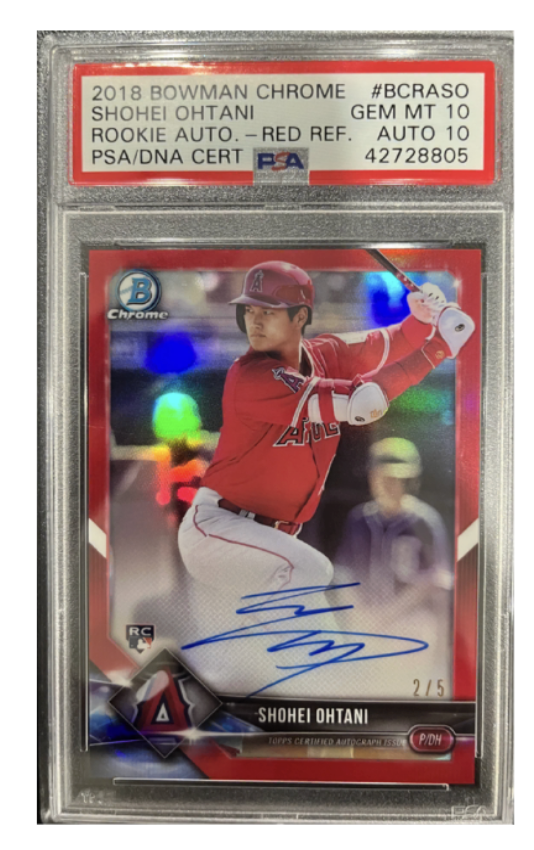
Here it is. The Shohei Ohtani 2018 Bowman Chrome Rookie Autograph (Batting) Red Refractor /5 PSA 10 / 10 (Auto). I own this card.
We can all agree, this is a valuable card. A very valuable card. It was valuable in 2021, when I bought it for $100K (in trade).23 But just in the last few months, I’ve turned down multiple $2M+ offers for this card - which might sound crazy, until you consider this:
I think this specific baseball card is the single greatest card in the history of the Hobby.
Seriously.
Here is my reasoning (TL;DR): It is the best card of the most collectible athlete, ever.
LONGER VERSION:
Most Collectible Athlete: A player’s collectibility has two components: Athletic Performance and Cultural Relevance.
On the simple grounds of Athletic Performance, Ohtani is an undisputed GOAT. And his GOAT status within baseball is far less contested than most other major league GOATs. The gap between Ohtani and, say, Babe Ruth is wider than the gap between MJ and LeBron.
As great as Ohtani is on the field, his cultural relevance is more significant. His significance within Japan; his significance in Asia and to the Asian diaspora; and his significance as the most famous player on the biggest baseball stage - it all adds up to an unparalleled supernova of sports-culture crossover.24
Best of the Best: Most people agree that the Bowman Chrome Superfractor Auto is the best modern baseball card. Therefore, my card - the Bowman Chrome Red /5 Auto - is the second best card a baseball player can have. But I’m claiming that this particular Red Auto is the best. It is better than the other four Red Autos and it is better than the Super Auto.
Here’s why:
Ohtani has two 2018 Bowman Chrome Autos - one pitching and one batting - and my Red /5 (batting) is the highest graded copy of all ten Reds. It’s the only PSA 10 of the group, and has a grade 10 auto, to boot. Also, his batting card is better than his pitching card.
Now, the controversial part: my Red /5 Auto, being objectively the best of the ten Red /5 Autos, is subjectively a better card than either of the two BC Super Autos because:
a) It’s more rare: there’s only one PSA 10 Red Auto vs two Superfractor Autos; and
b) It has exponentially greater eye appeal. The red Angels jersey color-match . . . the blue auto against the blue hits in the corners . . . it’s a thing of beauty, a true work of art! The gold Superfractor pattern? It’s actually ugly and jarring on this particular card.25
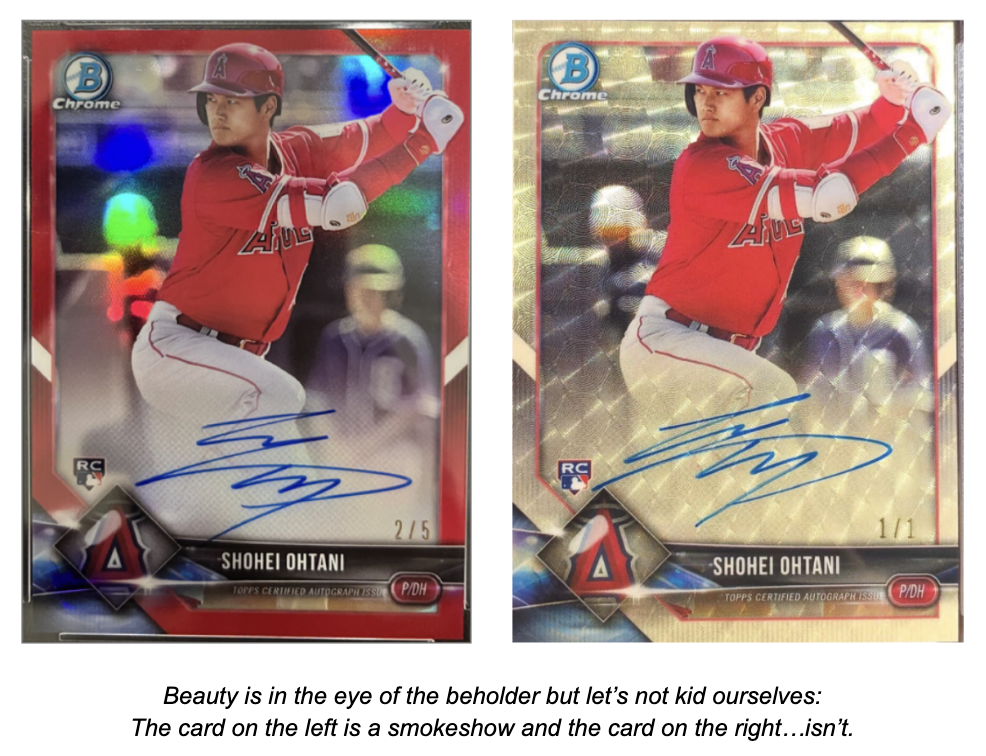
In sum, Shohei Ohtani is the most collectible athlete of all time.
In sum, my Red Ohtani is Shohei Ohtani’s best card ever.
For these reasons (and more), my Red Ohtani is the greatest trading card of all time.
***
At this point in the argument, there are two groups: The first has collectively lost their mind, has stopped reading and is already crushing me on Instagram (and or DM’ing Gio or Cage to see which one will take up the case). The second is enjoying the thought exercise but is ready to come at me with one or both of the following objections:
Objection 1: Legends Still Matter
You simply cannot compare a card from 2018 with historical icons from the past. Cards like the ‘52 Mantle or T-206 Wagner are still legendary, even if the legends are lies.
Objection 2: Michael Jordan
Even if we grant this is Ohtani’s best card, surely MJ has to be at the top of the pyramid? He’s got two $10M+ Exquisite sales just last year!
Let’s take each of these in turn, starting with the ‘Legends Matter’ group.
***
Let me start by conceding the obvious: yes, card legends matter - regardless of their truth value. Just like player legends matter, regardless of their truth value.
Mantle and Wagner are both objectively, scientifically all-time great players. But the legends - both inside and outside the Hobby - make them even greater. And when it comes to the past, present and future collectibility of a card, the legends matter most.
Mickey Mantle: the blue-eyed adonis with a tragic-hero drinking problem and undiagnosed sex addiction. Honus Wagner: the greatest player of baseball’s first generation, one of the first five people inducted into the Hall of Fame, who used his popularity to stand up to Big Tobacco.
These legends travel through history with far greater speed than any objective fact. They are passed down through generations with far greater force than any Bill James statistical equation. That’s why we’re still talking about Mantle and Wagner 57 years after the youngest retired. Their legends have some serious juice.
But here’s the thing: they’re yesterday’s legends. I love them as much as anyone, but they belong to another place and time. The further we move forward, the less relevant they are.
Moreover, their reasons for enduring were historically contingent - the product of a culture that no longer exists. The reasons Mantle and Wagner became legends – let’s be honest – has as much to do with demography than democracy.
In the 20th century sports world, and especially the 20th century Hobby world, legend-making was mostly a job for white guys. The people who made the legends and passed them down, they preferred their legends with blue-eyes and blond hair - or legends with names like “Honus”.
And not just white guys, but New York white guys. Mantle played in New York; the Gretzky/McNall auction happened in New York - to a very important extent, this was all a matter of zip code. Mantle and Wagner were the beneficiaries of New York PR and Yankee Nation propaganda - and that mattered far more than any objective facts.
“Most mythology is manufactured in New York”, wrote David Halberstam, decades ago. And he was correct, decades ago. But the 20th century is over now.
New York doesn’t have a monopoly on myth-making anymore. Madison Ave and Midtown might as well be replaced by Los Angeles and Tokyo. Or Oshu, Japan - the tiny, rural town in which Ohtani grew up. Myths aren’t made in tabloids - they’re made on the internet. And maybe even in white papers published on the internet.
That’s why Shohei Ohtani, in just seven years, is already the biggest legend in baseball history.26 That’s why parents around the world are naming their kids Shohei, while literally no one is naming their kid “Honus.”27

Ohtani is a “mythical legend in human form”, according to fellow players. He’s a “two-sword samurai”, according to the press (and the ads). And he’s only 31; what’s left to come?! Better yet, we’re still learning about the herculean things he’s done:
Apparently, when Shohei was 12 years old, he actually pitched with both hands! That’s right, he would ‘switch-pitch’, depending on the batter! There’s no video of this because he grew up in such a small town28, but the locals say that he could throw 80 mph with both hands!
Ok, fine. I invented that last one. But you believed it for a second, right? You’d believe almost any baseball feat about Ohtani. He’s the closest thing to Paul Bunyan since Bo Jackson - and with a far better career. We all know it: Shohei’s got the juice now.
***
Look. I understand the desire to hold on legends, even if some of them are myths and lies. We’ve all been indoctrinated in the image of Slim Charles (“If it’s a lie, then we fight on that lie”), and if I was the owner of a Mantle or Wagner, hell I’d fight on the lie too. So if you wanna grab a nailgun at the Hardware Barn and come at me, I’d recommend the Hilti DX 460 MX.
But here’s the thing:
The legend of my Red Ohtani doesn’t depend on the historically-contingent preferences of a long-bygone Hobby era.
It doesn’t need mythical scarcity, because it has actual, concrete, objective scarcity. It’s numbered to 5 with a 1-of-1 grade!
And do you want a good provenance story? How about just an actual acquisition story?
How about the one I told you earlier – about Vince and Tyler and the great Hawaii-hunt! Objectively, scientifically – my Red Ohtani acquisition story is orders of magnitude better than their best. Just compare:
Gretzky/McNall: Two very rich guys spend way too much money on a fraudulent card in a fraudulent auction.
Me: A multi-million dollar card deal plays out across three strangers and five time zones. One person gets paid. One person gets a sunburn. And one person walks away with a holy grail.
On the surface, my ‘Hunt for the Red Ohtani’29 should be the next installment of National Treasure!30 But Nic Cage or not, it’s really a story about the humanity of man. It cuts to the very core of why we collect cards to begin with. My Ohtani story is to baseball cards what Moneyball is to baseball. Under all the data, under all the dollars, is the love of the game.
You’ve already read the short version, but that was intentionally vague. Whether you do it now or at the end, be a good egg and treat yourself to the Director’s Cut in Appendix 2. I promise you, it’s worth it.31
GROUP 2: Be Like Mike32
Now let’s address the second group of objectors. The ones who idolize 90’s basketball and worship at the altar of Karvin and point out, rightly so, that MJ is the Hobby GOAT, so any discussion of singular greatness must go through him.
There are now dozens of Exquisite 1/1s belonging to GOAT players like Jordan, LeBron and Kobe, and they all have market values that (presumably) exceed my Red Ohtani.
But this is an example where less is more. Yes, there are dozens of Exquisite TCCs, but we aren’t looking for dozens of cards. We are looking for one card. One singular, extraordinary card. The ultimate TCC.
As crazy as it sounds, Jordan (and Kobe and LeBron, for that matter) has too many 7- and 8-figure cards! There’s not even consensus as to which Jordan is best. Or whether a multi-player card can be his best card, let alone the all-time best card.
So to find the ultimate TCC, we are gonna need a new metric, something designed for the specific intricacies of the Jordan card market. We need a WAR metric - as in “Wins Above Replacement.”33
Let's call our metric CAR: Collectibility Above Replacement
For the three NBA GOATs, take any of their Exquisite TCCs and each CAR will be infinitesimal or, in some cases, negative. There are just too many other TCCs in the comparison set. If you take just Jordan - and of course we start with Mike - he has ten Green PMG’s alone!
By contrast, Ohtani’s entire CAR comparison set is the two Superfactor autos and the four other batting Red autos. That’s it. And we’ve already explained why this one is the best one.
Therefore, by the indisputable math of CAR analytics, my singular Ohtani is a better TCC than the dozens of MJ, LeBron and Kobes. You can cite however many 8-figure sales you want, but like Billy Bean says, advanced metrics > box scores every time.
***
My “Collectibility Above Replacement” argument might seem advanced, but today’s Hobby arguments about collectibility have gotten so advanced and so complex, you have to be Will Hunting to keep up.

For example, did you know that not every 1/1 is equally rare? That some 1/1s are more rare than others? If you think that statement is inherently illogical, you should start listening to Hobby savants like Chris McGill (aka Chris HOJ). He can reveal the logic within the illogical.
One of my favorite recurring segments on HOJ-cast (Chris’s pod) is when he runs through a player’s full career 1/1 checklist, and ranks them all by rarity. How can two cards that are both 1/1 have different rarity? Oh, Chris has found many ways, including Lineage Rarity, Chronological Rarity and Print Run Rarity.34
How do you like them apples?
But Chris doesn’t argue for apples. He argues because that’s what hyper-obsessed TCC-heads love to do! The same way I love to argue about my Red Ohtani.
The argument is the point
This is the key takeaway. This is why I spent the last seven pages debating the status of one specific card. Because debating the status of my Red Ohtani is one of the essential things that makes it a TCC.
The reason I love my Red Ohtani has very little to do with my actual ownership. It’s not about having the greatest TCC - it’s about inventing insane new metrics like CAR and arguing with people that it is just that.35
In his meditations, Pascal asks a question about why men play billiards.
“Why does a man play these games? What object has he in all this? The pleasure of bragging to-morrow among his friends that he has played better than another.” - Pensées, 214
The purpose of billiards isn’t to win the game - it’s the experience of bragging to your friends that you did! And it’s the same reason I treasure my Red Ohtani. The argument is the point.
3.4. - COLLECTING TCCs
Is your card a TCC?36 For some cards, the answer is obvious. But there’s always a bit of uncertainty (and as Pascal teaches us, uncertainty is part of the fun).
After all, the standards for being a TCC are ever-evolving. Consider how back in the day, the Hobby didn’t value aftermarket autos. But over time, that perception changed. Today’s aftermarket autos are highly valued, often imbued with a legacy (i.e., the Uncle Jimmy Collection) and can be graded independently. Now, usually, they increase the value of a card - sometimes irrationally so.37
But let’s try to get more specific...
An Almost Definition
Here is everything we’ve said about TCCs thus far:
TCCs are inaccessible.
TCCs are cards that we struggle to hunt.
TCCs are cards that we mourn when we lose, and tell stories about when we win.
TCCs are cards we argue about.
TCCs are cards we sell to fund other TCCs.
And when we pay too much for a TCC, we thank the seller for letting us.
These are all super important, super essential, and just generally super definitions of the TCC experience. They capture what is special about hunting and owning a TCC.
But at the end of the day, it’s still mostly vibes. How many TCCs meet this definition? It’s hard to really say. And that’s the problem with vibes.
An Almost Calculation
So let’s move past vibes and try for something more exact. Specifically, let’s try to calculate the population of TCCs, focusing only on cards that are worth $100K or more.
Why $100K? Well for one thing, I purchased my Red Ohtani in June 2021 for $100K (in trade), so there’s some symmetry there. But more important: if a card is valued at $100K today, it unquestionably qualifies as a TCC. In fact, it’s probably the kind of card you can at least imagine becoming the greatest TCC of all time (at some point in the future, if the right things happen on the court and in the Hobby).
To be clear: just because a card is worth less than $100K, that doesn’t mean it can’t be a TCC. Like my Troy Brown Jr Black Prizm 1/1. Or Red PMGs. Or Gold Kabooms! Or Purple Horseshoes!38 Those are all TCCs (inaccessible, hard to hunt, etc.), even if they aren’t $100K.
But for the purposes of our “almost definition”, let’s put all those cards aside for a moment. If we set the baseline at $100K, how many of those cards exist?
To answer this question, we started with Card Ladder data. They were kind enough to provide a spreadsheet with all $100K+ sales, all years. For 2025, they reported 910 transactions. We did our best to remove non-sports cards, sets, wax and miscellaneous, and we were left with 798 sports cards sales of $100K or more in 2025.
Here’s how that broke down:
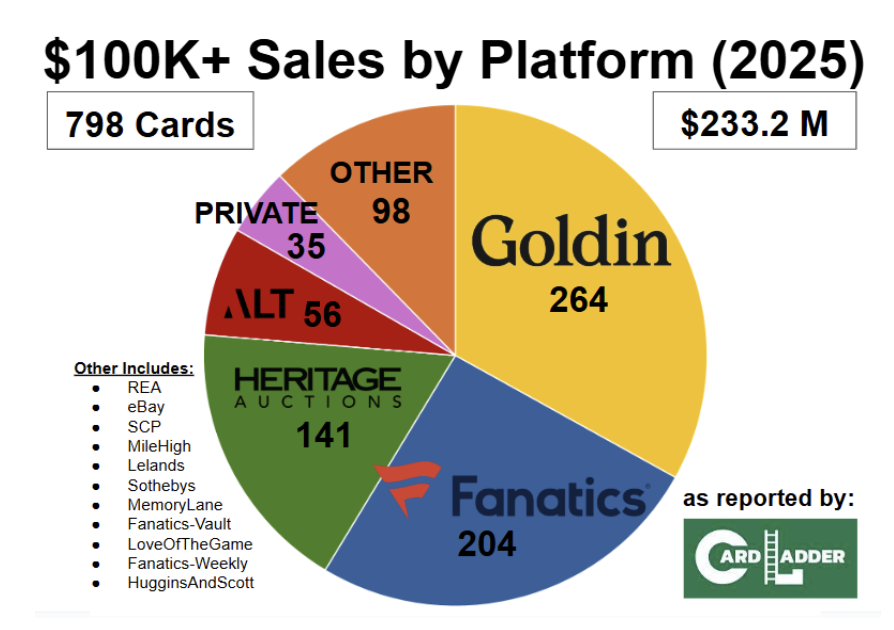
Of course, these are just sales; the actual number of $100K+ cards that exist is much greater. We would need a methodology. I reached out to a number of Hobby experts. Leore Avidar (CEO, Alt) and Spinotron (famed high-end collector) were the two most helpful. Together, we estimated the turnover rate (e.g., the % of $100K cards that sell each year), and used that to estimate the total population.
I’ve documented a lot of the work in Appendix 3. We worked through three different methodologies and all of them ended up around the same place:
Approximately 50,000 cards worth $100K+ exist
To be clear, what we are saying here is that there are 50,000 unique cards. So, for example, a MJ 86 Fleer PSA 10 has a population of 333. This means 333 cards; not one.
Still, 50,000 cards is a lot of cards.
Or maybe it’s not.
Our turnover estimate, for these very expensive cards, was only 3% per year. So we’re saying that 3% of 50,000 cards - or 1500 cards - will be available for purchase in the next 12 months. And, fwiw, only about half of those will become available publicly. For the rest, you’ll have to wrestle it from someone’s PC.
So even though the total number of $100K TCC’s feels massive, each individual one maintains its condition of inaccessibility.
To own one, you have to hunt it.
Who is Chasing What, and How?
As anyone who’s read the Hobby headlines recently knows, there’s a lot of people chasing TCCs on the singles market, including:
High-end collectors like me, Spinotron and Nat Turner buying TCCs to collect
High-end collectors who operate card funds buying TCCs as investments - like Shyne and Mr. Wonderful (Secure Collectibles) and Leore (Alt Funds)
Corporations buying TCCs for PR purposes - like Dick’s Sporting Goods buying the Paul Skenes Debut Patch for $1.1M39
Billionaire NFL owners buying TCCs of their players - like Commanders Owner Josh Harris buying Jayden Daniels Black Prizm 1/1 RC for $500K in front of Daniels and Micheal Rubin at Fanatics Fest; and all these people are competing with
NEW collectors, presumably wealthy individuals coming into the Hobby for the first time, ‘holding dry powder’, looking to ‘diversify their portfolio’40
Obviously, this is all anecdotal. But it points towards a conclusion none of us want to say out loud: Maybe TCC’s are destined for people with money, and only people with money.
***
And here’s where there will be (and should be) a collective objection. It goes something like this:
Josh, don’t be an elitist asshole. Cards are for everyone, particularly kids. They always have been, and always will be.
***
Ok. Fair. Right. But most people can’t afford a Skenes Rookie Debut Patch, so what are they buying? Can’t be TCC’s, right?
Actually, it is: Non-millionaires are chasing TCCs too - just not on the singles market.
The new kids coming into the Hobby? The ones who DON’T have the capital to allocate to the singles hunt? They’re hunting TCCs like the rest of us - but they’re doing it in breaks.
This is why breaking has become such a central engine for Hobby growth. Can’t afford to hunt a six-figure Logoman at auction? No problem! You can buy into a break at a fraction of the price!
When I was a kid, the idea of chasing a monster card was positively unthinkable. They didn’t exist in the wax products that I was ripping, and they were too expensive to buy on the singles market. This is why we effectively conscripted the best HITS of the era - Mattingly ‘84 Donruss; Griffey ‘89 Upper Deck - to be our TCCs, even though they would later prove to just be HITS. The Griffey was the biggest card we could hit in a pack in 1989, and it was only worth $25. There were zero three and four figure cards within our grasp.
There was precisely ONE kid from my entire generation who ever even sniffed a legit TCC - and it was as the biggest case of mistaken identity for 8 years, until Woo peed on The Dude’s rug.
The Dude, in this case, was twelve-year-old Bryan Wrzesinski.
One day in 1990, Bryan walked into a card shop in Itasca, Illinois and asked about the 1968 Nolan Ryan rookie card on display - the greatest TCC of the era - and the hapless clerk, misreading the price tag, sold it to him for $12 (instead of the actual price: $1,200).
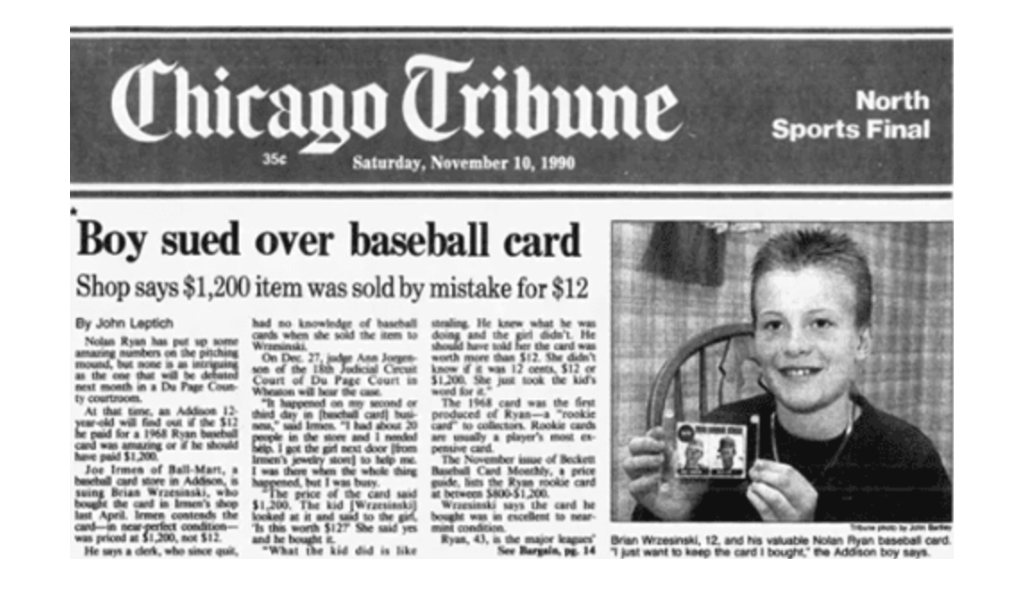
Look at that TCC smile. What I would have given for a smile like.
Bryan was the Forrest Gump of the Junk Wax Era. The Slumdog Millionaire of OG collecting. And when all was said and done . . . Bryan couldn’t even keep the card! The store owner sued and the Circuit Court forced a sale (with proceeds going to charity). No more smiles for Bryan.
But that’s OK. Kids like me still had plenty of fun. We got to keep ripping our $1 packs, sorting our piles, and piecing together little collections. And kids today can do the same thing. There will always be low-end blaster boxes at Target to service that simple experience.
BUT…if kids today want a different experience (and most of them do)...if they want to hunt TCCs in breaks (and most of them do)...well, now they have an option.
So today, we have stories like Colton and Henry Anderson: the 11 year-old twins who bought into a Topps Chrome team-break to chase (and pull!) the Ohtani Logoman 1/1. And unlike Bryan Wrzesinski, they got to keep their TCC.
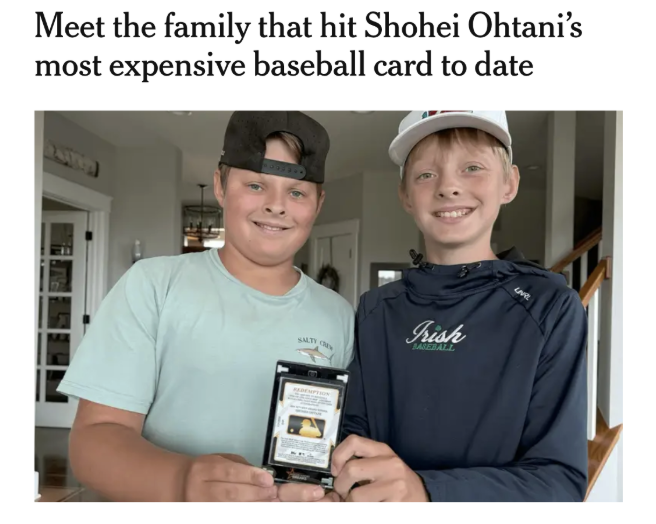
Except they didn’t keep the card. Of course they didn’t keep the card! They sold it for $3M because possession isn’t the point!41 And now they can keep on ripping until the end of time.
Thanks to breaking, collectors of all stripes and socioeconomic statuses can participate in the same Pascallian TCC hunt.42 The playing field isn’t exactly leveled; the breaking odds are long. But formally speaking, the hunt is open to all.
Tying it all together
Let’s go back to the beginning.
We started this paper with an observation about the singles market, and the bifurcation between two types of card booms. Then we made the provisional distinction between HITS and FILLER.
Repacks, we discovered, are the engine of this distinction - focusing our mind on the experience of the HITS, and degrading the value of the FILLER.
But taken to its logical conclusion, the repack experience - the casino-style infinite chase loop, and the gambler psychology it engenders - caused our provisional distinction to collapse. In the final analysis, HITS and FILLER both degrade into poker chips.
The value of the chips will always remain relatively stable. There will always be new rookies and prospects - new HITS and FILLER pulled from new wax. So if the value of the old chips degrades too much (because the 90% buyback velocity gets too high), the casino can always restock with new ones.
But that’s all they’ll be. The only cards that will truly matter, in terms of actual collector/investor demand, will be TCCs.
Let’s formulate this into a prediction:
In the future, the only HITS that will appreciate in value - the only ones with real collector/investor demand - will be TCCs. All other HITS will become poker chips.
Some of these TCCs will be ultra-expensive grails, like the $100K subset we analyzed above.
Some will be truly rare GOAT cards, like the kind driving the Card Ladder indexes for Curry and Mahomes (less than $100K, but not exactly cheap).
And some will be truly scarce 1/1s like my Troy Brown Jr. 2020 Black Prizm 1/1 (low-end today; maybe less low-end tomorrow; but never going to be $100K).
But any card that doesn’t have the properties of a TCC - including many of the HITS that are booming today - will eventually cease to be a HIT altogether.
Everyone will chase TCCs through breaks - including breaks of hybrid wax.
Some people will chase TCCs on the singles market.
And every other card - the ones that are just poker chips? They won’t be chased at all.
Is that a problem? I don’t know, but I still own thirty-six 5000-count boxes of commons. I’ve been lugging these from house to house with me since I was a kid.
(What a weird picture to end all of Part I. I actually use these particular 18 boxes as a shelf to display ghosts. If you look closely you can see ‘1990 Leaf’ written on one of the post-its. So what’s the point? I think it’s this: part of the experience of an OG card collector has been to live with these basically worthless, heavy boxes of cardboard for my entire life. The next generation will have their experience, too.)
PART II: EVERYTHING ELSE
CHAPTER 4. THE CONVERGENCE OF COMMERCE AND GAMBLING
Let’s go back to Pascal.
While famous for his arguments about human psychology, Pascal is even MORE famous for his theory of theological gambling - or what is commonly known as “Pascal’s Wager.”
A student of probability, Pascal treated the reality of God’s existence like any other gamble. Faith in God was no different than a spin of a roulette wheel or the result of a five-game parlay.
“Let us weigh the gain and the loss in wagering that God is. Let us estimate these two chances. If you gain, you gain all; if you lose, you lose nothing. Wager, then, without hesitation that He is.” - Pensées 233
In other words:
The expected value of belief in God is greater than the implied cost of doubt.
So you might as well start loving Jesus.
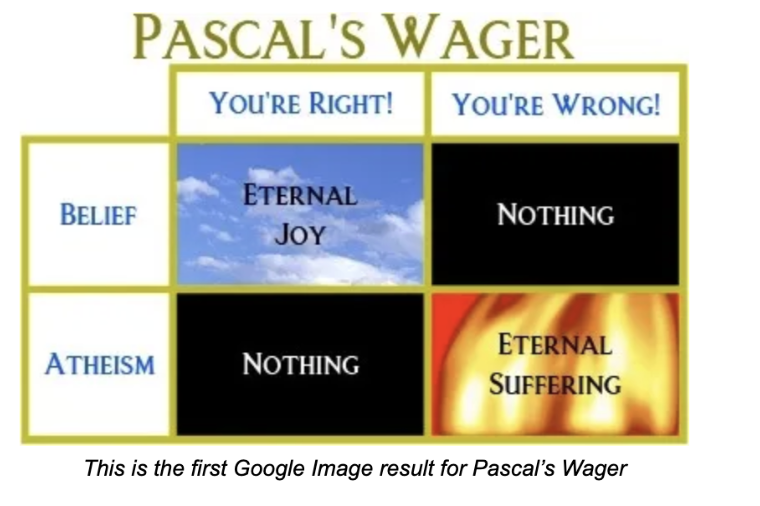
For Pascal, gambling was the ultimate chase - the ultimate expression of his trademark psychology. It was only natural, then, that he should invent a theology wrapped in a wager.
***
We aren’t that interested in God here.43 But we are interested in gambling.
As you’ve probably noticed, gambling is everywhere right now. What used to be a subterranean vice that “stayed in Vegas” has finally hit peak mainstream. And the reason you know this is because I just saw a Super Bowl commercial for Fanatics Sportsbook featuring Kendall Jenner making fun of how many basketball players she’s slept with. DraftKings and FanDuel don’t take bets on the existence of God (yet) . . . but they do take bets on pretty much everything else.
At the same time that gambling is converging with the mainstream, collectibles are converging with gambling. The gamification of commerce is taking place across multiple industries, in multiple contexts. We’ve already talked about one (repacks). Now let’s touch on several others.
4.1 - 2026: THE BLINDBOXIFICATION OF EVERYTHING44
GameStop, Lucky Box and Polymarket
In every great historical era, there’s usually one company that defines its zeitgeist. In the Gilded Age, that company was Standard Oil. In the postwar era, it was General Motors. And in today’s hyper-Pascalian casino economy...well if I had to pick just one, it would be GameStop.
GameStop started out as a video game store - a place for young men to chase dopamine-highs from the latest and greatest RPGs. (Note: video games are a proven gateway to gambling).
Then, GameStop became a meme stock - one where Richter-scale price swings created a “lotto-stock” for retail investors. (Note: there’s a reason they call it WallStreetBets).
Today, GameStop is continuing the casino convergence in a third way: by becoming a retail chain for blind box collectibles and repacks. Literally, the physical embodiment of THE BLINDBOXIFICATION OF EVERYTHING.
For anyone who’s walked into a GameStop recently and said ‘holy shit, when did this happen?’ The answer is when Ryan Cohen took over as CEO.
In 2023, Wall Street heaped scorn on Cohen. The new CEO “doesn’t have the first clue”. But the CNBC talking heads missed two critical and obvious facts: Ryan Cohen was born in 1986, and now he’s a billionaire. That means he was ten years old when Pokémon cards first came out. And now he has ‘Fuck You’ Pikachu money to try some Pikachu shit.
Cohen’s pivot started in 2024. That’s when GameStop partnered with PSA to become an official drop-off location for grading submissions and Nat Turner joined the board. In 2025, they launched PSA-graded repack products, followed by digital “Power Pack” repacks, powered by PSA Vault. GameStop also started selling trading cards, TCG cards, and blind box toys within their brick-and-mortar stores.
It’s been a huge success. Collectibles, including trading cards, accounted for 29% of GameStop’s sales in the first quarter of 2025, with a 50% increase in the segment. The PSA partnership has been cited as a major factor in their financial turnaround.
Commerce keeps on gamifying, and GameStop stays on the leading edge. Maybe the retail investors were right all along. Maybe Dumb Money will prove as prophetic to business as Idiocracy was to politics. Roaring Kitty for Fed Chair? Nah, Ryan Cohen for Allen & Ginter.
***
If GameStop is the brick-and-mortar casino of blind boxes, Lucky Box is the slot machine.
The first time I saw a Lucky Box vending machine was in the middle of last year. I was walking through O’Hare Airport on my way back from The National. It stopped me in my tracks. I was used to seeing repacks in hobby stores and card shows, but seeing a version of it in the airport - it was like a tiger had escaped from the zoo.
What is this thing doing out in public?
Then I looked closer. There aren’t even checklists. It’s just categories and prices! Sports cards, TCG or autographed jerseys - $99 and up. This isn’t a tiger! This is Gizmo eating after midnight! It’s so cute just sitting there, but it’s about to turn into a Gremlin and terrorize anyone in its path.
Now Lucky Boxes are everywhere. There are already fifty here in the States, with the highest concentration in Vegas casinos. Because, well, of course.
***
If GameStop is the collectible casino, and Lucky Box is the collectible slot machine, what are you to make of prediction markets like Kalshi and Polymarket?
At the moment I’m writing this, nearly $6M in bets have been placed on Polymarket by people speculating on Logan Paul’s Pikachu Illustrator sale price.
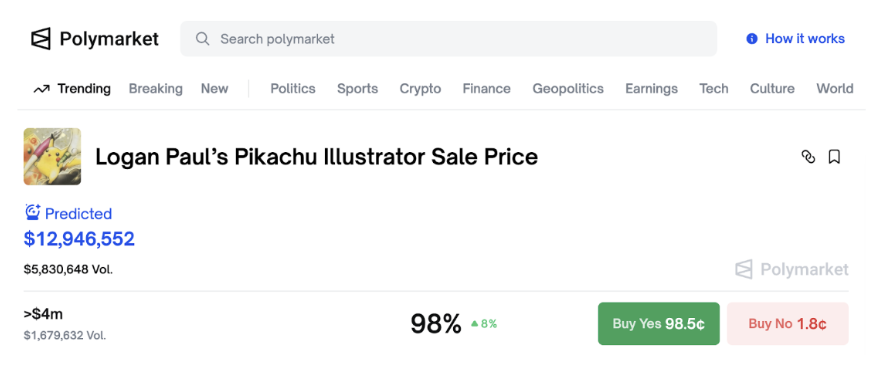
If you come up with a better example for the convergence of cards and gambling, I’m all ears.
Kalshi meanwhile has officially partnered with StockX on a series of “product-focused events”, allowing users to “predict” (read: bet on) the average price of Pop Mart Labubu, Retro Jordans, Pokémon cards and more. In this way, one kind of wager is layered on top of another - the same way an NFT mystery box lets you bet on a speculation.
It’s an infinite regress of games upon gambling. It’s turtles all the way down.
We really do mean EVERYTHING...
GameStop, Lucky Box and Polymarket are obvious examples. But when we broaden our vision, THE BLINDBOXIFICATION OF EVERYTHING extends to all corners of commerce.
Lids, Nike, Disney, Starbucks - they’re all making blind box products now. And blind boxes are one of eBay’s fastest growing categories - up 500% this year.
In the digital world of video games, “loot boxes” have become a $15B revenue stream. And the ability to buy and sell the contents for cold hard cash has turned gaming into literal gambling, as sites like CSGOEmpire have created casino games where video game skins serve as currency.45
There are entire retail chains, like MINISO, built around blind boxes; with 7,000 stores around the world, they’re fast becoming Pascal’s Wal-Mart.
You have Hobby-adjacent blind boxes: like PSA Magazine “chase variants” that are randomly sent to subscribers (a blind box in the mail).46
You have “just a pitch for now” blind boxes: like Bill Simmons’ idea for a “credit card roulette” restaurant, where diners spin a wheel to determine who pays.
And when we say EVERYTHING we really do mean everything. You know Le Creuset cookware? The fancy orange pots from your wedding registry? They make blind boxes too!
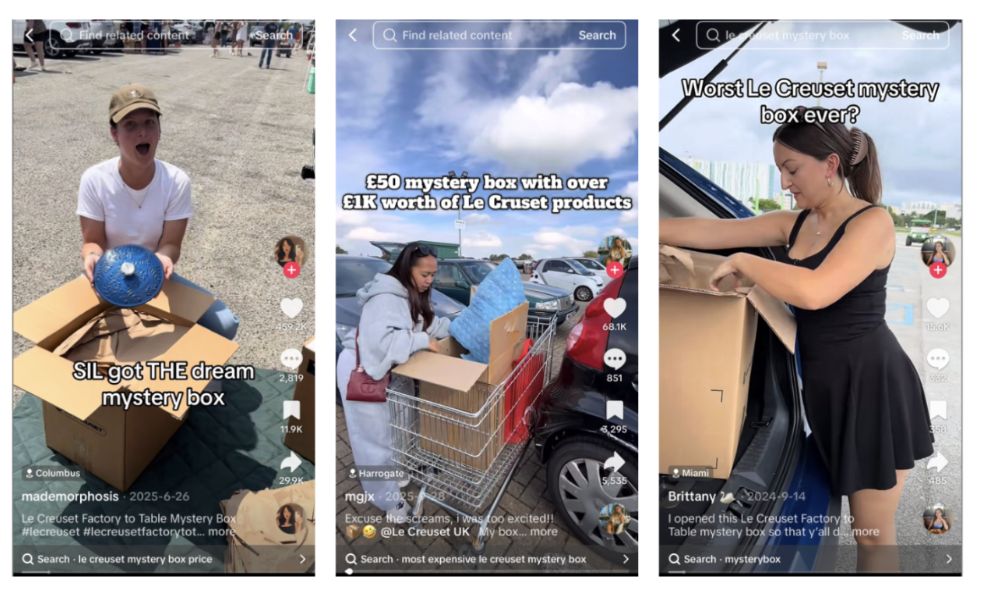
From a brand POV, Le Creuset is miles away from companies like GameStop or Lucky Box. They aren’t trying to create an experience; they’re trying to do a clearance sale with a blind box chase twist.47
But from the customer POV, the product IS the experience. They’re hooked on the cookware chase, the same way hobbyists are hooked on the repack chase.
Spend five minutes scrolling Instagram, you’ll quickly see what I’m talking about. In one post: a college kid celebrating his five-leg parlay win. In the next: a cookware enthusiast flexing the $500 Dutch oven she “hit” in a $50 blind box.48
***
In sum: we’re reached a point in history where commerce and gambling have nearly fully converged - and blind boxes are the driver. Just as prediction markets allow you to bet on any event, blind boxes let you bet on any product.
As we’ll see in the next Chapter, none of this happened overnight. It took nearly 100 years for the blind box to evolve into its current form. And it took over 100 years for gambling to become fully normalized and mainstream. THE BLINDBOXIFICATION OF EVERYTHING, and the mainstreamification of gambling - they both evolved together, hand in hand.
So let’s get in our Deloreans and go back to the beginning:
4.2 - 1930-1989: SIMPLE GAMES AND DEMAND-SIDE HITS
Blind box cards and blind box toys go all the way back to the 19th century.
For cards, it began in the Rutherford B. Hayes administration (literally), when “let’s put a random card into a sealed pack of cigarettes” unleashed the most addictive invention since, well, cigarettes.
In Japan in the 1860s, “lucky bags” (fukubukuro) - the antecedent of blind box toys - were used by fabric merchants to sell off excess inventory in a gamified clearance sale.
In other words, all blind boxes share the same ironic, uncanny, or just plain perfect origin story: selling dangerous and addictive drugs, or shit nobody wants.
***
As for gambling...
The first major turning point, at least in America, came during The Great Depression. That’s when a broke and desperate Nevada decided to legalize gambling (1931), setting our great nation on a direct trajectory to become Worm.
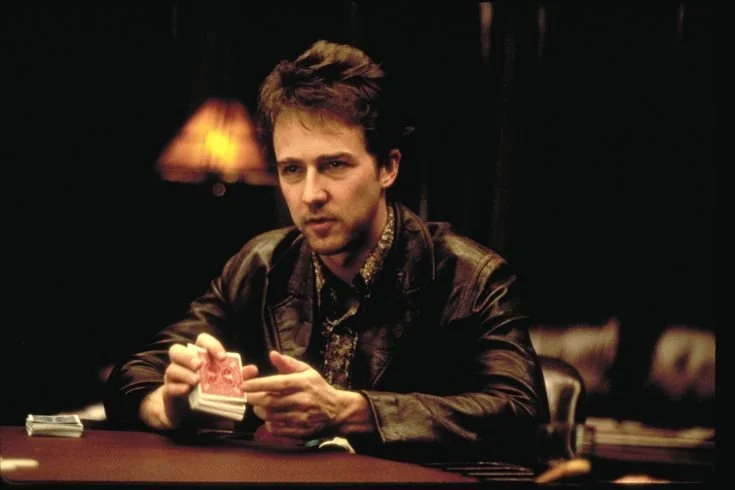
“I don’t play the game straight up...I see a mark, I take him down. That’s what I do.”
But worms don’t turn overnight. It would take another century after The Great Depression for gambling to become fully mainstream. And it would take just as long for simple collecting to gamify into the modern day chase.
Here are some key inflection points:
1933 Goudey
For cards, the first moment came two years after Vegas went legit. In 1933, the Goudey gum company created a card set to sell with their bubble gum. The set spanned 240 different cards49 - a massive number at the time - and each pack of gum included a single random card.
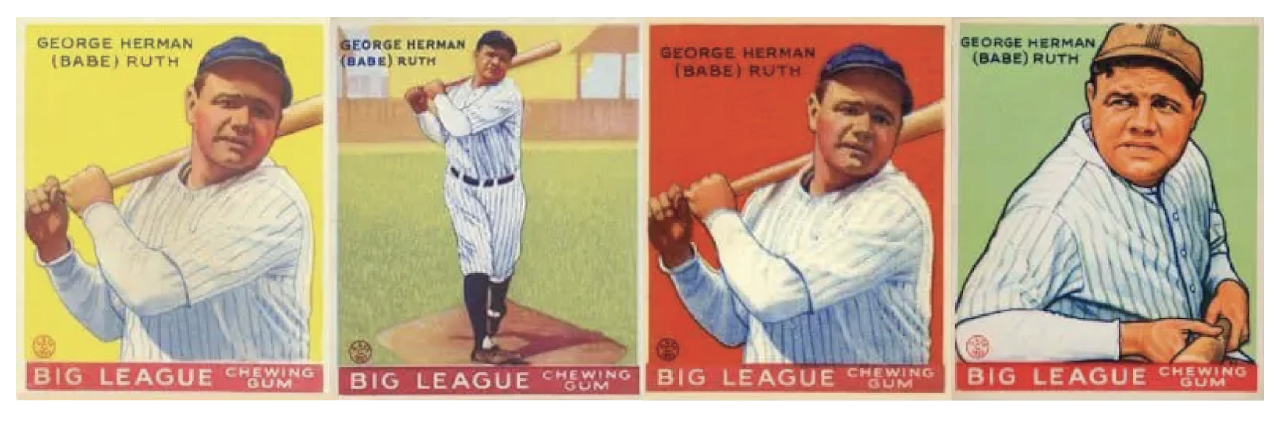
Except get this: there were actually FOUR different Babe Ruth cards in the set. Card numbers #53, #144, #149 and #181 all belonged to The Great Bambino! Four completely different cards, with completely different pictures.
Babe Ruth had appeared in earlier card sets, but those sets were far smaller - and mostly just featured Ruth. With Goudey, the four Ruth cards were sprinkled into a checklist that included over 200 “commons”. And this - not just the Ruth card itself - is what created a true chase. To collect all four Babes, you'd have to rip hundreds if not thousands of 1-card gum packs. They were only a penny each, but those pennies added up.
Goudey wasn’t trying to create this new chase experience. They were just trying to sell more gum to kids. But because they did the first thing, they also did the second.
The effect of the introduction of Big League cards was staggering. Goudey’s total sales were a modest $335,000 in 1932; they soared to a whopping $1.47 million in 1933, perhaps the most cash-strapped year in American history.50
Just as legalized gambling in Vegas created a new revenue stream in the darkness of the Great Depression, Goudey’s chase created a booming business in a nation of broke kids.
Blind Box Kids Toys
1933 Goudey, it should be noted, was the first major card product to come with gum, not cigarettes - and this is significant for our story. For the first time, blind box cards were for kids - and only kids. It was a simple chase, for a simple customer. That was enough to get kids hooked. No extra nicotine required.
Other kid-centric blind boxes soon followed, using the very same formula. For toys, the inflection point came in 1965, when Ryuzo Shigeta introduced the first capsule-toy machines to Japan. In 1977, Bandai trademarked the “Gashapon” machines and filled the capsules with series-based IP. Like Goudey packs, each capsule contained one random toy; the IP created a finite universe of characters to collect; and the most in-demand characters became “hits” for kids to chase.
This same primitive experience lives on today - in my own house, with my own kids. My daughter, now 13, spent years obsessing over LOL Dolls Surprise51 while my ten-year old son prefers LEGO x Super Mario Character Packs, which are up to Series Seven.
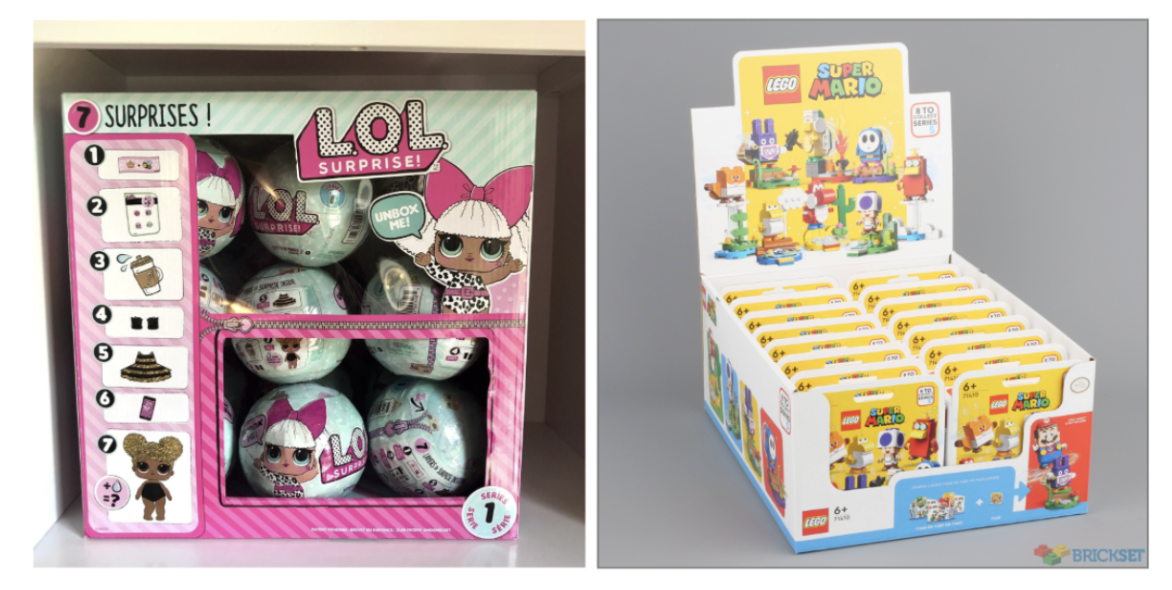
To an adult, the whole thing can start to feel absurd. My son says he wants to collect them all, but he REALLY wants to “hit” the Luigi. So we rip three bags, and we get three Bowsers, and now I’ve just paid LEGO for three identical products!
“If you really want a Luigi, I’ll just buy it for you on eBay!”
But my son says no. He wants to keep ripping. The frustration of three consecutive Bowsers doesn’t dull his enthusiasm - it only makes it stronger. His mind prefers a meaningful gamble to a meaningless certainty. Which is no surprise to our friend, Blaise Pascal.
***
Of course, I understand my kid’s blind box obsession. I was the exact same age my son is now when 1989 Upper Deck first came out. Ken Griffey Jr. was my Babe Ruth (or was he my Luigi?).
Opening a pack of ‘89 Upper Deck had a distinct physical sensation. Even today, it can trigger the sense memory of childhood, transporting me back through time like Proust's madeleine. The feel of the thin foil ‘tamper-proof’ pack, and the ease with which it tore. The clean sound of the two halves separating and, what’s that, a color picture on the back of the card?! You pull them out and get hit with that sharp, futuristic chemical smell and then . . . holograms! Let’s go!
The most extreme part is the Pascallian anticipation that accompanied it. I might pull a Griffey!! Please let me see words instead of a picture on the back!
Griffey was a pure demand-side hit. Like Goudey and LEGO, there was no supply-side scarcity, and the odds of getting his card were the same as any other player. It was a “hit” only insofar as Griffey was Griffey. And for kids like me, that was enough.
But in the 1980s, a new group of card collectors were taking the helm. Adult collectors were more focused on long-term value and investment. These middle-aged Pascals had different expectations. They were attending newly-created card shows, reading newly-printed price guides, and seeing vintage cards selling for thousands of dollars a piece.52
In a 1990 survey of card collectors, 77% cited “good investment” as a reason for collecting.53 Collector demand was becoming collector/investor demand. And the collector/investor was growing up.
But 1989 Upper Deck was an unsophisticated product. The Griffey “chase” was a rudimentary ‘demand-side’ hit (two Griffeys for every three boxes). Hunting The Kid was a game for kids - not adults. And it wasn’t much of a “good investment” either (and this was before rumors that Upper Deck printed off extra sheets of 100 Griffeys at a time).
4.3 - 1990-2017: INTENTIONAL SCARCITY AND LIVE SHOPPING
In the 1990s, card brands began to evolve their product - creating a chase experience more generationally fitting for the adult collector/investors entering the Hobby. But this evolution happened purely by accident. Or more accurately, it happened by irony.
The grown-up chase of the 1990s? It was inspired by a kid’s movie.
1990 Upper Deck
In 1990, Don Bodow had an idea.
Bodow was Upper Deck’s Vice President for Marketing. He was also a massive, massive Willy Wonka fan. In Card Sharks, a history of Upper Deck, journalist Pete Willliams recounts how Bodow and his young son would rewatch the movie over and over on VHS (1971 Gene Wilder version, not Chalamet).
For the 1990 Upper Deck set, Bodow proposed an intentionally scarce “golden ticket” to complement the abundance of demand-side hits; or perhaps to balance the top rookie prospect drop-off from Ken Griffey Jr. to Ben McDonald.54 Either way, ‘Find The Reggie’ was born.
Just like Wonka’s chocolate bars, Upper Deck created 2,500 Reggie Jackson hand-signed cards, which were randomly sprinkled among the 200 million-plus base cards in the set. It simultaneously created the first modern “chase card”, and the first pack-pulled autograph, ever.
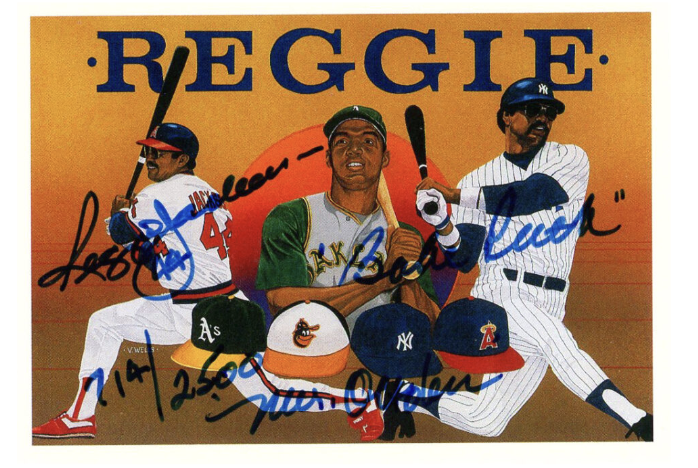
For Don Bodow, the ‘golden ticket’ was little more than a PR stunt. He wasn’t trying to transform the collector experience. He was just trying to score some earned media from all the joyful Charlie Buckets. Here’s Pete Willliams:
The publicity Upper Deck would receive could be enormous, Bodow thought. He envisioned newspaper articles around the country reporting on local youths discovering a Jackson autographed card...Willy Wonka would have been proud.55
What happened, of course, was more than just publicity. Bodow helped drive what is perhaps the best example of a culture/commerce influence loop ever (Roald Dahl → Gene Wilder → Wonka’s Golden Ticket → Find The Reggie → all modern chase cards → the trading card industry as we know it today).
Here’s what followed in the immediate aftermath:
1990 - first chase ever / first auto - 1990 Upper Deck baseball (Reggie Jackson)
1991 - first serial numbering - 1991 Upper Deck Final Edition
1992 - first premium / chromium card stock - 1992 Topps Chrome
1993 - first refractor / parallels & artist sketch - 1993 Topps Finest & Skybox Simpsons
1994 - first ultra-thick premium SP base cards - 1994 Upper Deck SP
1995 - intentional short prints - 1995 Upper Deck SP Championship Series
1996 - first game used-jersey card - 1996 Upper Deck baseball (Griffey)
This seven-year window established the complete modern chase stack. It was too late to save the Junk Wax Era, but it paved the way for everything that followed. From patch cards and Logomen to 1/1s and RPAs - it’s all just a recombination and escalation of this core strategy of intentional scarcity.
It’s probably not a coincidence, then, that PSA graded its first card in July 1991. ‘Condition scarcity’ was another of the growing list of ways for collectors to value certain cards over others.
***
It would take a while for graded cards to become ubiquitous, but chase cards transformed the blind box experience overnight. From 1933 Goudey through 1989 Upper Deck, the experience consisted of a simple game and a childlike chase. All you had to do to “win” was collect them all. And all you had to do to collect them all was keep ripping.
With the intentional scarcity of the 1990s, the game shifted to new terrain - from collecting players to hunting hits. The 1990 Reggie autograph was a true chase - approximately 1/148 boxes. And it kept changing from there...
Beanie Babies
In 1993, the same year that Topps introduced the first modern parallels, Ty Inc. started making Beanie Babies. In the beginning, they were an always-on product, like every other retail toy. But in 1997, Ty did something novel.
They started "retiring" some of the most popular Beanie models - pulling them off retail shelves and halting production. The retirements became a marketing event. Ty would announce them on their website (they were among the first consumer brands to even have one), and collectors would refresh their Netscape browsers with anticipation of the news.
Beanie Babies didn’t come in a blind box, but they did benefit from BLINDBOXIFICATION - functionally, if not literally. The retirements functioned like supply-side chase cards, and the online announcements were the reveal - like a proto-digital-unboxing.56
On the newly-christened World Wide Web there were forums dedicated to Beanie Babies. Internet users traded tips about where to find the rarest, retired Beanies. And a massive secondary market rose up to meet the unmet demand. The great “Beanie Chase” was on.57
And just as chase cards happened to coincide with the birth of PSA, Beanie retirements coincided with the birth of eBay. In the late-90s, Beanie Babies were the biggest product category on eBay.58 eBay, in turn, turbo-charged the Chase, bringing a whole new category of (adult) demand from collectors, investors, and speculative resellers.
Suddenly, Beanie Babies weren’t for kids anymore. The agony and ecstasy of the Beanie Chase was all-consuming. In 1998, Dr. Paula Benchick-Abrinko described the experience of her sister (an avid adult collector):
“The calm experienced with owning the collection comes only after the storm of the hunt...Peggy has had many sleepless nights thinking of places she hasn’t searched and nightmares of calling a store as the targeted piece leaves the store to a lucky buyer”59
Here, Pascal would interject:
The “calm” of owning the collection was never the point. The point was “the storm of the hunt”.
***
And it wasn’t just Beanie Babies. Other brands stumbled into the artificial scarcity game too:
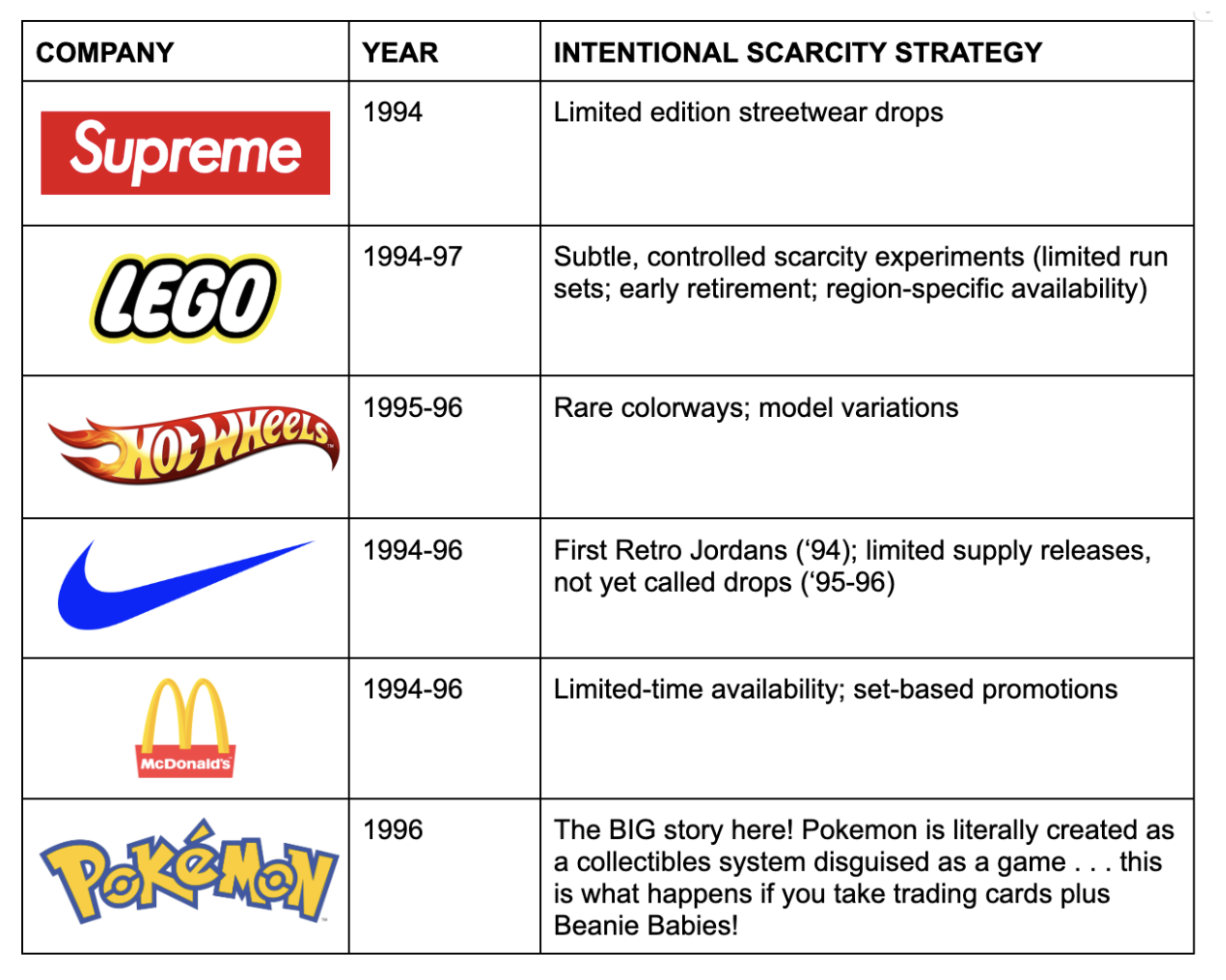
The 1990s were the golden era of supply-side scarcity. Just like today, when every consumer brand on the planet is doing blind box packaging, a host of major brands in the 90s got into the scarcity game.
But none of it was by design. These were six businesses just trying to use the best thinking of the time to build their brands. They weren’t trying to create a blind box chase, just like Ty Warner wasn’t trying to create “hits” or “collectibles”. He certainly couldn’t have predicted that eBay was going to come along - two years after he started - and endow his plushies with four-digit resale values. He was just trying to sell more toys.
Live Shopping
In the 1990s, cards and toys transformed into collectibles thanks to the magical alchemy of intentional scarcity. But outside the consumer good space, the model for mass-produced collectibles started even earlier, the 1960s, with an entrepreneur named Joseph Segel.
In 1964, Segel started selling “limited edition” medallions and commemorative plates, made out of sterling silver. At first, the products were marketed strictly as collectibles. But over the next few years, the price of silver on the commodities market started shooting up (a purely fortuitous coincidence for Segal), and his original medallions began to trade on a booming secondary market. Consequently, Segal was able to market his products - not as mere trinkets - but as savvy and sophisticated investments.60
Sound familiar?
But we’re not interested in Segal’s medallion business here. We’re interested in the business he founded next, and the the one he’s most famous for: QVC
Segel founded QVC in 1986, just a few years after Home Shopping Network (HSN).61 Together, the two companies created a new form of retail distribution: live-shopping. The fact that one of the two networks was founded by the godfather of mass-market collectibles isn’t a coincidence.
Live-shopping is a subset of BLINDBOXIFICATION, servicing the same Pascalian psychology. Just as Segal’s medallions created a chase product, live-shopping created a chase experience.
“One night only! Get ‘em before they’re gone!”
Thanks to Jennifer Lawrence and the movie Joy, most people associate QVC and HSN with ordinary retail products - like mops. And yes, lots of mops got sold on TV. And yes, JLaw was great in that movie. But the most successful products - the ones that really moved - were the new class of consumer collectibles taking shape in the 1990s.
In 1989, Paul Goldin and his son Ken (yup, that one) became the first in their industry to combine sports collectibles with live-shopping - signing a groundbreaking deal with the Home Shopping Network. But the most famous live-shopping innovator from that era was Don West.
Everyone in the Hobby knows Don West. Everyone in the world should know Don West. Because with all due respect to Blez and Nicky Ripz and the Backyardigans and everyone else, Don West was the greatest live-shopping pitchman in the history of the Hobby.
But Don West didn’t just sell cards. He also sold . . . you guessed it . . . Beanie Babies!
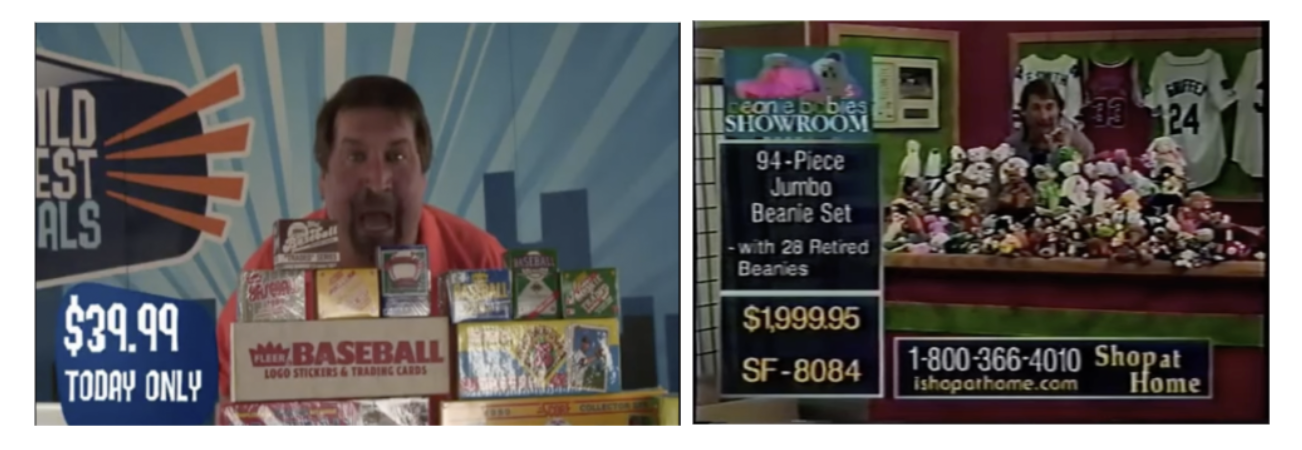
The entire history of 1990s collectibles is contained in these two videos.
In the first video, Don pushes Junk Wax cards, promising they’ll appreciate in value.
“Buy these cards now for $39.99. They’re going to be worth twice as much tomorrow!”
He also says you’re a loser if you don’t buy it, and then guarantees that if you do buy it, you can walk into any bar and take home the hottest woman. Seriously.
In the second video, he pushes a $2K Beanie Babies lot, promising the exact same thing (minus the sexual conquest guarantee):
“Rumor has it they’re going to retire the Princess Bear. Do you know if that bear retires, that bear ALONE will cover the price of EVERYTHING"
He also says “hippity hoppity and floppity” which is for sure a phrase I’ve never heard before (but one I’ll be using whenever I can).
You really have to watch it yourself. My words don’t do Don justice.
Contradictions and Limitations
In the 1990s, live shopping added an additional layer of gamification atop the blind box experience, and the potential for collectibles to appreciate in value made them the perfect product-fit for the networks. For both businesses, it was a massive success.
In December 1998 the Home Shopping Network announced its best month of sales in company history—buoyed by the sale of 550,000 Beanie Babies at prices far higher than the prevailing values on online auction sites.62
Live shopping was a distribution channel targeted explicitly at adults. This was important for the evolution of the companies. Beanie Babies and baseball cards, even in the ‘90s, were largely marketed and distributed in ways that targeted kids. Not collector/investor adults.
Live shopping was different. No kid was buying $2,000 worth of Beanies from Don West - no matter how much they believed his promise about value appreciation. This was a channel - and a chase - designed for adults.
***
Here, however, the collectibles brands ran up against a contradiction. On the one hand, they were making a kids product. On the other hand, they were designing an ever-more gamified chase - one specifically geared towards grown-ups. Moreover, they were doing it within a cultural context where gambling itself was still largely taboo.
Gambling had become slightly more normalized by the 1990s. In 1984, Glen Waggoner’s Rotisserie League Baseball book helped turn fantasy sports from a niche parlor game into a national fad. And in 1988, The Indian Gaming Regulatory Act brought a flood of new casinos to states across the country, making it easier than ever for Dad to go play craps.
But gambling was still a ways away from mainstream acceptance, for kids and adults. But especially for kids.
In 1996, a group of parents sued Topps and Fleer, claiming that “chase cards led to compulsive gambling and, ultimately, amounted to an illegal lottery.” In a similar suit filed against Upper Deck, the lawyers said that the insert card chase was like a modern-day Joe Camel. “They’re selling a dangerous product to kids.”63
As for Don Bodow’s golden tickets . . . it wasn’t the unequivocal PR win he envisioned. Within a couple years, the backlash that came for Fantasy Sports came for chase cards, too. Writing in The New York Post in the summer of 1993, columnist Phil Mushnick railed against the gamification of the Hobby, and put the blame squarely on Upper Deck:
“Upper Deck has fed the sickening reality that has turned the just-for-fun kids’ hobby of collecting baseball cards into the scam-infested, greed-driven industry that sports collectibles have become. Upper Deck sells baseball cards to children the same way lottery tickets are sold to adults - buy a pack, kid, not to embrace baseball, but because maybe you’ll strike it rich.”64
Mushnick, it should be noted, wrote similar columns condemning Nike for the wave of “sneaker killings” allegedly sweeping the inner city at that same time. The moral turpitude of intentional scarcity wasn’t just a Hobby thing.
***
Needless to say, the backlash didn’t last forever. Intentional scarcity won. Phil Mushnick lost. The lotto-ticket hunting in today’s card products makes 1990 Upper Deck look like a game of nursing home bingo - yet no one is really protesting.
So how exactly did we get here?
4.4 - 2018-PRESENT: GAMIFICATION AND GAMBLING
2018 Panini Prizm
The commonly accepted belief is that this generation’s trading card resurgence is directly tied to the Pandemic (generally) and The Last Dance (specifically). In reality, the inflection point for our current era arrived in 2018 (generally), with that year’s Panini Prizm NBA product (specifically).
Everything that followed - industry consolidation; the booms; transformation of the ecosystem; even my own personal role in the story - 2018 Panini Prizm basketball created the foundation.
2018 Prizm will always be ‘Luka Year’, the same way that 2017 Prizm football is ‘Mahomes Year’ - but my God, the rest of that rookie class was something special: SGA, Jalen Brunson, Trae Young, Jaren Jackson Jr., Anfernee Simons and THIRTY-SIX other guys who played at least six seasons!
Here’s the crazy part. As stacked as that class is - and it could end up being one of the greatest drafts ever - 2018 was the first year where the product was more important than the players.
***
In 2018, the Hobby was beginning to take off. New collectors were pouring into the Hobby for the first time - like Gen Z sneakerheads who used StockX. Older collectors were returning to the Hobby for the first time since the 90s - like Gen X sneakerheads who founded StockX (ahem, me). These new collectors came from the worlds of drop culture, crypto, and alternative asset classes. They understood - and valued - scarcity.
The Panini forecasting department was on its A-game. They saw an increase in demand coming and took proactive steps to address it. The basic strategy to increase supply (and maintain hit rates) was to create more parallels. And in part, they did just that.
Here’s a chart we used in the last white paper to illustrate Runaway Parallelism:
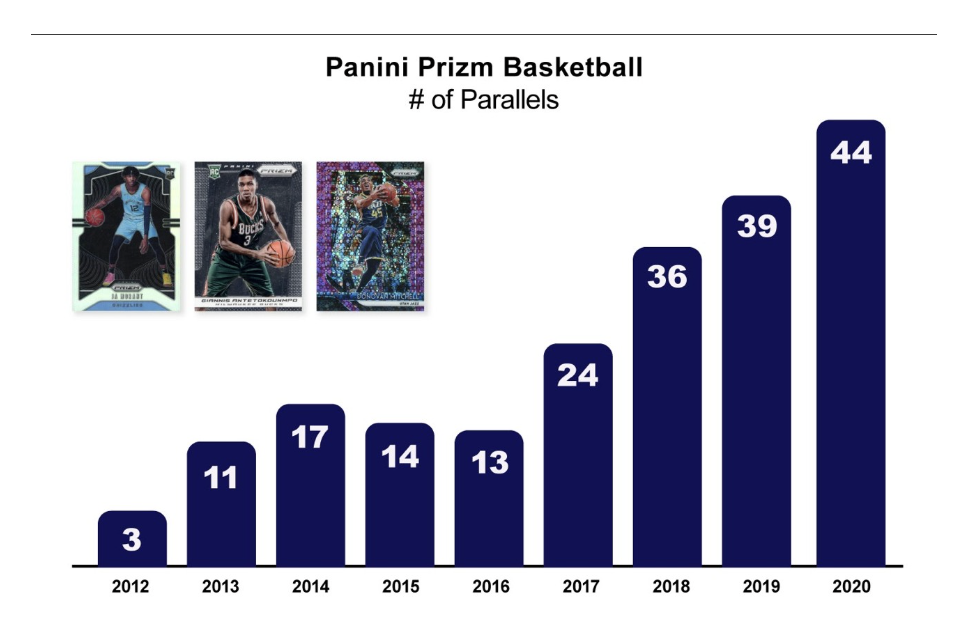
As you can see, there was a 50% bump in the number of Prizm parallels between 2017 to 2018. And that allowed Panini to increase the supply of wax by 70%.
But that’s not all that Panini did in 2018. They also added new product lines, each with its own dedicated parallel structure and low-numbered chase grails. And they added new low-numbered parallels to products that were becoming popular:
In other words, they didn’t just increase the number of parallels and keep the chase logic constant. They also changed the fundamental structure of the product. The leap from 2017 to 2018 was the single most impactful structural change to an entire industry since James Naismith switched from a square ball to a round one.
Specifically, they added:
In Prizm:
Choice - first international product, complete with a new set of parallels, including the Nebula 1/1 and Tiger Prizm
FOTL (First Off The Line) - first structured ‘pre-product’, complete with a new set of Shimmer /7 parallels that would later evolve into the Black Shimmer 1/1
Black Gold / 5 - first new big hit in the most important Prizm product (Hobby)
White Sparkle 1/1 Auto - first 1/1 out of White Sparkle, elevating that product
Outside Prizm:
Kaboom! Green 1/1 and Gold /10 - first Kaboom! parallels
Downtown Gold Vinyl 1/1 - first Downtown parallels (NFL only to start)
ALL OF THIS STARTED IN 2018!
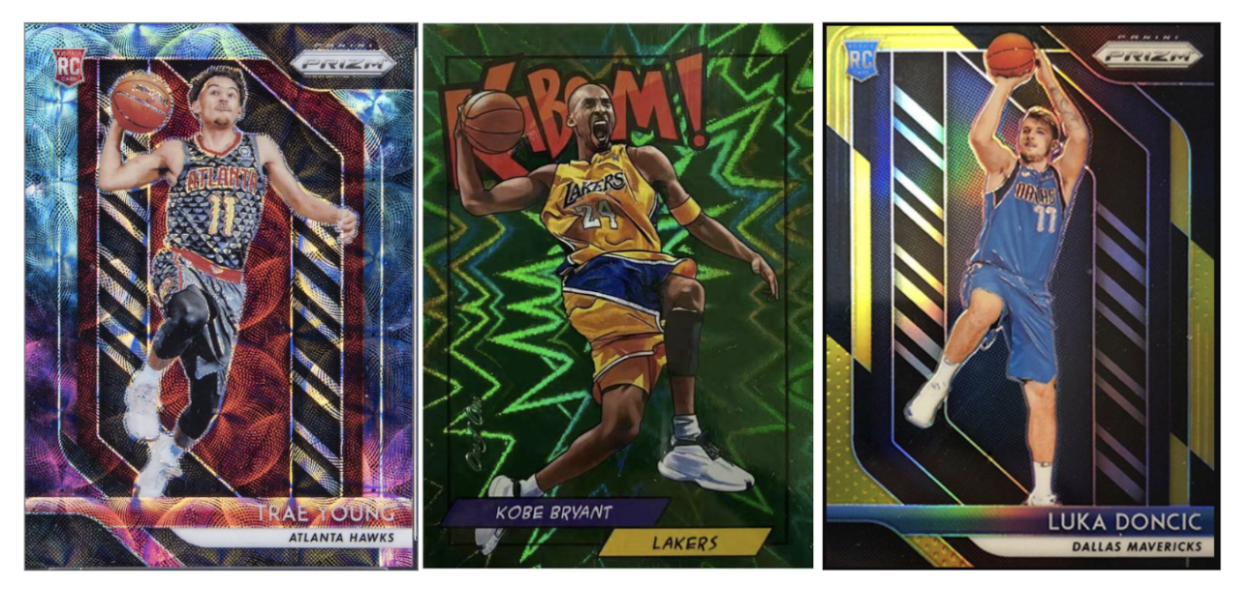
The advent of this dizzying new system had three key implications:
First: the combination of great new rookies + great new hits led to the Hobby’s first million-dollar chase cards, such that for the very first time, wax resembled an actual, real-life lottery (even if that lottery wouldn’t go into effect for another year). 2018 Prizm basketball was released in November 2018 but it wasn’t until October 2019 when Luka went from ROTY to HOF in the first ten games of his sophomore year, setting his card values on fire.65 This kicked off the chase for Zion and Ja hits, which bled into 2020 and the pandemic - and so it felt like Covid and The Last Dance was The Prodigy (aka Firestarter), but it was really the structure and chase elements put into place in 2018 (Choice, FOTL, etc.).
Second: The 2018 structure rendered traditional practices of collecting completely obsolete. How can you “set collect” when the set is sprawled across so many different product lines, some not even available in your country? How can you complete a rainbow that is fragmented across a thousand different color wavelengths? How can you even collect the top of the market when such massive hits have been sprinkled in downmarket products?
Third (and perhaps most important): All of Panini’s structural innovations created new forms of scarcity and complexity. Adding an Asia-exclusive product (Choice) created geographical scarcity (e.g., the chase became harder depending on where you live). Spreading out hits across product lines and price points made the chase more challenging and complex. And all of this was perfectly (if inadvertently) tailored to the new collector/investors who were entering the Hobby during the Pandemic. The sneakerheads and StockX sellers; the hypebeasts and crypto bros. The people who were used to chasing regional-exclusive Nike drops and Foot Locker raffles. 2018 Prizm, and everything that followed it, was the perfect Product-Pascal fit.
***
Looking back now, 2018 was one of those truly remarkable hingepoints in Hobby (and human) history. A revolutionary new product coinciding with a world-historical NBA rookie class. And not just the NBA either. Baseball had Ohtani, Acuna, Soto, Tatis, Vladdy Jr, Torres and Devers. Football had Josh Allen, Lamar and Saquon.
Indeed, there’s something eerie about how hard the 2019 rookies fell off - like the universe reminding us how special the year before was. Zion and Ja were the face of the Pandemic boom, too big to fail . . . until they did . . . and then they became the face of the crash. Compare: 2018 had HOFers hiding as second and third tier prospects (SGA, Brunson).
2018 was special:
It could mean that that point in time inherently contains some sort of cosmic significance. Almost as if it were the temporal junction point for the entire space-time continuum. On the other hand, it could just be an amazing coincidence.66
Taken together, the 2018 developments primed the Hobby for a massive, psychological paradigm shift. Add breaking to the mix, and the new world order was clear:
Wax isn’t to collect. Wax is to gamble.
***
We’ve said it before, but we’ll say it again: none of this was by design.
Panini didn’t intend to make cards into gambling. They weren’t trying to destroy the traditional collecting experience. Much as the Upper Deck chase itself began as Willy Wonka PR, and the non-card brands foray into scarcity was more accidental than intentional, the evolution of cards into gambling was also, basically, an accident. An accident of business. In all cases, these were ordinary businesses following an ordinary course, trying to grow their companies. Business 101.
In 2018, Panini was just trying to be smart about growth. Scale required more product, and more product required more parallels, so they followed basic retail strategy - i.e., customer segmentation - with a decision flow like this one:67
We have growing demand for trading cards. Should we make more of our best brand (Prizm) or create a new brand? Make more Prizm.
Our fastest growing geo is Asia. Should we make more of an existing Prizm product or make a new product specifically for Asia? New product for Asia.
The new Prizm sub-brand for Asia needs parallels. Should we extend the current parallels from existing Prizm product, or make new ones? New parallels for Asia.
In essence: a century’s worth of consumer psychology followed from a single line of marketing: “Find 2 Autographs in Every Box!”68
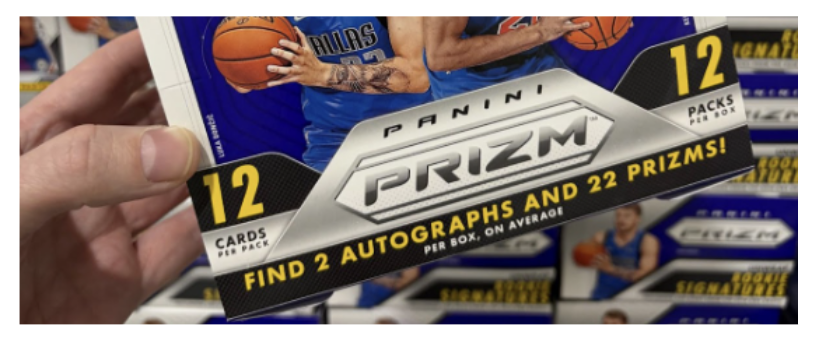
And now here we are.
Labubu69
We’ll all remember 2025 as the year of Labubu. The year our girlfriend, cousin, or daughter texted to ask: “Where can I get one of those cute plushy things?”. Literally, while I wrote that last sentence, Instagram served me the Hypebeast post naming Labubu its product of the year. (File that one under “yes, my phone is definitely reading my mind”).
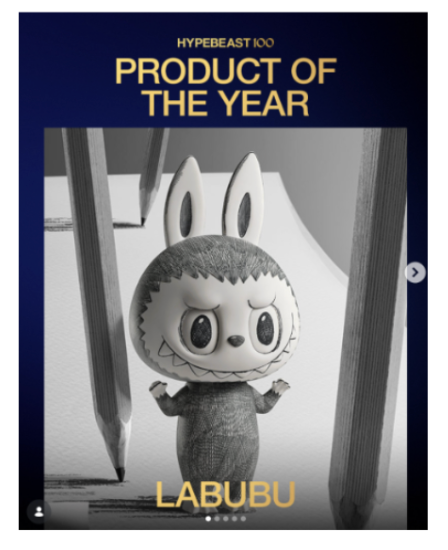
Beanie Babies were the evolution of Gashapon - adding supply-side scarcity to the chase. And Labubus were the next evolution - putting the chase in a literal blind box.
With each new Labubu series, collectors were encouraged to chase the “secret edition”, which would only appear in 1/12, 1/72 or 1/144 boxes (depending on the series). TikTok made the chase into a social experience, with millions of people tuning in to celebrate (or commiserate) the results of the pull. And companies like StockX endowed each chase Labubu with an immediate product page, bringing all buyers and sellers together in one place across a real-time market price, raising the stakes even higher.
In the media, Labubu mania was treated like any other fad. The focus was on Rhianna and TikTok and Lisa from BlackPink - the same way the GameStop story was about Roaring Kitty and Reddit. But the real stories underlying both were different. The real stories were THE BLINDBOXIFICATION OF EVERYTHING.
After all, Labubu toys had been around for a decade, and had never found mass success. The artist Kasing Lung created the first toys back in 2015: they were sold individually - without a chase or a box. It wasn’t until Pop Mart licensed the designs, and began using blind boxes, that Labubu mania took off.
Labubu engaged an entirely new group of (previously underserved) collectors: young adult women. It became a demographic bridge between this group and the collectible space - the same way GameStop is a generational bridge between young gamers and grownup hobbyists.
Indeed, Labubu has been SO successful, it’s starting to raise red flags. In Beijing, state media is now raising alarms about the hometown Chinese toy brand - warning of the dangers of “blind box addiction,” and comparing Labubu hunting to a form of gambling. Likewise, psychology journals are going viral with blazing-hot takes like this one:
Spicy!
4.5 - CONVERGENCE
As we’ve seen, none of this happened overnight. It took 100 years for the blind box evolution, and 100 years of gambling normalization. Over the course of that same century, these two arcs were driven forward by the same, ordinary business logic.
For gambling, each hinge-point started with an opportunity: Nevada went broke during the Great Depression and innovators found ways to capitalize. A hundred years ago, those innovators were mobbed-up Jews in the desert; a century later, it was Daily Fantasy apps. After the disruptors get their piece, the established incumbents invariably follow - whether it’s Howard Hughes and Conrad Hilton, or Michael Rubin and Adam Silver.
For collectibles, it’s more or less the same thing. Goudey needed to make money during the Great Depression; they invented the perfect game to make kids buy more gum. A half century later, Upper Deck finds a novel way to juice demand while down a PR rabbit hole. Twenty-five years after that, tech startup Courtyard.io taps into a sales velocity cannon while trying to recover from the NFT bandwagon. At each innovation, the big players take notice, follow suit and copy them.
At each hinge-point in the evolution, the protagonists are both influenced and constrained by broader culture. Each time gambling becomes more normalized, it allows blind box commerce to become more gamified.
I’m repeating that line, making it bold and adding some weird spacing:
Each time gambling becomes more normalized,
it allows blind box commerce to become more gamified.
Highlight it. Write it down. Take a picture.
When chase cards were first introduced in the 1990s, gambling was only partly normalized. In the offices of the major sports leagues, employees were actually banned from playing fantasy sports because it was too much like sports betting. And in 1991, Upper Deck issued a memo to their executives, saying they’d be FIRED for playing Rotisserie baseball at work.
Parents were filing class-action lawsuits. Columnists were railing against “lotto-like” chase cards. So even if Upper Deck wanted to fully-gamify their product, how far could they really go?
But now? Well, in the same year that Panini was using an NBA license to completely gamify trading cards, the Supreme Court in Murphy vs. NCAA (2018)70 struck down the federal ban on sports betting. This opened the door for the NBA / MGM deal just three months later - the landmark moment for the mainstreamification of sports betting.
Today, the leagues don’t just tolerate sportsbooks - they’re partners with them! The last remaining taboos have melted away. Not only is everyone at Topps allowed to play fantasy sports and bet on games, their sister company will take all the action (Fanatics Sportsbook).
We’ve mapped it all out in one simple diagram. And if you take ONE thing away from this entire Chapter, it should be this:
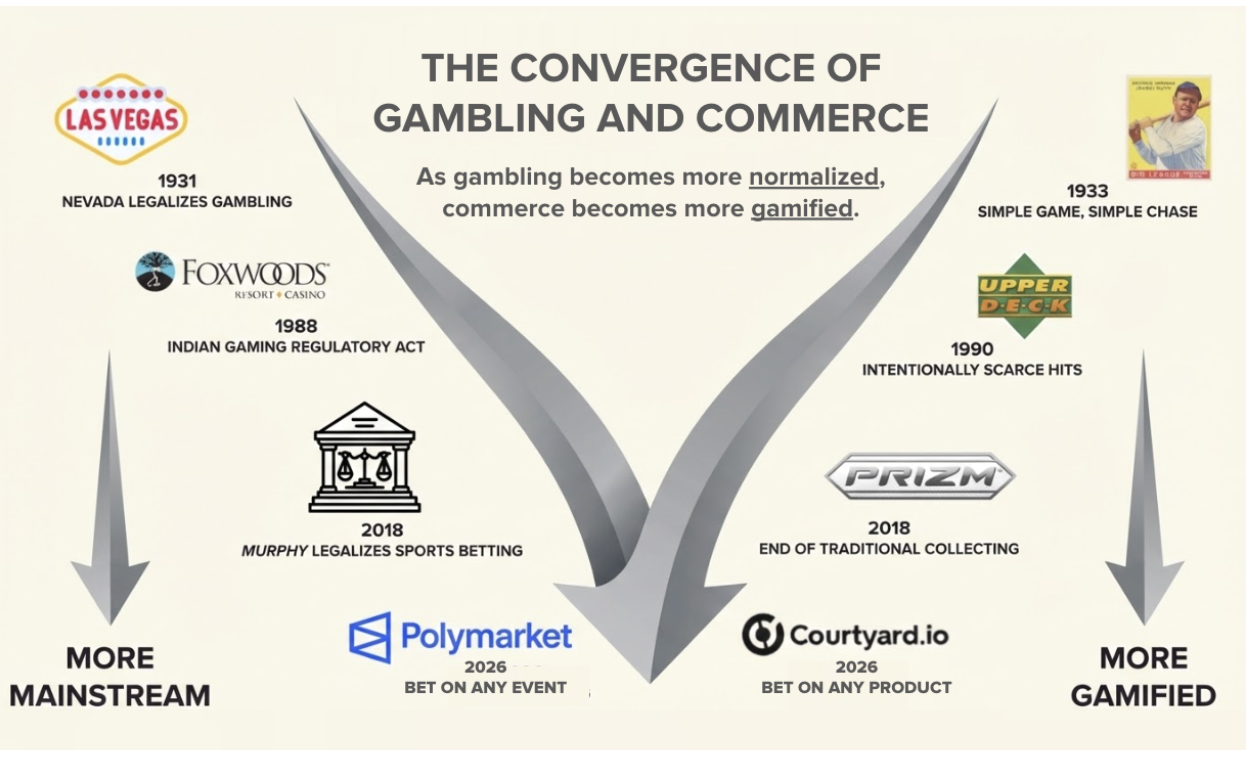
***
But wait . . . there’s a twist . . .
Thus far, we’ve treated gambling and blind boxes as separate categories - two different things moving towards each other through time. But as we move into Chapter 5, we’re going to challenge that assumption, beginning with a simple truth. Ready to have your mind blown?
Gambling is just a subset of blind boxes!
Didn’t see that coming, did you? M. Night would be proud.
That’s why chasing a big card feels like a lottery. A Flawless case break feels like gambling. And if you don’t buy this mystical appeal to experience, perhaps you’ll be persuaded by science.
As (Doctor) Darren Rovell explains in his footnote71, all blind boxes play on the same brain chemistry. The dopamine peak of a blind box comes BEFORE you actually open it. Once the contents are revealed, the dopamine drops - even if it’s a hit!72
Actual brain doctors have found the exact same neurobiology at play in casino gambling. For blackjack players, dopamine peaks during moments of maximum uncertainty - before the win, not after. Let’s let the scientists speak for themselves:
“Studies show a sustained dopamine response toward stimuli with maximum uncertainty, which may explain the continued dopamine release and gambling despite losses in gambling disorder.”
Yikes. Is that even English? We much prefer the French translation:
“The pleasure of the hunt is greater than the pleasure of the capture.”
Pascal said it first, and he also said it best.
***
But just because the biology is the same, that doesn’t make the blind boxes the same!
Blind boxes are made by people (brands). Each is designed for a specific purpose. Gambling is one subset of the blind box. Collectibles is another. The two are related (same brain chemistry); and the two have become more similar (convergence). But the two subsets are distinct. They have different purposes.
Gambling and Collectibles aren’t opposites, per se, but they do live at opposite ends of a continuum.
In fact, all blind boxes live on a continuum.
To navigate a continuum you need a map. And lucky for you, we’re the Mapquest of blind boxes. Which is another way of saying, you’re gonna need to print it out.
CHAPTER 5: THE BLIND BOX CONTINUUM
In this chapter, we’re going to take an inventory of every blind box we’ve talked about for the past 80 pages. Beanie Babies, Labubu, Goudey, Prizm, Nike sneaker drops, even Le Creuset mystery boxes - we’re going through them all. With that aggregated knowledge, we are going to map out the Blind Box Continuum
This is a big deal. It’s also a big job. Too big, in fact, to do it all at once. So like Voltron, we’re gonna put this together piece by piece.73
We’ll start with the easiest terrain and go from there. Our v1 map will cover the two blind box subsets we just finished discussing: Collectibles and Gambling.
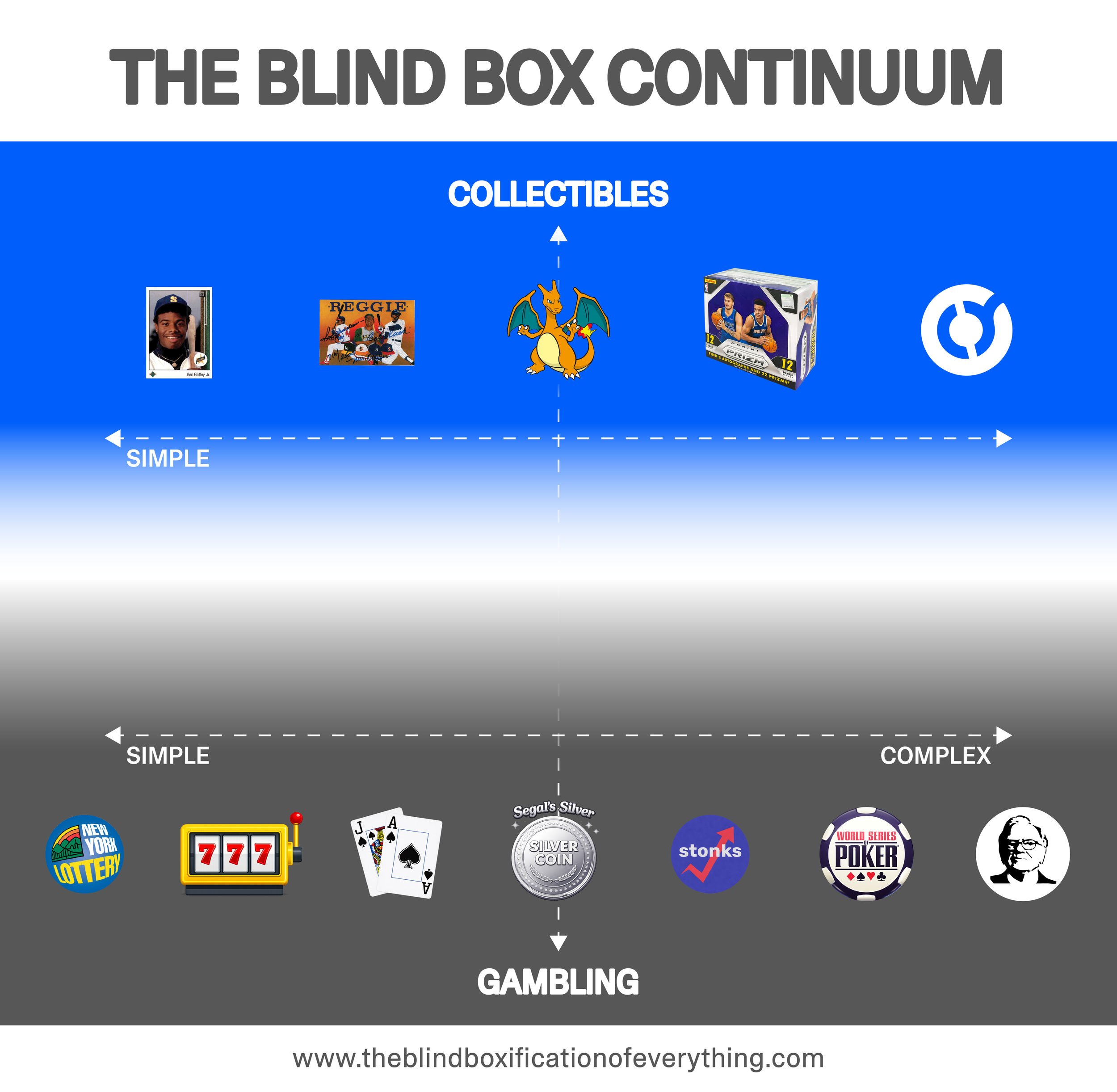
Although the Blind Box Continuum is not a traditional X/Y graph, it can be helpful to start from that framework. The x-axis of the Continuum is complexity. As the chase logic becomes more sophisticated; as the experience becomes more gamified - the blind box moves from left to right, from a simple chase to a complex one.
The y-axis is purpose, or type of blind box. As you move up and down, the purpose of the blind box changes. As you can see, the Gambling tier sits at the bottom of the Continuum, while the Collectibles tier is up top. There is no positive/negative association with top/bottom here; it’s just how we chose to map it. There’s a third tier, however, that is intentionally between the other two for continuum purposes. It’s empty for now; we’ll get to it in the next section.
***
Within the Collectibles tier, the placement tends to be chronological. As we saw in Chapter 4, blind boxes evolved over time - growing more complex with each progression. 1990 Upper Deck was one evolutionary leap (supply-side hits). 2018 Prizm was another leap (structural scarcity). Each blind box was more complex than the last, so each one is farther to the right on the Continuum. It doesn’t have to be that way, but so far it is.
Gambling blind boxes move along the complexity axis too - just like Collectibles - but obviously not chronologically. Each game’s complexity is judged on its own merit.
The two subsets exist in different tiers, and they move differently within their tier. Put simply, they are different. So before we get deeper into our cartography class, we need to discuss why this is the case.
5.1 - GAMBLING VS. COLLECTIBLES
For the Phil Mushnick’s of the world, let me start with three facts, simply and directly:
Gambling and Collectibles are subsets of blind boxes
Not all blind boxes are Gambling
Collectibles are not Gambling
The distinction between blind box tiers is grounded in the distinction between blind box laws. Gambling follows one law; Collectibles follow a different law.
Gambling follows the law of: Money In, Money Out.74
A scratch-off lotto ticket is a blind box that you open by scratching.
A slot machine is a blind box that you open by pulling a lever.
And blackjack is a blind box the dealer opens for you.
The games are different, but the logic is the same. You pay money to win money.
Like Collectibles, Gambling blind boxes have clearly-defined hits and clearly-defined odds. But unlike Collectibles, the value of the hits exists independently.
It doesn’t matter what logo is on the poker chip. There’s no such thing as a “culturally relevant slot machine.” The value is completely independent of the game itself - and the brand behind it.
Compare this to a Collectible blind box, like Topps Chrome, where the value of the hit depends entirely on the game (and the brand/IP). It depends on the scarcity of the cards. The performance of the athletes. The desirability of Chrome itself.
For Gambling, the product is money. For Collectibles, the product is the game.
Money In, Game Out.75
Consider this thought experiment:
Imagine if the New York State Gaming Commission decides to print a million scratch off-tickets. But instead of the normal odds, they make it so that every other ticket has a $1M prize.76 In this scenario, all those tickets would still be worth $1M dollars, right?
Right.
Now imagine if Topps did the same thing? What if they print thousands of Ohtani Superfractors, and make it so that every other case got one of those hits? The Ohtani “lotto ticket” wouldn’t be worth a million dollars. It wouldn’t be worth anywhere close. The Superfractor is worth $1M precisely BECAUSE it can only be pulled once.
The value depends on the game.
It depends on the blind box game (the scarcity of the hit). It depends on the real-world game (the singularity of Ohtani). And it depends on the Hobby game itself - the brand value of the Superfractor, and the games we play when we debate it.77
Here’s another way to think about it:
The MGM grand has zero control over the value of money. But Topps has at least 50% control over the value of Ohtani cards. The rest is split between Shohei, God, Rob Manfred, Dave Roberts and Shohei’s “interpreter” (snitches get stitches, Ippei!). But Topps controls at least 50% - and 50% is a lot!
So even though Topps Chrome feels like a form of gambling, the law of Collectibles makes it something else. You can choose your metaphor:
A raffle for a cultural stock certificate.
A roulette wheel for an IP lotto ticket.
The value of that stock or ticket will always be tied to the game itself - the card game and the sports game.
MGM is just the conduit for money, but Topps is the central bank. How it manages supply and demand will ultimately determine the value - and whether the game itself is even worth playing.
***
Let’s get back to our Continuum.
Beyond casino gambling, there are other games that follow the rule of ‘Money In, Money Out’. When mapping the Continuum, we included those in the Gambling tier.
Joseph Segel’s collectible medallions are one example. Remember those, from Chapter 4.3? There’s a reason I told you that story, and it wasn’t just because he created QVC.78 Recall that the value of those “collectibles” was ultimately tied to the price of sterling silver. In other words, it was independent of the product itself. So even though Segal didn’t run a casino - and even though he marketed his medallions as “collectible” - they still count as Gambling.
Money In, Money Out.
The stock market is also a gamble. Investors “play” the market, like any other Pascalian game of chance. The complexity of the game varies with the balance of luck and skill: Warren Buffett plays a more sophisticated game than meme stock retail investors, just like poker requires more skill than blackjack. This is why we mapped the Oracle of Omaha all the way to the right, over with the WSOP sharks. But everyone is betting money to win money.
Money In, Money Out.
***
Most trading card brands we’ve discussed in this paper fall in the Collectibles tier (d’uh). The one example that doesn’t is 1933 Goudey. We’ve mapped that blind box in a different tier - the one we’re going to talk about in a moment. But before we do, let me anticipate your objection:
C’mon Josh. How is 1933 Goudey NOT a Collectible? A high-grade Ruth is a $1M+ card. What’s more “collectible” than that!?!?
That’s a legit objection — but you’re mistaking the present for the past.
1933 Goudey is truly collectible today - and all four Ruths are TCCs - but it wasn’t in 1933. Goudey was a gum company, not a card company. And card collectors, as a community, didn’t even exist back then. There were no dealers. No price guides. No secondary market. The Babe Ruth card was valuable to an 8 year old, but it didn’t have actual value.
Today, that card is collectible the way vintage ticket stubs are collectible. Some people obviously “collected” them at the time (because people value experiences and want to remember them - i.e., Pascal); and today some are worth tens of thousands of dollars (mostly because of grading). But they weren’t designed to be collectibles, nor were they treated as such at the time. The event was the product, not the ticket.
The same goes for 1933 Goudey. The blind box chase was just a way to gamify the experience of buying gum. The cards were a promo - but gum was the product.
Money In, Product Out.
And here we’ve arrived at the THIRD tier on our Continuum map. The tier of Gamified Retail. Strap in, because it’s a doozy.
5.2 - GAMIFIED RETAIL AND ITS DISCONTENTS
Gamified Retail lives in a specific place on our Continuum - between Gambling and Collectibles.
This tier is big. Really big. In fact, most of the examples we’ve talked about in this paper actually fall into Gamified Retail! This is why we left it off our original v1 map: we didn’t want to overwhelm you.

No, the v1 map isn’t exactly wrong. It’s just a bit distorted. The same way Mercator maps distort the size of Greenland and Africa (as any self-respecting Cartographer for Social Equality will tell you). And now that we’re ready to discuss Gamified Retail, we can map it correctly:
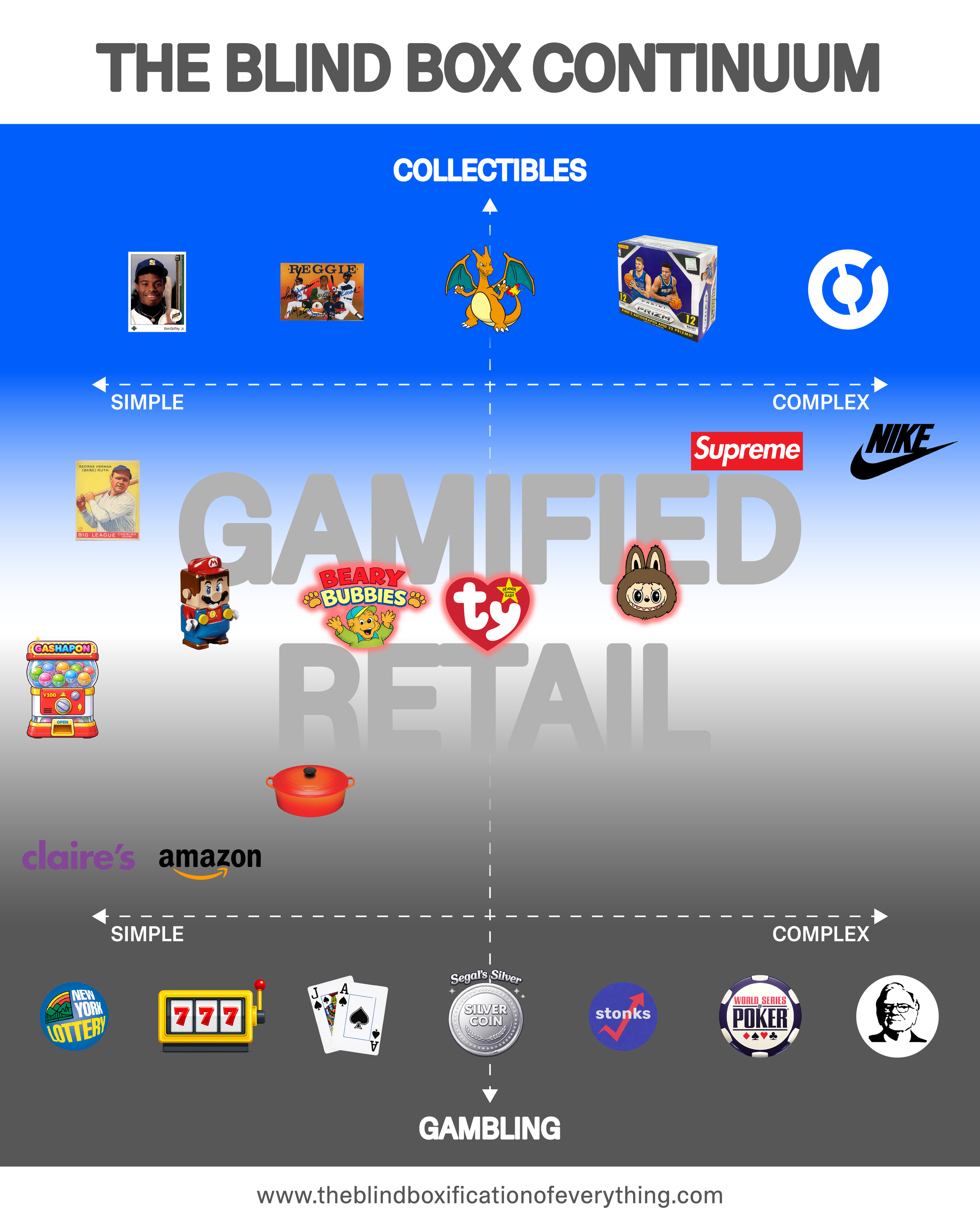
Oh boy! That’s a lot of real estate!
Gambling and Collectibles are fairly straightforward. The examples conform to our expectation. Gamified Retail blind boxes, however, can be much trickier to pin down. As we’ll see, these blind boxes are often confused with Gambling and Collectibles. And sometimes they even move and evolve in that direction.
Even so, Gamified Retail is a distinct tier, because it follows a distinct law:
Money In, Product Out.
Let’s start with some easy examples.
Clearance Sales
In the bottom left corner of our new map, you’ll see a cluster of “clearance sale” blind boxes. We touched on these in Chapter 3.
First, we have Claire’s. Last year, the retailer used £10 “mystery bags” to liquidate inventory from shuttered stores in the UK. Next to that, we have Amazon, which has been selling $700 “mystery pallets” stuff with hundreds of pounds of returned products.
Next to Amazon and Claire’s, but slightly up and to the right, we have Le Creuset.
We talked about Le Creuset in Section 4.1. As you’ll recall, the cookware brand sold mystery boxes for $50 a pop. Some of the boxes had expensive hits, like a $500 cast iron Dutch oven. Others were filled with mere filler, like simple mugs and boring-ass spatulas.
With these examples, you can clearly see how Gamified Retail differs from both Gambling and Collectibles. Sure, there are overlaps in the experience and the brain chemistry (pulling a Dutch Oven feels like a jackpot). But in a clearance sale, the hit is just a product. The brand is just doing ordinary commerce - with a gamified twist.
Money In, Product Out.
Simple as that.
***
Except . . . it’s not that simple. At least not for Le Creuset.
Unlike Amazon and Claire’s, Le Creuset created a more complex game, and a more collectible chase (that’s why we mapped them on a different plane). In Connecticut, customers had to purchase tickets to attend the sale in person. The tickets sold out instantly, and some diehard Creuset-heads traveled hundreds of miles to attend the event.
Moreover, Le Creuset is an elevated brand, and some of the mystery box hits were supposed to include limited edition styles and rare colorways. So when buyers opened their boxes and some people got nothing but mugs and spatulas . . . well, let’s just say drama ensued.
Here’s what one shopper told EyeWitness News:
“We’re all grateful for the experience. It’s just that when you get a certain event hyped up so much, and hyped up for the last couple months, the last year, and you see other locations and their mystery boxes, and the colors they got. They got these rare colors, or these limited-edition items, and then we go in Hartford, and we get two items. Some people got one egg cup, and two mugs, and broken items, and used items, and scratched items.”
The story went viral - as viral as the original boxes. A few days later, Le Creuset was forced to issue a public apology.
Ouch.
***
As Nate Silver points out in his most recent book, On The Edge (2025), many people who play slot machines expect to lose. They’re in it for the experience, not the money. So when they leave Vegas with nothing but spatulas, no one thinks to complain.
The same thing is true for card collectors. We expect that wax will have negative EV and we expect more FILLER than HITS. That's just part of the game. The game is why we play. And, of course...
Can you imagine a card collector ripping Topps Chrome and being so mad they go on local TV?
We’re all grateful to Topps for the experience. But I’ve spent the last two months amped on Cherry Cola Celsius with my TikTok FYP showing Cooper Flagg autos and Ultra Violet SSPs pulled from hobby boxes...I watched a breaker pull a Kon Knueppel Superfractor LIVE on stream...But then I finally get my value box and rip it, and all I get is one Luke Kornet auto, some random ass Robert Horry Clutch Gene insert, and three Pat Connaughton base dupes!??!?!
And THEN can you imagine Topps writing a public apology letter - not just to the one collector, but EVERY collector who was disappointed?
To everyone who opened a box of Topps Chrome basketball and was disappointed by their Luke Kornet autos, we sincerely apologize. We deeply regret if our Clutch Gene insert cards fell short of expectations, and we promise to remove Pat Connaughton from all future checklists. Please direct all future complaints to our co-founder, Josh Luber (email redacted). We think he’s living in Texas now. Sincerely, Mike Mahan.
Hard to imagine, right? Because Mahan doesn’t have my email. But also because Topps is a different kind of Blind Box. Collectibles, not Gamified Retail.
Booms and Busts
Now let’s turn to the second group of blind boxes - the plushies.
This tier includes simple, gamified kids toys like LEGO x Super Mario blind bags and Gashapon capsules. And further along the complexity axis, right in the middle of Gamified Retail, we find a group of ‘kidult’ plushie toys: Labubu, Beanie Babies, and Beary Bubbies:

Wait...what? Did you say “Beary Bubbies”? WTF is a Beary Bubby?!
Fair question. Bear with me.
***
Do you remember The Berenstain Bears, by Stan and Jan Berenstain? Of course you do.
Do you remember the one where Papa Bear got addicted to blackjack and lost Brother and Sister Bear’s college tuition fund at the local casino?
No? Good, because that never happened in Berenstain land.
But do you know what did happen? Beanie Babies!
I kid you not.
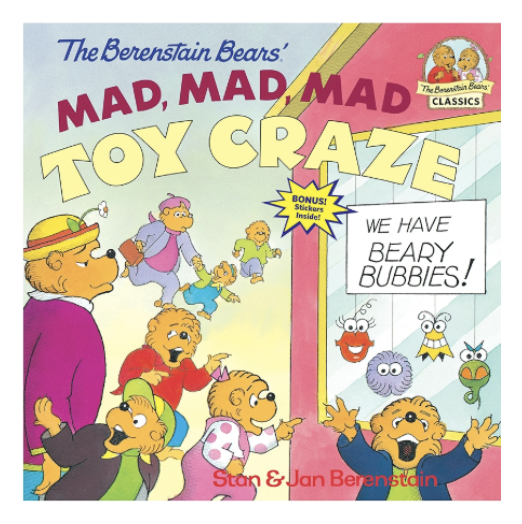
Published in 1999, The Berenstain Bears' Mad, Mad, Mad Toy Craze tells a tale about our favorite furry family getting swept up in a fictionalized “Beary Bubbies” chase.
It starts with the kids, who go chasing sold-out Beary Bubbies down at Herb’s Hobby Shop.
Then Mama Bear and Papa Bear read newspaper stories about the secondary market - “a rare Beary Bubby was sold for hundreds of dollars!”. Now they’re chasing them too.
But then, something changes.
The overproduction of Beary Bubbies makes them abundant and accessible. And now the chase is over, for the whole Berenstain family,
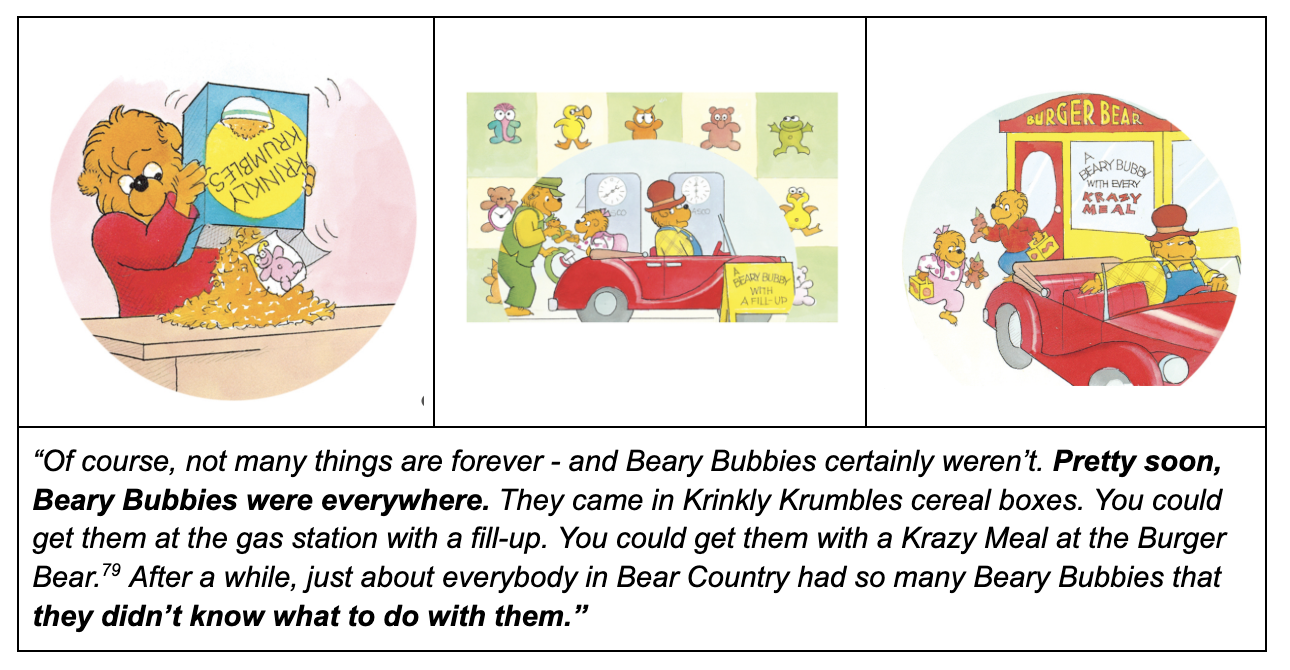
***
The story of the Berenstain family was fictional, but also prophetic. And for a certain kind of Gamified Retail blind box, it captures the entire boom-bust story arc:
Accidental Scarcity: A retail product becomes popular and sells out (demand>supply)
Retail Chase: Buyers chase the product
Resale Hype: Collector/investors (Mama & Papa Bear) chase resale values
Abundance: The brand increases supply to meet demand
Game Over: The product is now accessible, and the chase ends (unless it evolves)
A year after the book came out, the Beanie Baby story ended the exact same way. Ty Warner pumped out so many new models that everyone stopped chasing them. “The problem is over-abundance,” wrote an article in Mary Beth’s Beanie World magazine in 2020. “Beanie collecting has waned significantly.”80
It’s a story as old as time. Stanley Tumblers in 2024. Adidas NMD in 2017. Tickle Me Elmo in 2006 - and 1996. And it almost happened to sports cards in the 90s and Pokemon cards in the early 2000s. If those brands hadn’t evolved, they could have ended up as Beary Bubbies.
And now, in 2026, it seems like Labubu is following this exact same arc.
***
When we discussed Labubu in Chapter 4.4, we left off in the middle of 2025 - the height of the boom. Now we’re in the Abundance phase, heading quickly towards Game Over.
Faced with surging demand, Pop Mart flooded the market with new supply. They restocked, and restocked, and restocked - and then they restocked again.81 In part, they restocked because they had no choice. By law, China caps the retail price of a single blind box at US$31; they also cap secondary market prices to deter speculation. This means that Pop Mart cannot balance supply and demand by raising prices - or create a lotto ticket that is too valuable. Even if they wanted to create a plushy Prizm or fuzzy Flawless, they’d be legally proscribed.83
So they restocked. And because the scarcity of the chase editions was tied to the blind box odds (“1 per 72 boxes”), an increase in boxes meant an increase in chase editions, causing resale values to collapse.
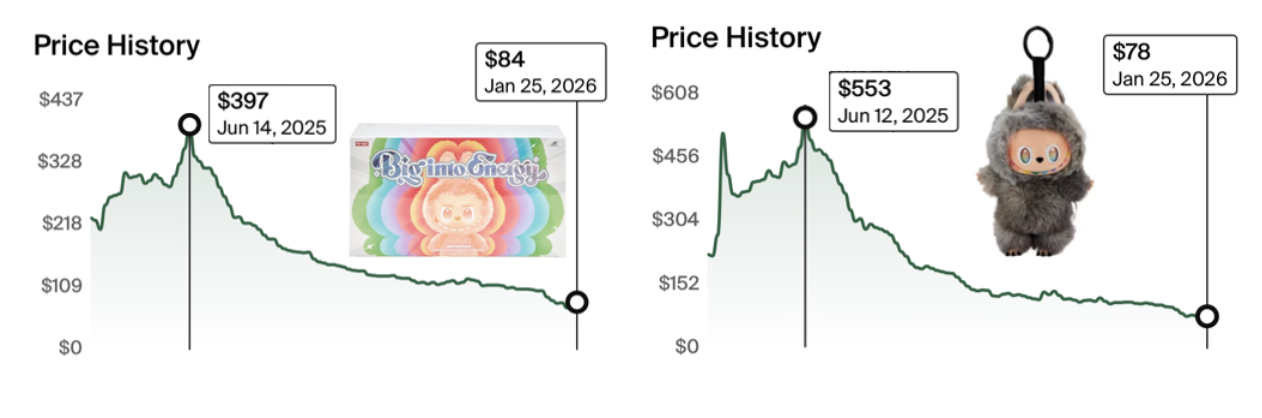
Sealed cases are now reselling for about half their retail price ($84) - down from a high of almost $400. The value of the Monsters secret edition, which used to be worth over $550, is now worth just $78. This means the hit is less valuable than the case.
Pop Mart would claim that this is all just resale shit. It doesn’t have anything to do with true demand from actual fans and collectors. But when the Beanie Baby bubble burst, actual demand cratered with it. And there are already signs in the data that the same thing is happening to Pop Mart.
On eBay, sales of Labubu Monsters are down significantly - not just prices, but actual volume.84 With resale prices falling, you would expect MORE true collectors would go online and buy singles - if only to complete their collections. But in reality, the opposite is happening. And analysts are taking notice:
“Pop Mart’s Labubu Risks Beanie Baby-Style Collapse”, warned a recent Bloomberg headline.
Time is a flat circle.
***
Beanie Babies took five full years to go from boom to bust. By comparison, the whole Labubu drama played out at warp speed. It felt faster, and bigger, than any plush mania that came before it. But why?
Here, the responsibility lies with StockX. Or maybe rather, with me.
5.3 - I KILLED LABUBU (aka RESALE HYPE)
StockX doesn’t just facilitate the market - it actively helps to create it.
StockX product pages go up instantly, sometimes before a product releases. This sends a signal to resellers (aka market makers): there may be money to be made. Tens of thousands of professional resellers use the site, and if there’s any imbalance in supply and demand, they’ll find it. They’ll make the market.
This happens fast. Very fast. And that’s usually a great thing for buyers and sellers - but it can create very real issues downstream. StockX reflects real-time pricing, not brand strategy. Labubu buyers and sellers don’t know if Big Into Energy is going to be restocked. Hell, it may be so early in the retail lifecycle, even Pop Mart doesn't know if the product will be restocked.
And so a buyer pays $500 for a Labubu secret edition - because the buyer wants access, and that’s the market price. But then Pop Mart restocks, supply increases, and prices plummet. No one did anything wrong. No one knew that Pop Mart was planning to treat Labubu like GM treats Cheerios or, worse yet, like Tyco treated Tickle Me Elmo. But that doesn’t make the consequences any less real - both for the buyers who “overpaid”, and the sellers holding inventory at an unrealized loss.
That’s the reality of a post-StockX world. The market moves fast. It doesn’t categorize or typologize different products. It doesn’t scratch its chin and ponder “what kind of blind box is this?”. It sees Labubu like any other product with a supply & demand imbalance - and it acts.
For the most part, the market has come to understand this. To accept it.
And you get it, too. I know you do.
But what’s really going to bake your noodle later on is . . . Would the imbalance even exist without a resale market to exploit it? Which came first: the demand or the market?
Viewed from one angle, StockX is just a supplier - resellers are just retailers who use market price instead of MSRP. But StockX isn’t just in the distribution game. It’s also in a demand-gen game. It sends signals to sellers and buyers.
“Look at this ordinary toy listed on StockX . . . It’s selling for 3x retail . . . The price has gone up 300% . . . It must be cool! It must be inaccessible! It must be collectible! I HAVE TO HAVE IT!”
This is what is meant by “Resale Hype”. Labubu creates a Retail Chase - by adding scarcity to the product. StockX creates Resale Hype - allowing the product to behave like a speculative asset. The exact same thing happened with Beanie Babies and eBay in the 1990s. The only difference is, now, it’s faster (and therefore bigger).
So the question becomes . . . Absent the StockX resell engine driving demand, would all those restocks be necessary in the first place? Did the excess demand create the market? Or did the market create the excess demand?
Take this in your hand...
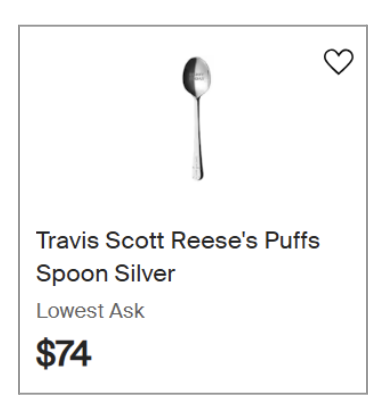
...and try to realize the truth.
There is no $74 spoon.
It is not the spoon that bends towards hype. It is only yourself.85
***
So yeah . . . maybe it’s my fault. Me and Pierre Omidyar. But if you want your money back, send your Monsters to Pierre. He’s richer.
Nike & Supreme
Could Beanie Babies or Labubu have acted differently? Must all Gamified Retail brands follow the same arc of boom and bust? The answer is no. And here it’s worth noting the exceptions.
When Supreme first started, demand for their clothing exceeded supply. At first, it happened by accident. Maybe they didn’t make enough hoodies; or maybe they just underestimated demand. But in the beginning, they decided to keep that way, allowing everything to sell out. And in this way, their origin story is similar to Beanie Babies, where the first retirement was closer to seasonal turnover than intentional scarcity.
But unlike Ty Warner, James Jebbia realized that being sold out was a good thing. Once the scarcity proved culturally valuable, he kept it going - or, rather, he declined opportunities to eliminate it. He didn’t choose the Beanie path (create more products), or the Labubu path (restocks). He simply kept shit limited. Even when he scaled, he always kept supply < demand.
Thanks to this fairly simple strategy, Supreme has maintained their hype for the better part of three decades, with customers lining up for the chase every single Thursday.
***
Nike has a similar story - but their evolution was more complex.
Like Ty and Supreme, Nike stumbled into hype the way Jordan stumbled into Toontown. In 1985, they were just doing ordinary retail shit - producing enough Jordan 1s to meet the modest demand forecasts. Then MJ went off, the shoe caught fire, and boom: demand >>>> supply. Total accident.
Next thing you know, Air Jordans are the coolest, most chase-worthy shoe on the planet. Kids are hunting them down by any means necessary. Sports Illustrated is running headlines like “Your Sneakers Or Your Life”, and old grumps like Phil Mushnick - the Upper Deck hater we met Chapter 4.2 - are blasting Nike and Spike Lee for inflating the hype.86
In response, Nike could have done what most consumer brands do. Increase supply, take the profit, and let the chase die. But they went a different way.
They started with “limited edition” releases of Retro Jordans in the late 90s (basic intentional scarcity). Then they fully-embraced drop-based distribution in the 2010s. Then they moved online with SNKRS and added further layers of gamification (e.g. raffles - a literal lottery).
And each time Nike leveled-up their retail strategy, Resale Hype got a level-up too.
In 1999, eBay turbocharged the Jordan Retro chase, the same way it turbocharged the Beanie chase. In 2016, the launch of SNKRS coincided with the rise of StockX (and GOAT). Retail and Resale Hype went hand in hand.
As for Nike today - their evolution keeps on keeping on. The latest? Releasing their new Panda Dunks in a literal blind box, complete with special chase colorways. “Is Nike Trying to Make Its Panda Dunk the Next Labubu?”, asked WWD in July of last year.87 But Nike isn’t following Labubu. They’ve been blindboxing for decades.
Scarcity Is Hard
Nike and Supreme are more the exceptions than the rule. The rule is abundance, not scarcity. And there are obvious reasons why.
For one thing, abundance means more money for brands, and scarcity means less (at least in the short term). Every time Supreme sells out - every time a Nike customer loses a raffle - that represents revenue not taken. The people running these businesses all have “make money” in their job description; so it isn’t easy for them to pass down the opportunity.
But what really, REALLY makes scarcity hard is the customers - especially for a Gamified Retail brand. Because as much as they love the chase, these customers are in it for the product.
Money In, Product Out.
Consider this example:
As 1999 was coming to a close, Ty Warner saw that the Beanie hype was fading. The writing was on the wall, so he began to contemplate something bold. He had the idea to retire ALL Beanie Babies! To halt production on every single model.
Ty actually announced this move on the website (December 1999), causing a surge in secondary market demand and prices. But as it turned out, this would be the last time that surge would happen.
After a few weeks, Ty rescinded the announcement. He was on the fence. So rather than make the decision himself, he left it in the hands of the people.
“After much thought, I am willing to put the fate of Beanie Babies in your hands,” read his message on Ty.com.
He invited collectors to cast thor votes on the mass retirement question. Should production end? Or should the supply of Beanies continue?
“BEANIE BABIES’ FATE LEFT UP TO TOY POLLOI”, read the pitch-perfect headline in the New York Post.
Over 200,000 people went online and cast a ballot. The result of the vote couldn’t have been more decisive. 91% voted in favor of more Beanie Babies. And the rest, as they say, is history.
Sometimes evolution means listening to your customers. But just as often, it means the opposite.88
***
Here once again, we see a fundamental difference between Gamified Retail and Collectibles.
At the end of the day, most Nike customers want the product - not the chase. They enjoy the experience, like any good Pascalian - and they might even be driven by it, subconsciously - but when the chips are down89, sneakerheads wanna wear sneakers.
That’s why they’re always screaming at Nike to “make more shoes”. Sure, there are some hardcore sneakerheads who oppose restocks on principle (I’m one of them). But we’re a minority. If Elliott Hill pulled a Ty Warner and put the question to a vote, my guess is 91% would say “keep those restocks coming”.90
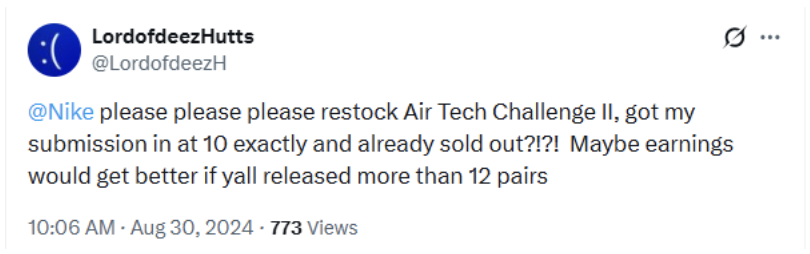
Money In, Product Out.
Card collectors are the exact opposite. We treat card brands like the Collectible makers they are. We don’t want more parallels. We don’t want our 1/1s to become 1/10s. And if Panini took a poll: “Should we go back and reprint more 2018 Prizm?”
We’d vote 91% “No”, with a 9% write-in vote for “FUCK NO”.
Because card collectors know that owning the cards isn’t the point. Our money is for the game, not the product.
***
This is why most Gamified Retail brands follow the path of abundance. The path of infinite restocks - like Labubu is doing now.
Or consider what adidas has done over the past decade. At several key junctures, they’ve found themselves with a gamified product and a chase-worthy (demand>supply) sneaker. And pretty much every single time, they opted for abundance.
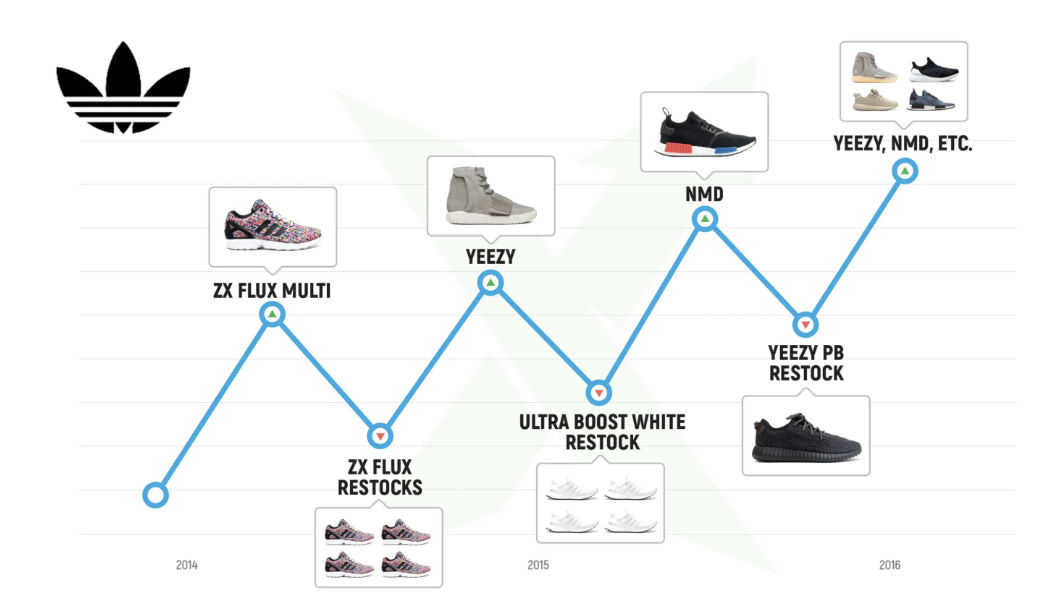
This is from a paper I published in 2016, called The History* of adidas Resell. It shows that each time adidas managed to (accidentally) create a hype sneaker, they restocked that sneaker and killed the chase. If I were to remake that same chart today, it would end with the line going down again: Yeezys and NMDs both got restocked to death, and now those chases are over too.
***
Some brands will choose scarcity; many more brands embrace abundance. And whatever path they choose is completely and totally OK. I’m not here to judge - at least not in this paper.
What I am here to tell them is this: whatever path they choose, Resale Hype will happen whether they like it or not. StockX product pages will go up whether they like it or not. Resellers will exploit the supply-demand imbalance whether they like it or not. And their customers - actual, real-life, honest-to-god customers - will start thinking of their product differently. Whether they like it or not.
In short: there will be category mistakes. And brands should be prepared. Because even if your purpose is Gamified Retail, your customers might start seeing something else.
Category Mistakes
In 1998, renowned legal scholar I. Nelson Rose - who literally wrote the book on gambling, penned a column called “Betting on Beanie Babies.” “If you want to teach your children how to gamble, have them spend their allowances on Beanie Babies,” declared Rose.
That same year, an Indiana casino ran a slot machine promo where all jackpot winners got random Beanie Babies with their payout.89 And newspapers compared Beanie buying and stock market day-trading.
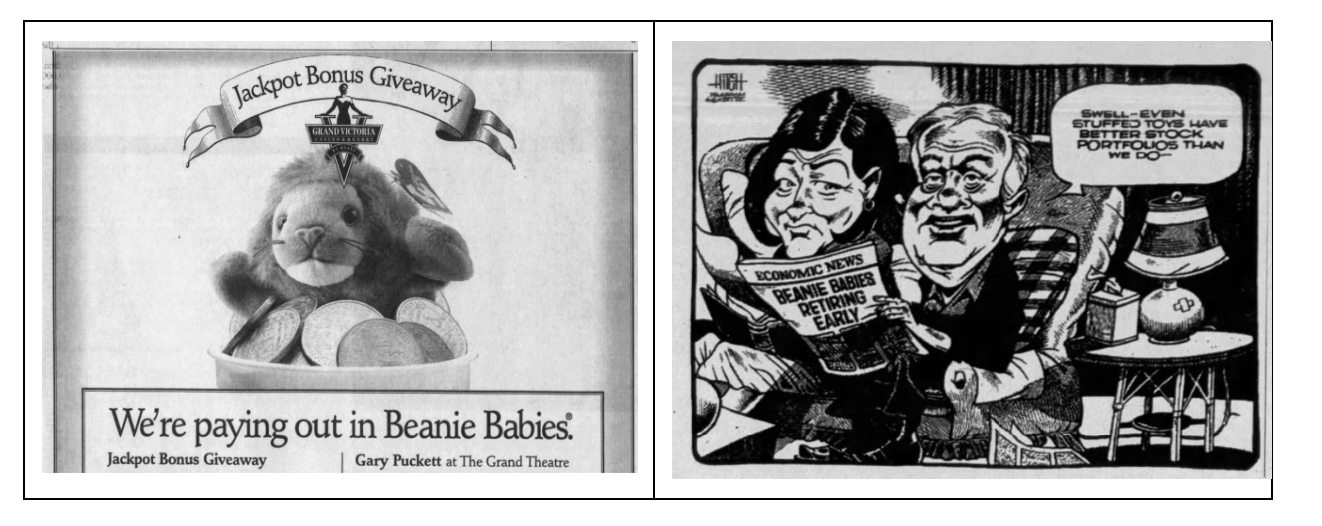
The implication was clear: Beanies are money. Beanies are an investment.
In 2025, professional resellers were buying and selling Labubu cases the way day-traders trade stocks. And adult collectors were paying $550 for secret editions - presumably because they thought prices would only get higher.
Kevin O’Leary, aka Mr. Wonderful, aka the Shark Tank/Marty Supreme culture/commerce, double-wristing horologist, multi-hyphenate . . . aka the dude who just bought a $12.9M card with Shyne for his Secure Collectibles fund (and is saying it’s worth $20M six months later) . . . aka the paradigmatic whale driving current demand for TCCs . . . even he was hyping up Labubu as a ‘priceless’ asset.92
The implication was clear. Beanie babies are collectible.
This was a category mistake. Beanies and Labubus were always destined to be what they are: Gamified Retail (Money In, Product Out). The point of the game was always the product.
But category mistakes have consequences - especially in an era of warp-speed Resale Hype. So as different brands chart their path on the Continuum, it’s important to keep an eye on the compass. And if customers get confused . . . you can always show them our map.
Pokemon: An Evolution Case Study
The last brand I want to discuss is Pokemon. Of all the stories on the Continuum, Pokemon might be the wildest.
Pokémon, you’ll notice, are mapped in the Collectible tier. But they didn’t start out there. Indeed, there were times in its 30-year history that it looked more like Beanie Babies.
The difference is, Pokémon evolved. And yes, the double entendre is intentional.
In fact, Pokemon is the ONLY brand I can think of that managed to make the jump from one tier (Gamified Retail) into another (Collectible).
Let’s run through the evolutionary moments (and give them some names)
1996 (Simple Charmander)
When Pokémon first came out, it was designed as a kids game. Literally. The cards were meant to be played, not chased. Indeed, the first cards released in Japan were dispensed via Gashapon machines - the very definition of Gamified Retail.
It was still a Pascalian experience - and a powerful one. But it was an experience meant for kids, not collectors (much less investors).
1999 (Evolution 1: Charmander → Charmeleon)
The first Pokémon base set releases in the United States. Almost overnight, the blind box experience changes. Here’s a New York Times article from April of that year:
Children can pit their cards against their friends' in a fantasy game. But many children, like Alex Silverman and his soccer teammate, Andrew Imber, quickly find themselves skipping the game to trade for more valuable cards.
That's not surprising, given that the more powerful and sought-after cards can fetch as much as $50 on the thriving secondary market, which ranges from friendly dickering between third-graders over chewing gum and candy bars to cold-blooded auctions on the Internet.
The odds of getting a powerful ''premium'' card are stated at 1 in 33, and certain specific cards may be twice as scarce as that.93
The article headline was: “Suit Claims Pokémon Is Lottery, Not Just Fad”. You get the point.
This evolution in the experience flowed from several sources. One was the Junk Wax Era itself, and the exodus of kids from sports cards creating a surge in Pokémon demand.94 Another was the rise of eBay - the “thriving secondary market” mentioned in the article.
But most important was the scarcity. The hype started with “geographical” scarcity, in that the first Pokémon cards were only available in Japan. This early inaccessibility drove demand among American kids (and adults) - just like in the 1990s with Bape (and other Japanese streetwear brands), 2000s with Nike CO.JP, 2010s with Bearbrick, and 2018 Prizm Choice.95
Then there was “accidental scarcity”. Wizards of the Coast couldn’t print enough cards and had to release a much more limited “1st edition” set. (This is the origin story of the $1M+ First Edition Charizard card).
From there, the brand itself took an evolutionary step and immediately started adding intentional, supply-side scarcity, in the form premium chase cards with limited odds (“1 in 33”).
As demand soared, and supply stayed constrained, there were campouts outside stores. There were fights in parking lots. In 1999, Pokémon wax looked much more like a Nike sneaker drop than an Upper Deck release. “Justin Carmical, a supervisor at a hobby shop in Colorado Springs, said the cards often disappeared from shelves within three hours of arriving,” reported the New York Times in April of 1999.
2001 (Evolution 2: Charmeleon → Charizard)
For three years, demand for Pokémon far exceeded supply, and the cards were treated as Collectibles - by kids and adults alike. But by 2001, Pokémon was finally able to ramp up production and print millions of new cards. And just like Beanie Babies and Junk Wax before it, Pokémon mania started to fade.
“So Long, Pokémon; Yu-Gi-Oh Is Coming,” declared a representative headline in the Los Angeles Times.
Secondary market prices rapidly declined. In 2004, a report found that Pokémon cards had lost 90% of their resale value.96 According to one hobby shop owner, the Pokémon card craze “lasted about 3 years, which is kind of amazing in this business.”97 But now, it was over.
Topps, which had acquired a license to make Pokémon cards in 2000, was printing money at first. But by 2002, their quarterly Pokémon revenue had fallen by an astonishing 93%.98
Over the next several years, professional resellers abandoned Pokémon cards - pivoting their business to other collectibles categories.99 And while kids continued to play the game, adult collector/investors went elsewhere.
In the three years between 1999 and 2001, there were nearly 2,000 newspaper articles with the words “Pokémon cards” and “investment.” In the following ten years combined (2002-2012), there were only 500 such articles. Newspaper keywords aren’t a perfect metric, but these numbers are clear enough to prove the point.
2026 (Evolution 3: Charizard → Mega Charizard X)
By the end of the Aughts, it looked like Pokémon was just another Beanie Baby story. Countless news stories from that era drew comparisons between the two “crazes’ and “fads.”
Yet Pokémon didn’t end up as Beanie Babies. Instead, they evolved into a Collectible success story - perhaps the most popular and enduring collectible brand on the planet.
In part, Pokémon cards remain a kids game - just like they’ve always been (even in the Aughts). But they also inspire a massive amount of collector/investor demand from young and old adults.
When it comes to grading submissions, Pokémon is BY FAR the most graded card brand in the universe. The TCG category on GemRate surpasses every Major League Sport (it’s not even close), and that’s largely thanks to Pokémon.
Unlike Beanie Babies, Pokémon continued to evolve after the mania faded and the collectibility crashed. After they flooded the market in 2001, they didn’t just go back to being an ordinary retail product (or Gamified Retail blind box). They evolved the product, and they evolved the experience.
Pokémon developed new parallels and hits for their retail products - like the 2024 Special Illustration Rare (hit rate: 1:45 packs) and Hyper Rare (1:180 packs). If you pull the right card and score the right grade, these can be $1,000+ hits.
They also created promotional ‘trophy’ cards, like the famed Pikachu Illustrator, which sell on the secondary market for six- and seven-figures. These ultra-rare cards don’t appear in packs - they’re awarded to tournament and contest winners. But their headline-grabbing secondary sales create a Logan Paul-sized halo for the blind box sets.100
Most importantly, Pokémon continued to evolve the game within the game (e.g. Pokémon Go), all while building a global IP universe that would make Walt Disney blush. They’ve evolved on the supply side and the demand side.
Pokemon isn’t Topps Chrome or Panini Prizm. It’s still a kids-focused product, with kid-friendly pricing. There are no 1/1s you can pull from packs.111 No million-dollar lotto tickets. No high-end Flawless-style wax.
And that’s totally fine. By evolving their strategies, they’ve created a Collectible game for kids and adults alike. It’s a different kind of game - but the game is no less Collectible.
Here’s what the evolution looks like on the Continuum:
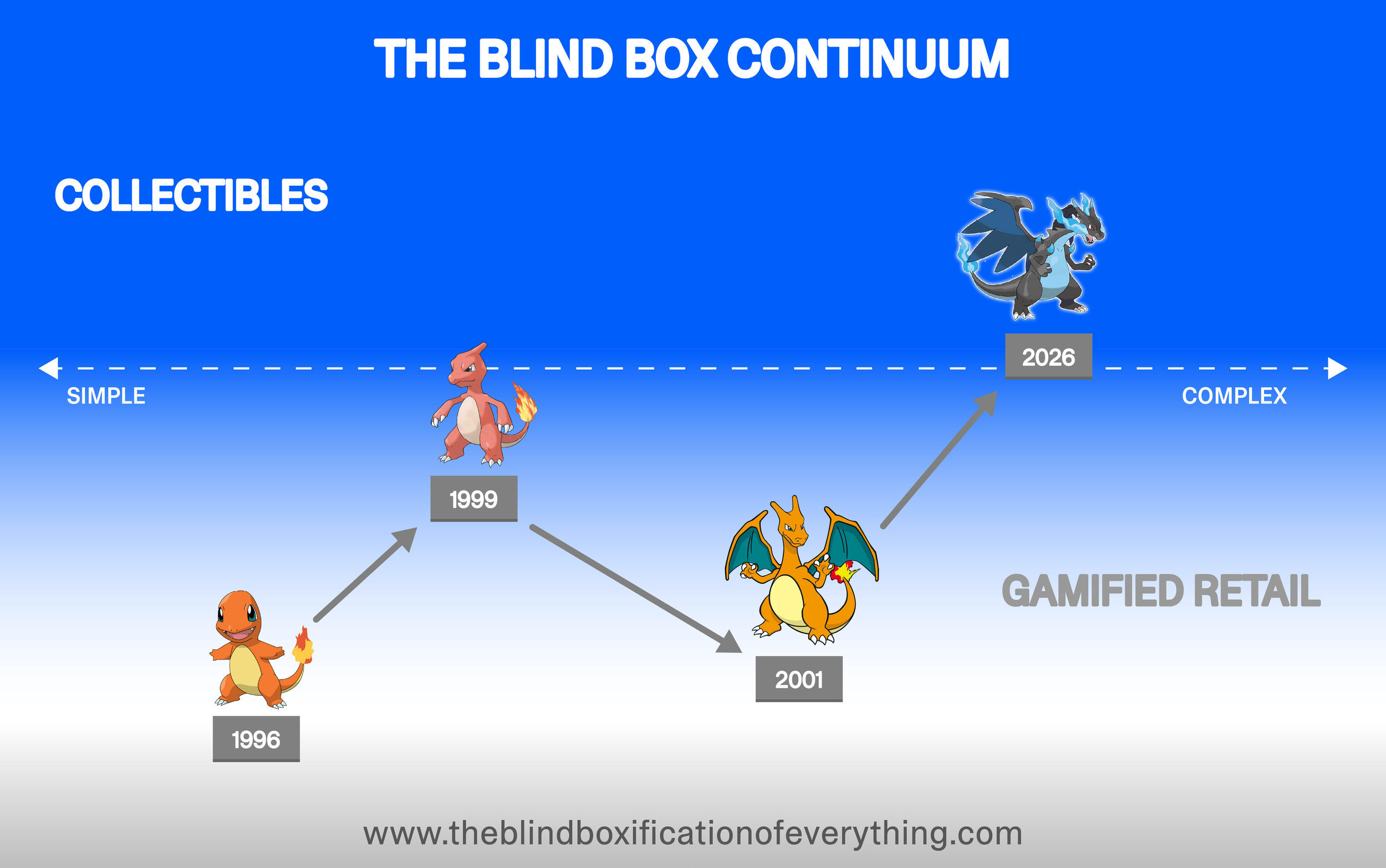
The pattern looks familiar, right? Looks a lot like that adidas resell graphic I made way back in 2016. And there’s a reason they look the same. But that’s a story for another white paper. For now, just know that Pokémon ended in one box, adidas the other.
5.4 - WEMBY’S BLIND BOX
To the brands out there, let me be super explicit and clear:
Labubu, Beanie Babies, Beary Bubbies - they’re all successful products that millions of people (and bears) love to hunt and love to own. Not everything needs to be an asset class. Not everything needs to be a poker chip.
The Continuum is descriptive, not prescriptive. We’re giving you a map, not directions.
It doesn’t matter how you evolve, but it DOES matter that you evolve. Because the world of gamification is evolving too, so anything less and you’ll be left behind.
In this way, the Blind Box Continuum isn’t about right and wrong. It’s not a good<>evil spectrum, or even a LeBron<>Bronny scale.
Blind boxes live on a Continuum the way introverts and extroverts live on a continuum - sometimes they switch places. Or the way Valium and Adderall live on a continuum - it’s whatever you’re in the mood for, man.
To illustrate this point, let’s invent a blind box experience, and see how it can evolve.
EXAMPLE #1: SIMPLE GAMIFIED RETAIL
Let’s say you’re a professional sports team - the San Antonio Spurs102 - and let’s say you’re in the mood for something simple. You’re just trying to fill empty seats for tomorrow’s game. You have 98 seats, all in the same section, normally priced at $50 each ($100 per pair). You take all those tickets, put them in a ‘blind box’, and add one pair of courtside tickets ($2,000 value) as a chase. You turn around and sell all 100 blind boxes for $120.
The game is tomorrow, so the value is fixed. The courtside hit is tied to the $2K face value - the same way a Dutch oven hit is tied to the $500 retail price. In essence, it’s the same as any blind box clearance sale. Money In, Product Out.
But simple can be good. As long as you clearly explain the odds, you can avoid any Le Creuset-style confusion. Fans line up to chase the big prize, and if they don’t get it, they’re happy to watch the game from the rafters.
The crowd goes wild. The tickets sell out. Problem solved.
EXAMPLE #2: COMPLEX GAMIFIED RETAIL
You’re still the San Antonio Spurs, but this time you want to gamify ticketing for the playoffs, one month away. You create a blind box with a differentiated ‘checklist’ of tiers: Upper Level, Lower Level, VIP, and Courtside - all within the same product. Customers can buy a two-seat or three-seat package; guaranteed to sit together.
The blind box product is priced at 20% more than the cost of an Upper Level ticket, which is just slightly less than a Lower Level ticket, but significantly less than the price of VIP and Courtside. That delta is fine, though, because 80% of the tickets are Upper Level, 19% are Lower Level, 1% is VIP and just one pair of tickets is Courtside.
Customers are happy to take a shot at winning a better seat though, because if they don’t like the seat they get, they can immediately try again. You create a 95% guaranteed buyback program - just like the digital repack companies - but the high buyback percentage is fine because a) market price doesn’t change; and b) the buyback is actually a ‘seat swap’ program, where the customer is required to use the refunded money to try again!
Because the game is a month away, the value of the hit doesn’t depend on the face value of the tickets. It also depends on the relevance of the team, and the performance of the players going forward. It's like how the value of hype sneakers floats with the cultural relevance of the brand or collab. The tickets have a (supply-demand) market value, not a retail price.
But this presents even more opportunity. You partner with a secondary market site like StubHub, so that professional resellers can participate along with fans. If someone hits a big seat - a VIP or Courtside - they can list it on a marketplace for whatever they want!
Not only will you sell your tickets - you’ll also bring in gamblers and chase-hunters of all stripes, which will increase liquidity, as well as profit.
With these two examples (mapped above), you can start to see the Blind Box Continuum as a useful heuristic. A way to understand how blind boxes serve different functions, and operate at different levels of complexity. And most importantly, how one can evolve into another.
***
Thus far, the examples of successful evolution we’ve cited have either been real-life trading cards or imaginary sports teams. But what about toys? Will they ever make the journey all the way across our blessed Blind Box Continuum - all the way to the upper-right?
To illustrate that evolution, we could create another imaginary example. Or we can talk about a real one.
Does anyone know a new innovative Collectibles company that has a somewhat complex blind box experience.
CHAPTER 6: CONCLUSION
6.1 - GHOSTWRITE
I live by the rule of Mitch & Murray. So I’m going to close this white paper by closing.
I’m going to offer you a blatant and biased advertisement for my own new company - a startup I’ve spent fourteen years in the Blind Box Economy working towards. It’s called ghostwrite.103
Will this section be self-serving? Of course. Will it be self-indulgent and self-regarding? Perhaps just a bit. But it will also be relevant to everything we’ve discussed so far.
Let’s start with some history.
I left Fanatics Collectibles in October 2022 to start:
a brand
a Collectible brand
a Collectible blind box brand
a Collectible blind box toy brand
Rubin a was the first check in, and next came other investors who’ve previously supported me (Gary Vaynerchuk, Mark Wahlberg, David Krane, Jackson Wang, Ryan Spoon, etc). They all understood the vision, which as an elevator pitch went like this:
Take every lesson from trading cards
and apply it to collectible toys
For our purposes here, let’s boil the lessons down to three:
Lesson 1: A Blank Canvas
In its most elementary form, a trading card is a blank canvas. It’s a 2.5” x 3.5” piece of cardboard, .5 millimeters thick. The value of that canvas depends on many things - subject, scarcity, condition, etc - but the canvas itself is always the same.
Well, maybe not always the same. Panini National Treasures, for example, is 3.3 mm thick. Does that mean that NT is not a card? Of course not. It’s just a different card– a blank canvas with different dimensions. That’s what we set out to create at ghostwrite.
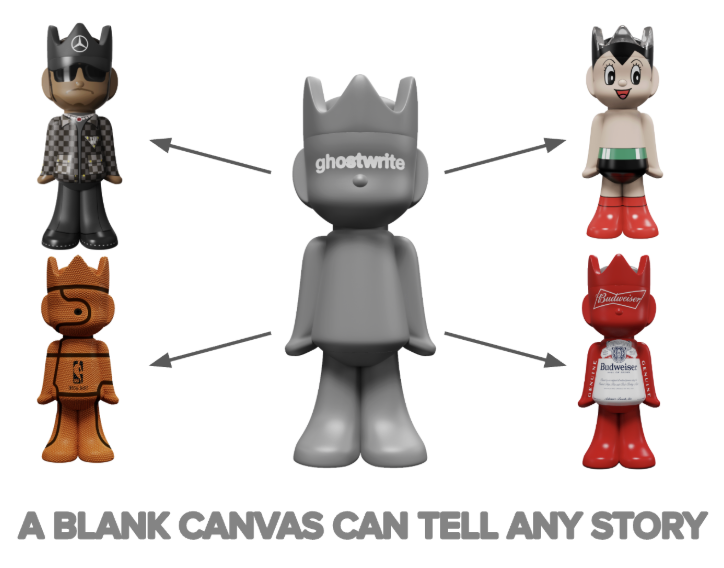
A ghost is a blank canvas. It has different dimensions than a card; a different form factor (shape); different materials. But like any card in National Treasures, the canvas is always the same - and that’s what makes it blank.
It took time. A lot of time. It took eight months working with fourteen different toy designers to design the canvas. And it took many months after that, working with different factories in different countries, to produce and ship a physical product.
In August 2024, we sold our first ghost ever: the ghostwrite “One” 400%. Twenty units were sold using a Blind Dutch Auction, which closed at a clearing price of $1,026.104
The first lesson was complete. So we moved on to the second one.
Lesson 2: A Blind Box
The first ghosts sold were 11” tall (or “400%” in our sizing lexicon). They were sold individually in limited quantities - much like the original Labubu were sold before Pop Mart. The audience was very clearly the collectible toy collector (notice we aren’t capitalizing “collectible” here).
At the end of 2024, we started selling a different kind of product, designed for a different distribution system and different customer. We partnered with major sports leagues to create smaller, 2.75” (100%) blind box sets. Then we partnered with breakers like Blez and DACA to sell them on their streams. All of this was unmistakably for the trading card collector.
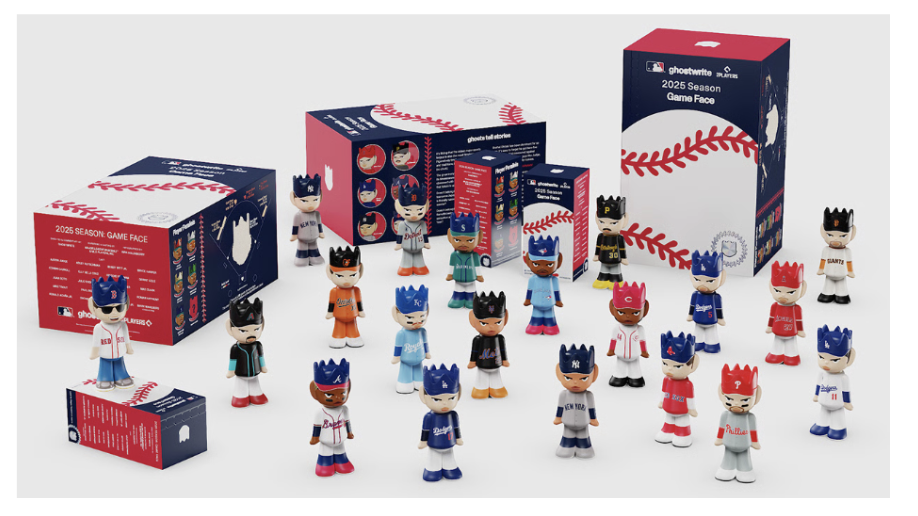
Each set is tied to a specific season of a specific league, with a finite checklist of players. The shape of the toy never changes, and the IP goes on seamlessly - like paint on a (ahem) canvas.
The finite checklist creates demand-side hits (Caitlin Clark, Shohei Ohtani), and the seasonality of the sets creates a natural “rookie chase”. The same way rookie cards are stamped “RC”, rookie ghosts are stamped “R” - a not-so-subtle reminder that this only happens once.
The singularity of stars, the finite nature of seasons - that’s all scarcity that is built into the IP. (Not that I need another reason to love sports, but goddamn they’re perfect for Collectibles). But just like the card brands that came before us, ghostwrite made scarcity truly intentional.
Lesson 3: A Truly Scarce Chase
Each ghostwrite blind box set features a series of parallels - the EXACT same kind you see in any modern trading card product. Like card parallels, these ghosts have transparent, finite supply. The Gold /10 parallel is numbered to ten and has a gold crown. Chrome /5 has a chrome crown. And the biggest hit, the Fire 1/1 - you guessed it: has a fire crown.
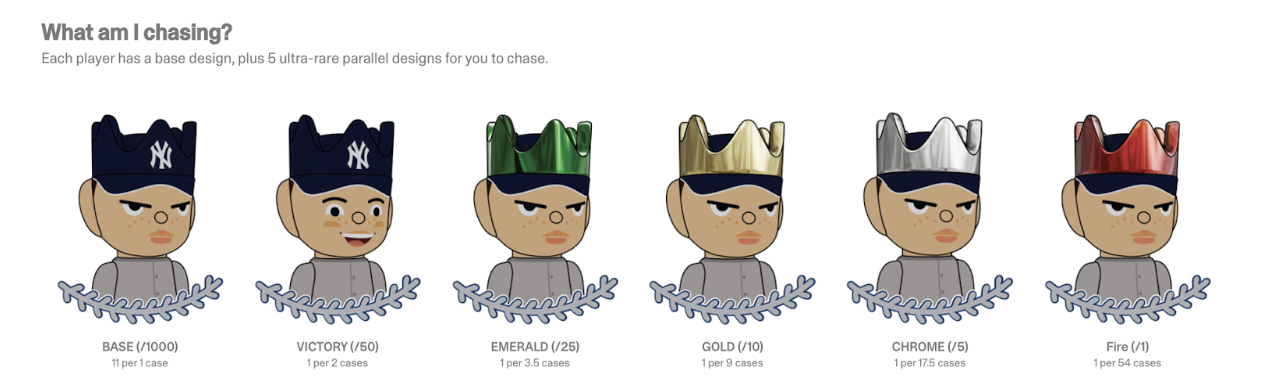
This is true scarcity, tied to the finite supply of the product itself. And this represents a real evolutionary leap from other blind box toys on the market.
But the point here isn’t really scarcity. The point is collectibility. It’s about creating a blind box where the product is the game. It’s about creating a true Collectible brand.
***
On the surface, ghostwrite might look like any other “collectible toy”. Bearbrick makes blank canvas toys just like we do - including 100% blind box sets. Pop Mart Labubu is a softer, squishier blank canvas in a blind box. Funko Pop!, while not a blank canvas, does make blind boxes with sports and other IP.
But all these blind boxes use a rudimentary chase system (e.g., “1 in 72 boxes”).105 There’s no true scarcity. No finite supply. And there’s a very good reason for that. Because at the end of the day, Bearbrick, Labubu and Funko aren’t really Collectibles. They’re Gamified Retail. They sell a product, not a game.
Funko makes kids toys. Pop Mart makes kidult toys. Medicom makes art toys. They all make products, and the blind box is just a way to gamify the retail side. And that’s all just totally fine.
It’s also fine that customers (at least some of them) make the category mistake of seeing them as Collectibles and (to get super close to the waters’ edge) it’s also fine that customers actually collect them. Bearbricks trade on the secondary market (though the values are depreciating). There are 3rd party Funko mystery box companies (though very simplistic ones). And at any given moment, a demand-side shock could propel these markets and businesses into another Beanie Baby-esque boom. It just won’t last long. And maybe that’s fine too.
BUT...
If any of these brands want to become a true Collectible . . . if they want to evolve out of Gamified Retail . . . if they want to take advantage of Resale Hype and repacks and breaking . . . well, there’s nothing stopping them from evolving.
Historically, trading cards (sports and TCG) have been the only blind box brands that use a game to sell a game. That’s why they’re the only brands that appear at the top of our Continuum.
But history isn’t destiny. The road to collectibility needn’t be paved in cardboard. And ghostwrite has already proven it.
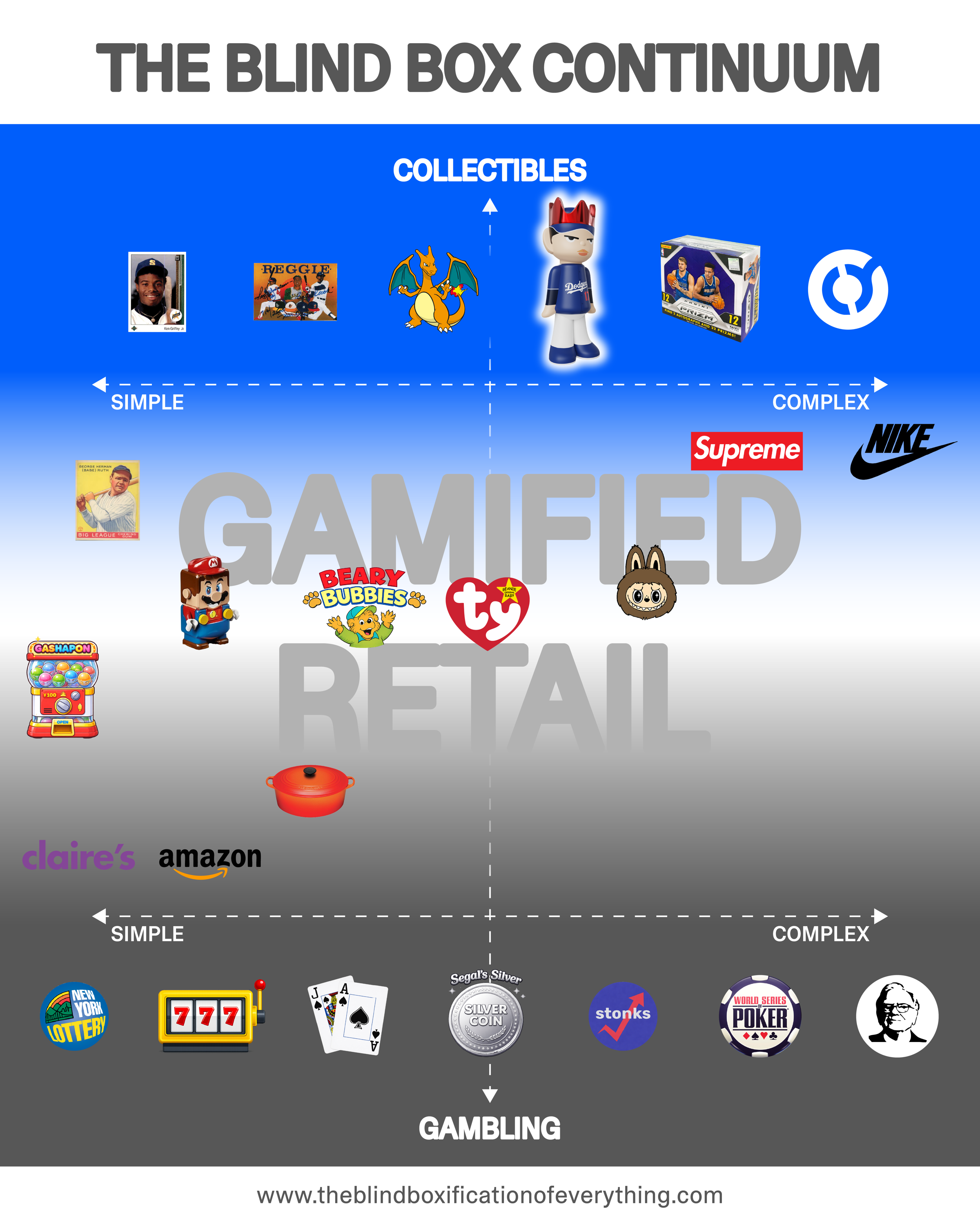
Hey, would you look at that. The map-makers mapped themselves!
A ghost is a toy. But it walks and quacks like a modern card set. It’s not quite as sophisticated or gamified as 2018 Prizm, but that’s only because we’re operating at a smaller scale (for now).
ghostwrite hits have real value, and each case has clearly-defined ROI. Collectors are getting their ghosts graded, and breakers are our #1 distribution channel. No one has made a ghostwrite repack product yet, but given where we already are on the Continuum, it's only a matter of time. It’s been discussed.
***
Our first blind box set with the WNBA released in December 2024, and featured the most important female athlete in the galaxy, Caitlin Clark. Demand was strong, driven mainly by the chase for rare Caitlin crowns, including a $30,000 bounty for her Fire Crown 1/1, and Gold /10s which were immediately reselling on eBay and StockX for $3000 or more.106
But the real game-changing moment for ghostwrite came in 2025, with the release of our first MLB and NBA sets (in August and September, respectively). The desire to chase the rarest Wemby, Steph, Judge and Ohtani ghosts drove demand into a frenzy. And secondary market values for these grails reached a level that surprised even me.
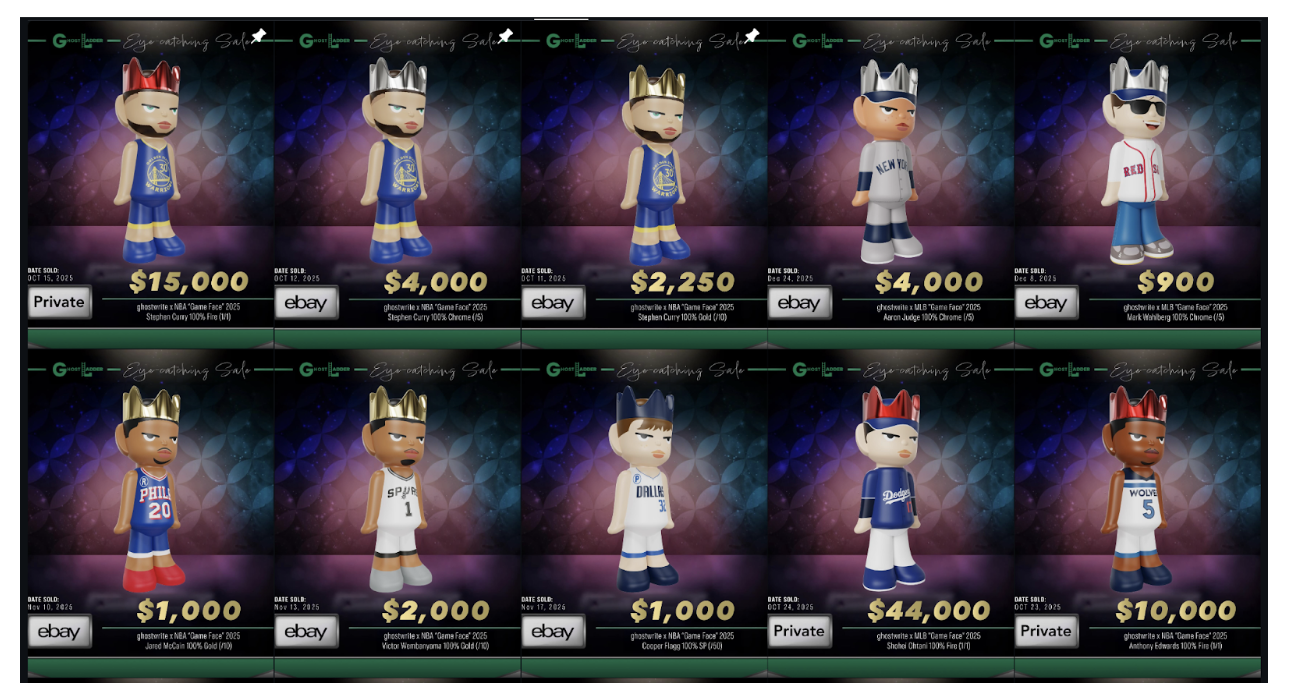
The most expensive sale so far has been the Shohei Ohtani Fire 1/1 ghost, which was purchased for $44,000 in late October 2025. The buyer was Spinotron - one of the most important and forward-thinking collectors in the Hobby. This is the fourth time I’ve mentioned his name in this paper, all briefly, and like many topics, he really deserves more space. But here I’ll just say this: having a true TCC-hunter like Spinotron hunting ghosts is additional validation that ghostwrite is, indeed, a Collectible.
Spinotron was thrilled he bagged the 1/1 Ohtani ghost. And I was thrilled for him. One day, in the not so distant future, I hope it will be worth as much as my own Red Ohtani. After all, they are the same:
A Truly Collectible Card and a Truly Collectible Toy.
6.2 - A MESSAGE TO BRANDS
“The pleasure of the hunt is greater than the pleasure of the capture.”107
It took 100+ years. It mostly happened by accident. But half a millenium after he wrote it, Pascal’s Psychology is now Pascal’s Macroeconomics.
Without even really trying, brands have created a world where capture (consumption) is incidental; where possession isn’t the point; where all that matters is the experience of the hunt.
For cards, the story began with a simple game of “collect them all”. Then came intentional scarcity, with its unintended consequences. And before anyone realized what had happened, the chase became the product, and the product became the chase.
We see it today in the singles market, where more and more cards are treated as FILLER - a mere denominator in a game of chance.
We see it in the buyback velocity of digital repacks.
We see it in the compulsive unboxings on TikTok Shop; the unending breaks on WhatNot; and the rise of GameStop, LuckyBox and Polymarket.
The gamification of commerce isn’t just happening to one business, or one industry, or even one market. It’s happening to everything, everywhere all at once. As gambling becomes more normalized, more customers expect a gamified chase.
Indeed, as we’ve seen, gambling and commerce have evolved together, hand in hand. Like Mel Gibson and Danny Glover, their stories are separate - but also the same.
And now after 100 years, those stories have brought us here, to a point of near convergence, holding a very powerful (and possibly lethal) weapon.
***
Are you a blind box brand?
Does your product include a chase? Or come in a mystery box? Or release in a drop?
Do your customers hunt your products - not merely consume them?
If the answer to any of these questions is ‘yes’, congratulations - you’re a redneck blind box brand.
And don’t worry – you’re not alone.
Sports cards, TCG, repacks, sportsbooks, prediction markets, LEGO, Labubu, Nike, Supreme - those are just a fraction of the brands that are blindboxing their products.
If you extend the definition to the blind box experience (live-shopping) . . . AND include brands that selectively blind box (clearance sales) . . . AND throw in Vegas and DraftKings and Kalshi to boot . . . well, Pascal’s economy could very well be the largest economy on planet earth. We’re talking about TAM in the TRILLIONS!!!
For all these brands, the critical question isn’t “should I blind box?” They’re already doing it.
The question is: “how should I do it?”
***
ghostwrite offers one direction to follow. The foundation we’ve created with our own product - that of a ‘true Collectible toy’ - is a foundation for other brands, too.
A Blank canvas product. Sold in a blind box set. With a chase system based on true scarcity.
It’s an easy recipe to generalize and copy - we copied it ourselves from cards. So if you’re a brand out there looking to break into Collectibles - please, go ahead, steal this book.
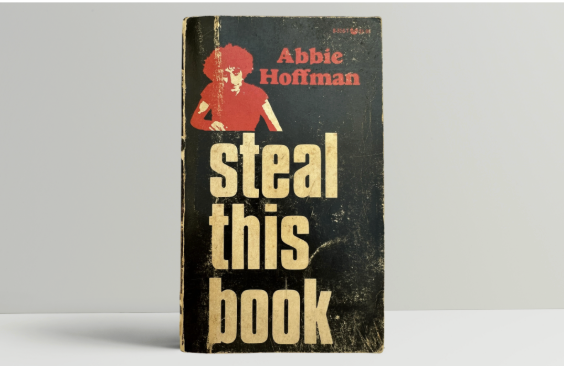
None of what we did was proprietary or even advanced. Yet these simple, easy lessons have created a foundation for what comes next. It’s the same way 1990 Upper Deck set a foundation, the same way 2018 Prizm set a different foundation.
These inflection points, these products at the elbows of BLINDBOXIFICATION - they changed the way people experience cards. ghostwrite will do the same for toys. And if you want to follow us, you can do the same for your industry.
If you want to.
***
If you don’t want to, that’s fine too.
Collectibles are one kind of blind box. Gamified Retail is another. A blind box, at its most basic level, is just adding a chase to your brand. The point of that chase can be a product - or it can be a game (or you can go for broke and build a Gambling startup108). The choice is up to you.
But take note, if you don’t know what kind of blind box you’re making . . . if you aren’t intentional about how you’re evolving . . . the rest of the world will take it out of your hands.
Resale Hype will happen with or without you. In the post-StockX world, any successful chase will end up creating a market. This will happen instantly, whether you like it or not. And, if and when it does
Repack Gamification will happen with or without you. Because a repack – at the most basic level - is someone else using your brand as a chase in their product. If your chase is resold, it will also be repacked.
Do you want your product to be someone else’s chase? Or do you want it to be someone else's filler? How you evolve your blind box will determine the answer.
***
Some of you will hear this and feel the urge to resist. From the pangs of nostalgia, or the pull of tradition, you will throw up your hands against the winds of history.
I don’t want to make poker chips!
I don’t want to build a casino!
I don’t even want to create HITS and FILLER and TCCs!
And guess what? You don’t have to. We’ve given you the map, but where you drive is up to you.
We saw this already in our ticketing hypothetical. A team could use a blind box to simply fill some empty seats. Or they could use it to create an entirely new ecosystem - with new distribution, new customers, and new revenue streams.
But what both examples show is that blind boxes are about more than increasing consumption. They’re more than just “let’s sell more black hoodies by mixing in a random red one.” A blind box creates a new experience, and that experience serves an old psychology.
“The pleasure of the hunt is greater than the pleasure of the capture”
Your customers don’t want the capture of consumption. They want the perpetual motion machine of a well-designed hunt.
And why shouldn’t they? After 100 years of business evolution, the inflection point is already behind us. Gambling is normalized. Commerce is gamified.
Prediction markets let you bet on any event. Blind boxes let you bet on any product.
That’s what makes it the second most disruptive global economic force after AI. That’s what makes it THE BLINDBOXIFICATION OF EVERYTHING.
And it will keep evolving, because that’s what evolutions do.
The only thing left to evolve is you.
THE END
APPENDIX 1 - FOOTNOTE 39
You did it! You found the tear strip on the blind box - the first blind box EVER to come in the form of a white paper.
This is groundbreaking stuff. The literary equivalent of 1952 Topps baseball. Take a moment to appreciate that.
Before you open the box, a quick refresher: 17 guest authors wrote 17 versions of the same footnote. Every other word in the paper is identical – the footnote is the chase.
This is the checklist:
Each guest author was given a prompt about the $1.1M Paul Skenes card sale. Some people wrote their footnote about that. Some people didn’t. If you want to know who wrote what, you gotta collect ‘em all. Which means you must read this paper at least 17 times.
Or you could download it 17 times. But where’s the thrill in that?
Ok, are you ready to see your footnote? Want to see if you pulled a hit? Is the anticipation killing you?
Or maybe you want to return to the page where the footnote first appears and read some more until you calm down?
No? You’re ready? Ok, here it is...
APPENDIX 2 - THE LEGEND OF THE RED OHTANI
To paraphrase Full Metal Jacket, there are many baseballs that look alike, but this one sold for $4.39M. Of course, that’s because Shohei Ohtani hit that one over the wall for his 50th home run last season. It traveled 391 feet and picked up a multi-million dollar story along the way.
Every great collectible carries with it a great story.109 Because physical objects are just that, objects. Until they’re more. The best example of the story making the collectible is the Gretzky/McNall Wagner itself. It’s hard to appreciate, today, just how famous and influential these two guys were in 1991.
Every card collector knows the name ‘McNall’ on the label of the Honus Wagner card owned by Wayne Gretzky. Some collectors know that McNall was the owner of the Los Angeles Kings, the team Gretzky played for. And fewer yet know that his first name was Bruce. But in 1991, Bruce Fucking110 McNall was the rising figure in hockey ownership and L.A. sports moguldom. He was “brilliant, aggressive, flashy, and unstoppable.” He was the guy who brought Gretzky to America; perhaps the most famous non-player in all of sports; highly visible with the cultural elite and just made of money. He was 2006 Mark Cuban x 2021 Michael Rubin.111
Wayne Gretzky aka The Great One needs no introduction. You know how big of a deal he was. You know the cultural earthquake caused by his arrival to Los Angeles - even if you were too young to know it yourself.112 You know, you know, you know. But you don’t know, you Mars Blackmon-spittin’ know-it-all. You have no fucking clue!
I asked ChatGPT to rank how famous Gretzky was in 1991. Here are the summary results:
Third most famous athlete, behind only Jordan and Tyson
#1 athlete in his sport by an unbridgeable margin
Only athlete who was treated as a living historical figure, not just a star (Jordan didn’t win his first title until June 1991; Gretzky already was hockey)
Top 15 most famous humans, behind people like Jordan, Madonna, Tom Cruise and Oprah, but on the same celebrity stratum as people like Arnold Schwarzenegger (pre-politics) and Clint Eastwood
The modern day comp for Gretzky is Messi
If these two cultural icons had never bought the T206 Honus Wagner, it would never have catapulted to be the most famous card in Hobby history. But once they did, the brand / PR value intrinsic to the very essence of Gretzky and McNall in 1991 transferred to the card. So much so that after the sale, people started saying stuff like this:
“The card is valuable because it is famous; it is famous because it is valuable,” noted Paul M. Green and Kit Kiefer in a baseball card book.113
If Gretzky and McNall had bought, instead, say, a Billy Ripken FF white scribble version - the rarest of the censored versions114 and still fresh in the public consciousness at the time, would the entire trading card industry look different? Would the entire world?
My best guess is that thirty-five years of the media repeating ‘fuck face’ would have softened the phrase into a term of endearment. Ken Kendrick would still have bought the card, but to make a point, he would’ve changed the name of the Diamondbacks to the Fuckfaces, retroactively making Luis Gonzales the most famous Fuckface of all time.
Hmmm. Sliding doors.
Maybe I should stick to stories that actually happened.
That being the case, I present to you the 100% true story about how I acquired the greatest trading card in the history of the Hobby - the TCC to rule them all.
The Legend of the Red Ohtani
In May of 2021 I decided to start buying Shohei Ohtani cards. I’ve done a lot of dumb things in my life; this was the opposite.
At the Dallas Card Show, on May 21, 2021, I bought a half-dozen or so big Ohtani’s in the room that day, including a Bowman Chrome Orange /25 (non-auto) BGS 9.5 for $3500. That was my biggest purchase of the show . . . until it wasn’t. With fifteen minutes left before the show closed on Friday night, I ran across a big one at a table all the way in the back of the room: 2018 Topps Chrome Update Rookie Debut Superfractor 1/1.
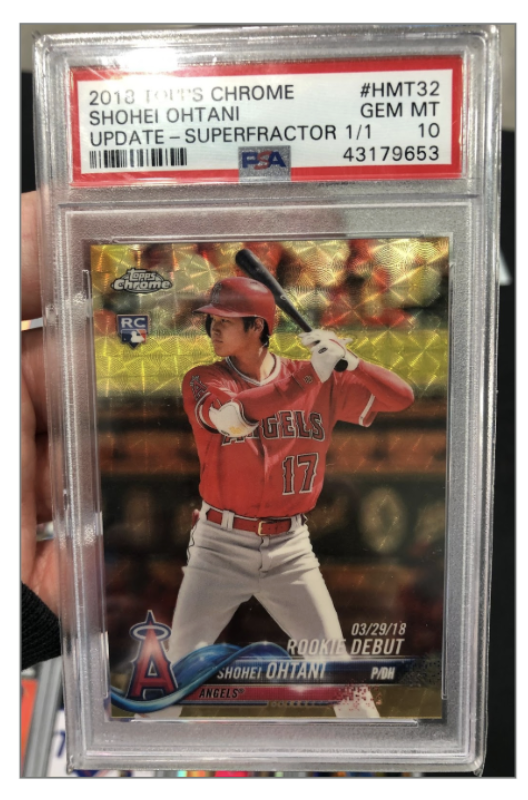
The guy had it stickered at $70K, which I wasn’t really looking to spend - but I happened to have a StockX-branded115 PSA-box of tradeable cards with me. The deal ended up being fourteen cards, which had a $27K cost basis for me, plus $6500 cash.
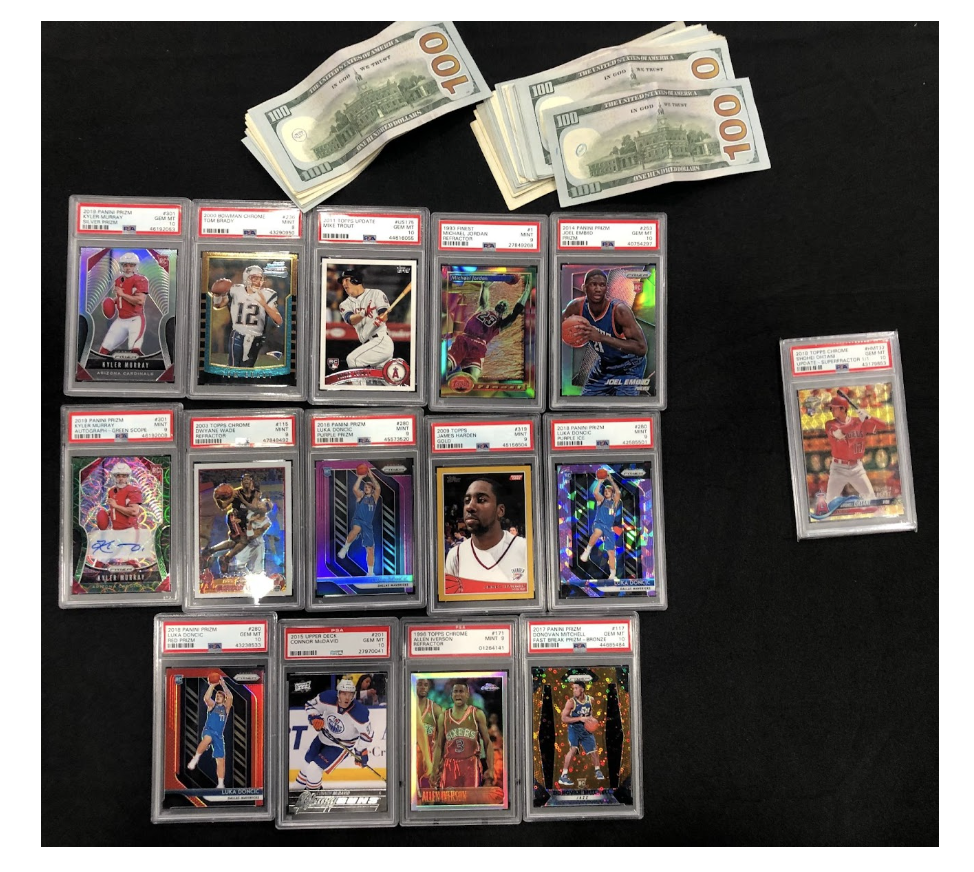
I don’t have to look up these cards to know that there’s no way they’re worth $27K today! If you can’t see, all the big cards are PSA 9 (Brady, Jordan Refractor, both Purple Luka’s, Iverson).
The comp checking process took a good hour or so. During that time I met a young kid who was set up at a nearby table. Mid-twentys maybe, wearing an Ohtani jersey. He was super interested in the deal. I showed him the Bowman Chrome Orange that I’d bought earlier. He said he had some other big ones to sell, if I was interested. I texted him my name, not thinking much of it.
The next day, Tyler Coleman (@22sCards on Instagram) texted me a pic of two Ohtani Bowman Chromes - one Red PSA 10 and one Orange 9.5 (both non-auto) - that he owned and was considering selling. We traded a few texts over the next couple days, not landing on a deal.
Then on May 25 at 1am - exactly four days from our first text - he sends me a pic of the card - the Ohtani Red /5 Auto 10/10 and says:
“I’m trying to buy this and if I can’t afford it, would you be interested? I’m sure you would be lol”
“Lol yeah. Hmu?”
“He was at 100k obo. I think it’s a steal but it’s huge for me. He has an orange auto too.”
“Ugh. $100k is still steep. Maybe we can get a bulk deal if we take both red and orange?”
***
Six days later, on Monday May 31, 2021, Tyler and I met at a hotel lobby in NYC where I gave him nine high-value cards and he gave me his Ohtani Red PSA 10 (non-auto) . . . as collateral.
Collateral?
Yes, collateral.
Because I wasn’t doing a deal with Tyler. I was doing a deal with “Vince Ohtani Hawaii” - as his name now read in my phone - the owner of the Red and Orange Auto 10s.
These two:
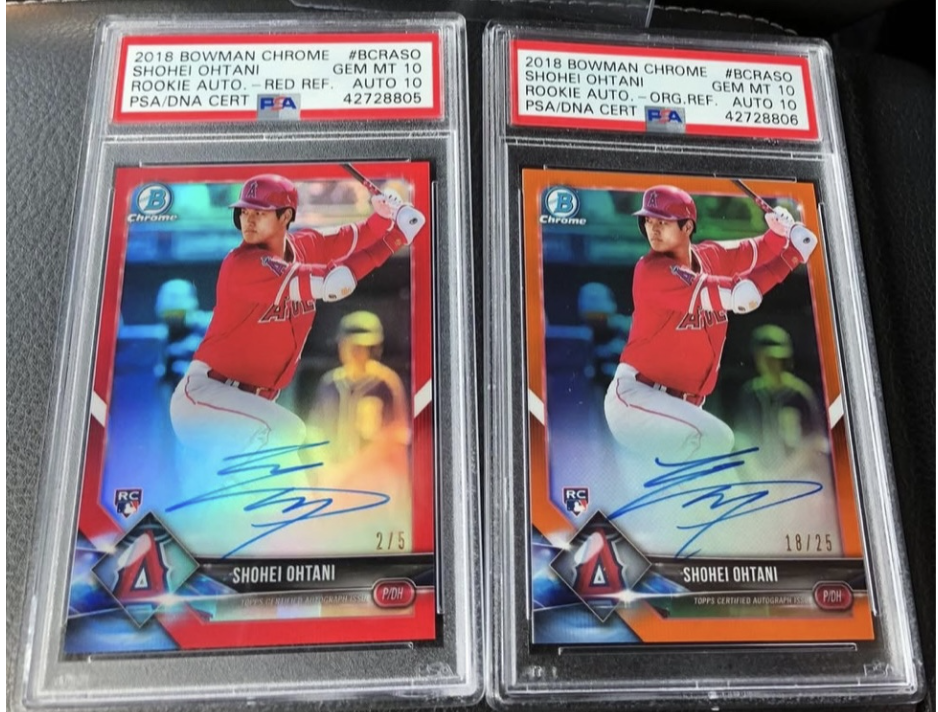
Through Tyler, I was able to work out a deal with ‘Vince’ for the two Ohtani monsters: $137K - $100K in trade plus $37K in cash. The only problem was, Vince, as you may have guessed, lived in Hawaii. And Vince said he ain’t shipping!
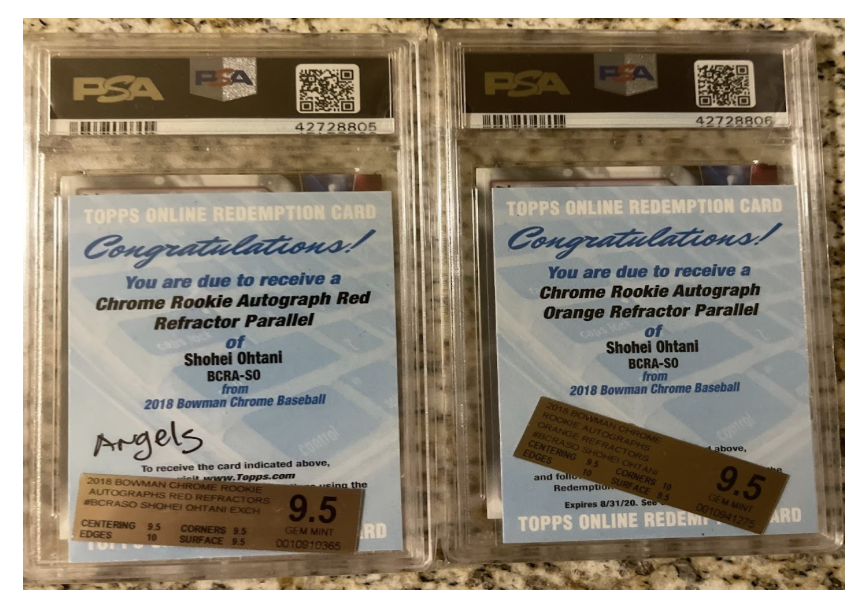
To this day I still don’t know his full name. In fact, I’m not 100% sure his name is even Vince. But his IG is definitely @5150breaks - a fact I only learned from Tyler during the final editing of this paper! For the last five and half years (and about 40 drafts of this paper) I thought I had bought the cards from @oahusportscards (I definitely don’t know that guy’s name but he once told me his ex-best friend is Vegas Dave). Apparently, that’s the guy who crossed the two cards from BGS to PSA, took the sick pic you see above (the Red and Orange side by side) and then sold them to Vince (aka @5150breaks). Tyler then found Vince by accident, because Vince had used @oahusportscards pics of the two Ohtanis as his profile pic.
What an industry; what a world.
Anyway, after we agreed on the deal (me and Vince, through Tyler), he (Vince) explained that there had been a rash of card thefts at the USPS in Hawaii where he (Vince) lived, so even though we (me and Vince) had an agreement in principle, he (Vince) wasn’t willing to ship the cards.
[OK, that’s enough of that]
The point is, we’d have to do the deal in person.
OK, no problem, I say, are you going to be in the 48 anytime soon?
No.
OK...
I was at a loss. I wasn’t quite sure what to do.
But then Tyler offered . . .
***
It really was 100% his idea. I swear. But once he put it out there, I jumped on it.
I paid for the plane ticket, of course. I also offered to pay for him to stay in Hawaii as long as he wanted - take a vacation on me! - but he just wanted to go and come back. I offered to pay him a fee, which he declined several times. And I gave him many chances to back out. But he insisted. I think he was more excited than me.
He was genuinely just excited for me to get the card and, once the idea had been planted, excited about the story.
And here’s the best part - at least the part that says the most about Tyler - he insisted that I take his Red Ohtani PSA 10 as collateral.
I ended up buying it from him a month later for $40K, but at the time of the deal, that wasn’t contemplated. Rather, he wanted me to feel confident that he wasn’t going to run off with my cards. He wanted me to hold onto his most valuable possession.
I declined several times, but he insisted.
I really wasn’t worried. I don’t know why, but I wasn’t.
I sent this text, during the days leading up to the trip:
How crazy is the card world. We do deals like this dont even know guys name. You and I barely know each other but I trust you to do a $150K deal lol.
***
I shared this story with Chis HOJ ahead of time, and this was his response, again verbatim:
There’s a whole extra book to be written on the “wild wild west”-ness of high stakes sports card transacting. And the layers of trust...or is it trust, or just an overwhelming NEED to get a card, and we just kick all caution to the wind and get lucky that it works out...Buying a house for $200k will generate weeks of paper work and attorneys and filings and mortgage documents...Buying a card for $2m wire transfer is done in one click on a screen and a meet up to hand it off
***
After the handoff at the hotel lobby, his next stop was JFK, and from there Hawaii via Minneapolis, where he went to make the best deal I’d ever made, for me.
I couldn’t have gone, even if I’d wanted to. On May 31, 2021 I was in NYC on my way to the Hamptons for the first and only zerocool company offsite ever at . . . wait for it . . . Michael Rubin’s beach house. Yes, the one you’ve seen host his White Party! True story. And check the dates; five weeks before his first ever White Party, he allowed me and our nine-person startup team to live in his home for a week.
While Tyler was flying to and from Hawaii, we were having strategic planning meetings, team breaks and midnight swims - all facilitated by the full-time staff - at this place:

I woke up Wednesday morning in the bed Robert Kraft had slept in four nights earlier. I checked my texts and there was one from Tyler that had landed at 4:07am ET (10:07 pm Hawaii):
“Yo. Got the Ohtanis”
I opened my laptop and wired $37K from my Bank of America account to ‘Hawaii Ohtani Dude’ and the deal was done. At least the first half of it.
***
The following week Tyler and I met up at The Philly Show. Friday 6/11/21. King of Prussia, PA.
To give you an idea of what my life was like at the time - coming off the offsite week at Rubin’s place - we had a Fanatics Collectibles ‘Board Meeting’ (which was just me, Rubin and one other person), I had gone to the Sixers game with Rubin, Robert Kraft, Meek Mill and Lil’ Baby, and I had filmed a video short for ESPN with Kevin Negandhi. We were working on zerocool; we were working on Fanatics Collectibles; we were working on the last white paper. It was a crazy time.
Tyler had declined payment several times, but I surprised him with an appropriate gift - one I knew he would accept after turning down cash and a vacation: a nice Topps #US1 Black /61 Ohtani, raw, for which I’d paid $1800.
And here are the pictures we took in Philly:
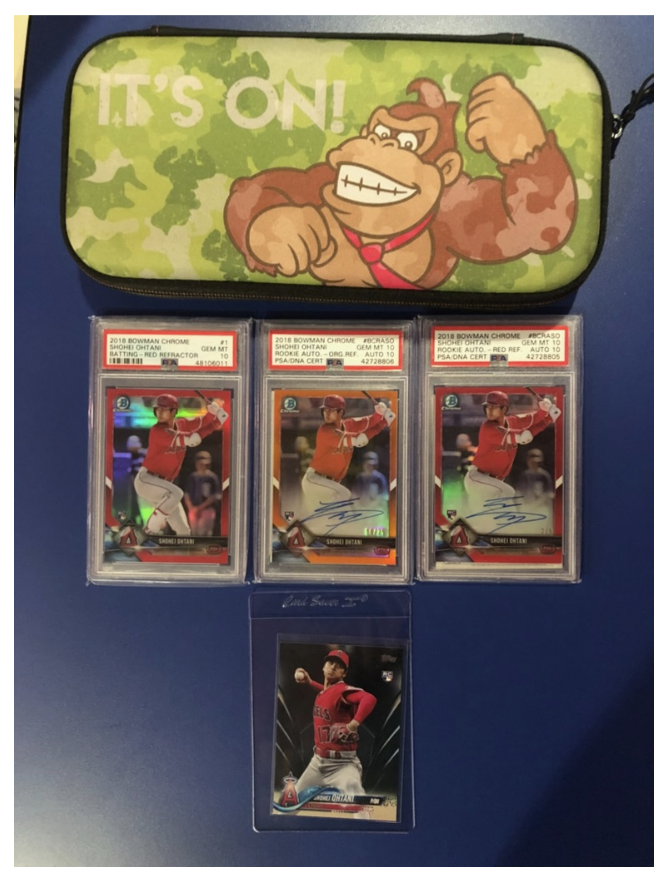
The Donkey Kong Switch case is what he gave me to hold his Red Ohtani non-auto (upper left card) as collateral while he was on the trip.
Here’s the final trade. I gave him back his card, the case and a new Ohtani Black.
He gave me an Orange Auto and the greatest card of all time.
How can you not be romantic about baseball cards?
***
Here is the final accounting of the deal.
Remember, I received two cards for this haul: the Red Ohtani and an Orange Auto /25 PSA 10. In my personal accounting, I recorded the Red Ohtani as a trade against those specific ten cards (the nine for Vince and the one for Tyler). I recorded the Orange Ohtani as a purchase for $38K (the cash plus the plane ticket). This makes sense, conceptually, as the original asking price was $100K for the Red and $40K for the Orange.
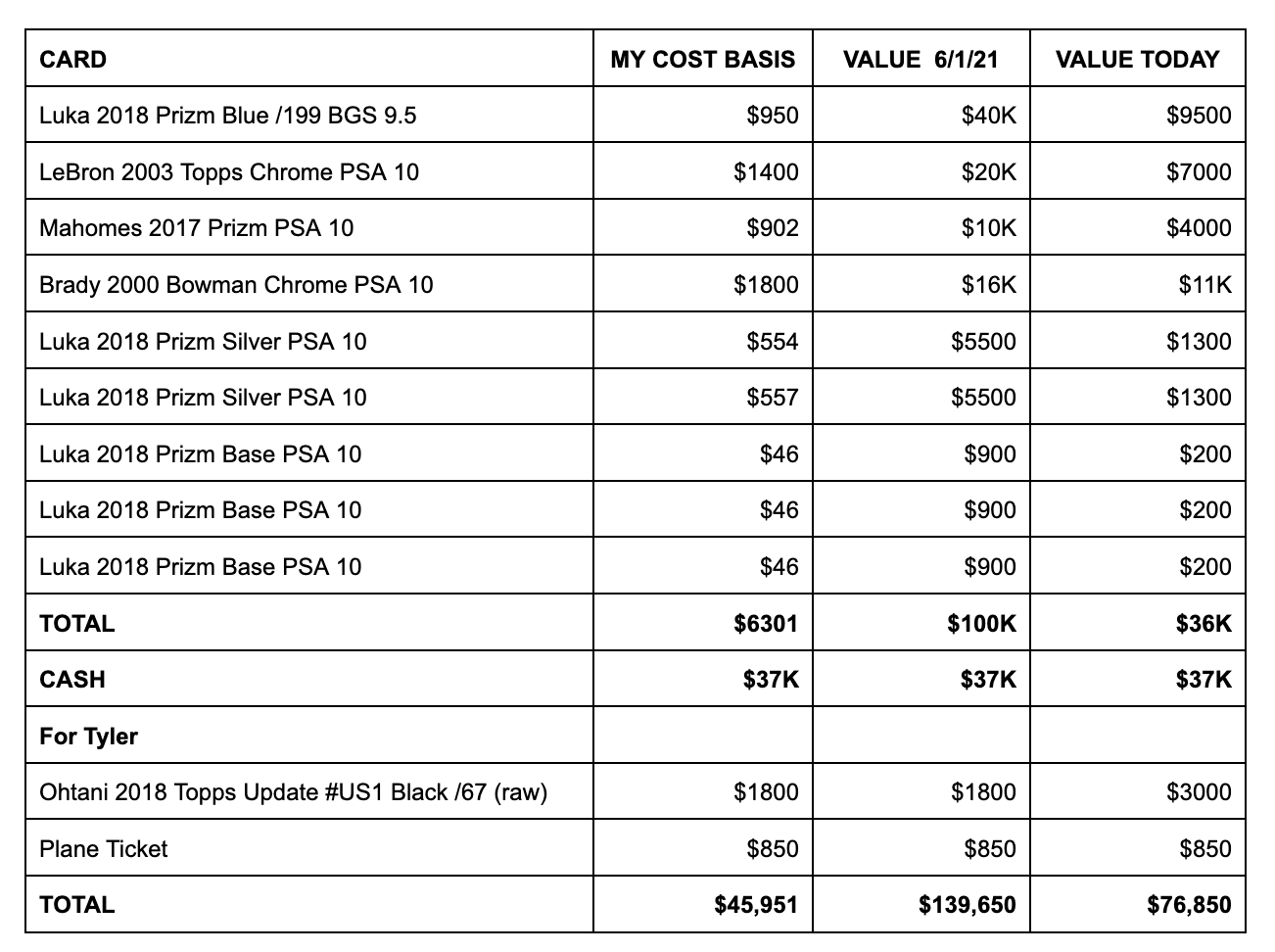
APPENDIX 3: HOW MANY $100K+ TCCs EXIST?
In Chapter 3.3, we estimated that there are 50,000 cards worth $100K or more that exist.
Here, I’ll share a few layers down on the work that Leore, Spinotron and I did to determine the number of $100K+ cards currently in existence - and the number that hit the market each year.
First, Leore and the Alt team took the same basic approach I had been considering, one based on turnover. If we know how many sales actually occurred (via Card Ladder) and we know what percentage of cards sell each year, then we can back into a total population number.
For example, if there were 1000 sales, and 20% of cards trade each year, then there are 1000 / .2 = 5000 cards that exist.
But this assumes a) the sales number is correct; and b) you know the turnover rate.
NUMBER OF SALES
Card Ladder is a great starting point but we still have to ask how might the data be off, and in what direction. We looked at this by two different categories: platform sales and private sales.
Platform Sales
Leore helped us here. Card Ladder reported 62 sales for Alt in 2025. Leore checked and provided us with the actual number, 67. This is a 8% discrepancy, which is pretty close, but is still a clear adjustment we could make
However, if there is one area in which Card Ladder might be too high in their reporting, it would be duplicate sales - i.e., if the same card is sold multiple times in a year. Due to how cards are named in the Card Ladder data, we were unable to identify any duplicate $100K+ sales in 2025 (and therefore did not remove any)
There are a number of ways we could have handled this. We all agreed that the net result of underestimating platform sales (possibly by 8%) and overestimating sales due to multiple sales of the same card each year, was likely a net increase in the number of sales each year. That said, we took the conservative approach and cancelled these two issues out.
Private Sales
What’s left is private sales - and this is where there’s a ton of variance. Card Ladder has 35 private sales recorded for 2025, which is obviously very low. And this makes sense; private sales are private for a reason.
One data point we have was provided to by Jesse Craig, owner of Acquir, one of the top high-end brokers in the Hobby. Jesse was kind enough to let us know that only about 10% of their $100K+ sales were captured by Card Ladder.
Together, we discussed, and agreed that most of the private transactions reporting to Card Ladder came from a small group of individuals, and the overwhelming number of private / dealer transactions were not recorded by Card Ladder.
This means we have two groups to add to the Card Ladder private sales data - the recorded group and the unrecorded group.
For the recorded group, we decided to use Jesse’s data to apply a 10x multiple to the number of cards recorded. 35 becomes 350. That number felt conservative; our assumption is that Jesse, being one of the most prominent brokers, would have had a higher percentage recorded by Card Ladder.
Next for the unrecorded group, we decided to make our most significant assumption yet and double the number of record transactions. So 350 becomes 700.
Obviously that is a big leap but after talking it through with several people, everyone agreed that that, too, felt conservative. It is more likely that there are less people reporting private sales to Card Ladder than those who are, therefore it would have been reasonable to 3x or 4x the 350, but we just doubled in.
In conclusion, from the starting Card Ladder number of platform sales of 763 (total minus private), we cancelled out the Alt factor with the duplicate factor, and then added in the new private number (750) and arrived at a new total number, 1513, which we are just going to round down to 1500.
New Total Sales (2025): 1500
TURNOVER
First, an example of where we might be heading. Here is a chart of possibilities, using 1500 as total 2025 sales, and a number of different turnover percentage

As you can see, the range is large, so the turnover percentage is important.
We started by discussing the number with several people and, anecdotally, 15-20% of a card’s total population was believed to come up for sale each year. That felt high to us, for cards so expensive, even if it might make sense for lower priced cards.
So our next stop was to look at the 2025 Card Ladder, by sales, to see if we could learn anything. This chart shows six well known six-figure cards, how many sales were reported by Card Ladder, their population on the day we did the analysis, and what turnover percentage that would mean. Here are the results:
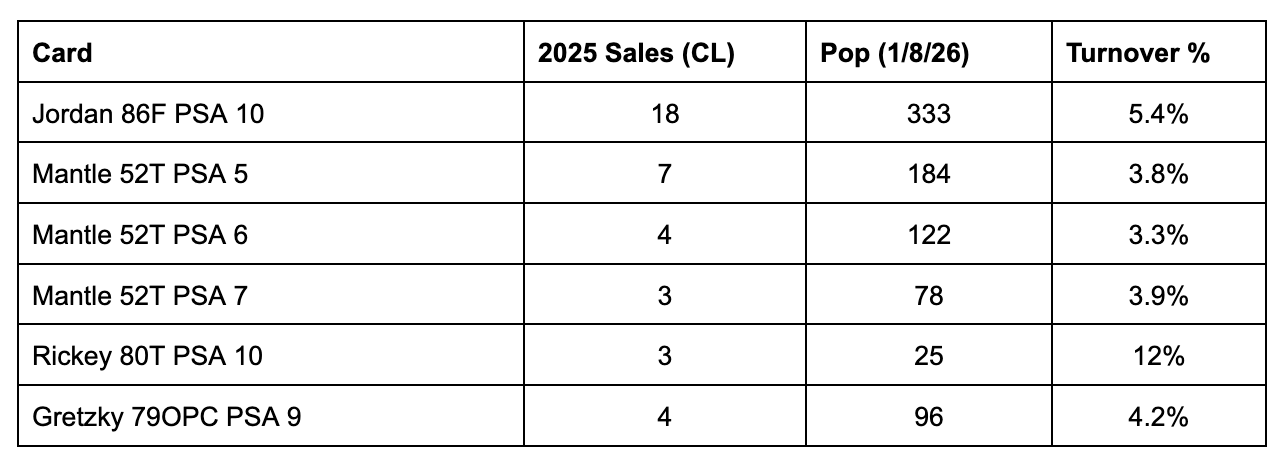
The Henderson is obviously an outlier here, due to its low pop, but it’s also an anomaly in that we all know the value is very much a function of its low pop. The others are all in the same ballpark 3.3% to 5.4%.
But what else do we know about these cards? Well, they likely have higher than the turnover average because they have high populations, are well known cards and are on the lower price side of the full population of $100K+ cards.
Other cards are likely lower-pop vintage (often tucked away), true 1/1s / Superfractors / logomans (held longer), and awkward “one-off” cards where the buyer pool is thin.
Thus, our conclusion is that this range is on the high side of the total $100K+ population. Or, to use that conclusion as a means of moving towards a number: we think turnover is considerably less than 3.3%.
BUT...if you recall, we’ve already doubled the number of Card Ladder sales, from 798 to 1500 ...and the data we are using here is Card Ladder sales data. So perhaps we should be doubling the turnover percentages in the chart, and it should be 6.6% to 10.8%?
Maybe. But in that case, we now have very high turnover ratios. So with that in mind, we decided to set the turnover percentage at 3%. That felt just low enough, regardless of which method you use.
FINAL CALCULATION: 1500 sales divided by .03 = 50,000 cards
Now, as a final check, we bring you the one and only, Spinotron:
Spinotron - Methodology
The best part of working with Spinotron is how much data he conveys in such small chunks of text LOL. Here, completely unedited, is one of the text chains he sent me:
A quick list will say Jordan has at least 1911 such 6 figure+ cards but must have some slip through as well as pop 3-5 cards of various others. So Jordan could have like 5000 or so.
Kobe could be more than 1911 above as he has an entire Panini era which has been going strong. but not sure about PSA 10 pop 3-5 version of other cards
So I feel Jordan, Kobe, LeBron together should be at ball park of 1Xk such cards
I did a quick run down of vintage from $300k+ (didn’t have enough time)
There are 65 distinct vintage cards in there (pre 1980 OPC). Much more if $100-300k. Each in top 2-3 grade could qualify
This could contribute to 1X000+, 65 x 50 x (1+3), can explain later on math. Also few grail card each for modern type of players from Gretzky all the way up to Flagg.
I feel 50000-1X0000 is the number
If you couldn’t follow this as well as me, just note that his final estimate was close to me: 50K+
And, to top it off, Spinotron actually sent me a third, completely new methodology, in which he also came out with around 50,000 cards.
It’s just an estimate, of course, but we spent a lot of time, and feel good about the result.
As an additional data point, just for fun: about 40% of these cards are $100-150K, about half are $150-500K and about 10% are over $500K.
Huge thanks to Leore and Spino!
Footnotes
1 and Campless and zerocool (IYKYK)↺
2 In addition to being my ghostwrite co-founder, Jesse also co-wrote the 2021 white paper with me (credited by a pseudonym). He was employee #62 at StockX. He joined me at Fanatics Collectibles. And before all that, he was one of the OG authors of FreeDarko - the first true sports analytics blog and spiritual forefather to every important writer of the milieu for the past twenty years. Don’t believe me? FreeDarko (2004) started before Sloan Analytics Conference (2006), FiveThirtyEight (2008), Grantland (2011), Moneyball the movie (2011) and Campless (2012). The last FreeDarko post, from 2011, is still up. You should read it. Jesse’s initial StockX purview was to reignite Campless-era data journalism and the rest was history. Many other people have contributed to our work over the years but Jesse has become my true thought partner. We’re also writing a book (or two!). Stay tuned…↺
3 Jesse really did co-write this with me, but it’s still easier to think about it singularly. One person simply cannot write this much intellectual fodder solo. Aaron Sorkin is maybe the only person to ever pull it off - West Wing Seasons 1-4 were the best 89 episodes in television history - but he also walked away with a debilitating cocaine addiction. Fortunately for me, working with Jesse is all the stimulants I need. ↺
5 Advertising (Brady Expos campaign), product innovation (Rookie Debut Patch), community (Rip Night), social (1-of-1 Day), collector engagement (MVP buybacks), collector aspiration (Three Kings card) and events/culture (Fanatics Fest) are all moving in the right direction. Well done, guys.↺
6 The best example might actually come from the other half of my Hype Economy career: When I moved to Detroit to start working with Dan Gilbert and team, they were calling the business ‘GRAILZ’. True story. I quickly killed that, and we came up with ‘StockX’ together. ↺
7 “That’s it. That’s my bad mother fucker.”↺
8 Shoutout to Jason Koonce for the data, and the success.↺
10 We make up terms all the time; it’s one of the great perks of being an accidental economist. But ‘Runaway Parallelism’ is one of my all-time favorites. That one was all Jesse. I had suggested ‘Parallel Entropy’ to explain this phenomenon. The ‘Mark y Mark’ Theory is my favorite from the last white paper; that one was me. ↺
11 Boom! I did it! I finally used ‘score’ in a sentence, correctly. Like basically every other kid in America, the first and only time I heard the word was in The Gettysburg Address in elementary school . . . but who ever needs to reference exactly twenty years?! And wasn’t the last year of Topps Chrome basketball 2009? Well, how long is the current Fanatics NBA license?? That’s right - twenty years! ↺
13 This is widely considered one of the best advertising campaigns of all time.↺
14 Note - that’s how I’m able to articulate it today, with the benefit of hindsight and the time it’s taken to write this paper. Back when I made the shift, though, it was a much more intuitive decision that was also influenced by the realization that Panini Prizm basketball would be going away very soon (Sorry; Not sorry!)↺
15 Ohtani was actually in this class, too, although the other guys were on a higher tier at the time. This further reinforces the cosmic importance of the year 2018 (more on this later; see Chapter 4.4) ↺
16 Hold that objection. We’re getting there.↺
17 Most importantly, these were the first two decades when Baby Boomers got their first jobs, got their first paychecks, and got their first nostalgic whiff of Pascalian vintage card hunting.↺
18 1951 Topps Red Back / Blue Back game cards↺
19 “I’m going to steal the Declaration of Independence” -Benjamin Franklin Gates↺
10 We make up terms all the time; it’s one of the great perks of being an accidental economist. But ‘Runaway Parallelism’ is one of my all-time favorites. That one was all Jesse. I had suggested ‘Parallel Entropy’ to explain this phenomenon. The ‘Mark y Mark’ Theory is my favorite from the last white paper; that one was me. ↺
11 Boom! I did it! I finally used ‘score’ in a sentence, correctly. Like basically every other kid in America, the first and only time I heard the word was in The Gettysburg Address in elementary school . . . but who ever needs to reference exactly twenty years?! And wasn’t the last year of Topps Chrome basketball 2009? Well, how long is the current Fanatics NBA license?? That’s right - twenty years! ↺
13 This is widely considered one of the best advertising campaigns of all time.↺
14 Note - that’s how I’m able to articulate it today, with the benefit of hindsight and the time it’s taken to write this paper. Back when I made the shift, though, it was a much more intuitive decision that was also influenced by the realization that Panini Prizm basketball would be going away very soon (Sorry; Not sorry!)↺
15 Ohtani was actually in this class, too, although the other guys were on a higher tier at the time. This further reinforces the cosmic importance of the year 2018 (more on this later; see Chapter 4.4) ↺
16 Hold that objection. We’re getting there.↺
17 Most importantly, these were the first two decades when Baby Boomers got their first jobs, got their first paychecks, and got their first nostalgic whiff of Pascalian vintage card hunting.↺
18 1951 Topps Red Back / Blue Back game cards↺
19 “I’m going to steal the Declaration of Independence” -Benjamin Franklin Gates↺
20 Jesse and I are actually writing a book about this topic. It’s about the Hype Economy, generally, which is driven by the unique relationship between supply & demand for collectibles, sneakers, streetwear and other Hype Economy products. There are several different types of demand, at least one of which can be circular based on supply. For example: sometimes people want a pair of sneakers only because they are limited. Sounds normal; nothing you don’t know - but try mapping that onto a Supply-Demand Equilibrium Graph! Fun stuff.↺
21 Remember: we didn’t have grading back then – PSA started in 1991; pop reports started in 2002. If you came across a ‘52 Topps Mantle at a card show in 1984 and the dealer said, “This is one of fifteen that exist” . . . How could you prove him wrong?!↺
22 A Topps 1952 Mantle sold in the same auction for $49,500 - more than triple the presale estimate.↺
23 Sometimes we use footnotes to add facts or a joke or a citation, etc - there’s no limit, really. Footnotes can be used for many reasons. In this case, I am delaying facts in order to build suspense and heighten your incredulity. Here goes: My cost basis on the nine cards that I traded for the (now) multi-million dollar, GOAT TCC, Red Ohtani was…wait for it…$6301. Yes, six thousand three hundred and one. Dollars. And, yes, “one” - I keep exact records. ↺
24 To make a very crude demographic point: we know that there are 3.5 to 4 billion soccer fans globally, but there are 4.9 billion Asians in the world, plus another 300 million non-Asian baseball fans. So while Messi might have an argument here, the numbers still favor Ohtani.↺
25 In the interest of some objectivity of argument, I asked Chris McGill from Card Ladder (aka ChrisHOJ) to give me a counter argument. Here’s my favorite part of his response, verbatim: “You say red looks better, I say gold is always the top shiny color on chrome. But who cares? No one can settle that debate, it’s just my taste against yours. But here’s what we can settle: The Superfractor is rarer. And not by a little bit. It’s 5 times rarer. Think about the magnitude of 5x. Ohtani hit 55 HRS this year. That’s 5x more than Nolan Jones, who hit 11 homers. The super is Ohtani with 55 dingers. The red is Nolan Jones.” LOL. He called my GRAIL Nolan Jones!! Touche, my man. And sorry Nolan Jones catching strays! ↺
26 Ohtani’s 10K, 3 HR game from Game 4 of last year’s NLCS isn’t even his best game ever. That distinction probably belongs to 8/23/23 when he threw a complete game shutout (1H, 0BB, 8K) and hit 2 HR with 4 RBIs.↺
27 In Japan, names using the “翔” (Sho) character - which is the first kanji in Shohei - was the #1 kanji used in boy names in the first half of 2024. The United States Social Security Administration does not list “Honus” on its annual baby-name popularity releases, which means fewer than 5 newborns were given that name last year. ↺
28 Oshu’s population is 110,000 - and declining. ChatGPT says that the U.S. city most similar is Missoula, Montana.↺
29 Sorry, had to do it just once.↺
30 Just to confirm, we do not acknowledge “National Treasures: Edge of History” (the short-lived Disney+ show), as part of the beloved treasure-hunting universe.↺
31 And if you get lucky and hit author #17 in footnote 39, it’ll be that much more special!↺
32 Obligatory “Be Like Mike” Gatorade commercial link↺
33 WAR, or Wins Above Replacement, is the all-in-one analytics metric commonly used to rank athletes against each other. WAR is not about how good a player is in the abstract; it’s about their value compared to an alternative. ↺
34 I’m not going to even try to explain them here, but I’d recommend you check out this episode, where Chris breaks it down for both Jordan and Jokic.↺
35 OK, it’s also a little about owning it too LOL, but you get my point.↺
36 Of course, everyone has a personalized understanding of value. As the saying goes, “one man’s Caleb Martin Purple Raywave Refractor is another man’s Cooper Flagg True Red.” Shoot, there’s probably a collector out there who thinks the 2018 Luka Prizm base card is the greatest card ever made. And that’s fine. But when we talk about TCCs in this essay, we are talking about market judgements, not personal ones. And for the market, the Luka base card is just FILLER.↺
37 In one of last year’s most illogical examples of a GOAT auto boom, a Michael Jordan 1986 Fleer PSA 10, which was autographed by MJ with a blue sharpie and then graded, sold for $2.5M. For context, an ungraded Jordan 10 sells for about $250K. Full story here.↺
38 The Lucky Charms reference isn’t entirely a joke. One of the many things I learned while writing this paper is that Lucky Charms marshmallows are NOT evenly distributed. It is, in fact, a blind box system where certain colors / shapes are more rare than others, and the ultimate chase is a box full of all marshmallows!↺
39 This is it! As we explained in the Foreword, this paper is a blind box, and this footnote is the chase. To see which one you pulled, go to Appendix 1. ↺
. But then come back and keep reading :) ↺40 Intentionally douchey phrases added for emphasis.↺
41 PASCAL! Sometimes it’ll be in the main text, sometimes in parentheses, sometimes it’ll be in a footnote, but goddamn I promise you will leave this paper knowing that Blaise Pascal of Paris, France (1600s) thinks the experience matters more than the result.↺
42 Of course, if wealthy collectors want to buy into breaks - rather than hunt TCCs on the singles market - they’re free to do that, too! Just because a collector can afford a six-figure card doesn’t mean that he or she isn’t also buying into breaks. In fact, Pascal would say that the experience of the break is the true value anyway. ↺
43 I gotta be honest - I think Pascal has made me more religious. Not a lot. It’s not changing my daily habits or anything - I’ll still continue to be a High Holidays Jew. But I think I’ll be taking Rosh Hashana services like maybe 10% more seriously this year. We’ll see. I’ll report back.↺
44 This is like when Doc says to Marty “Next Saturday night, we’re sending you back to the future!” or when Samuel L. Jackson has had enough of a certain animal on a certain vehicle. ↺
45 BBC reports children as young as 11 have been exposed to gambling this way. It is a legal grey area in the U.S. where gambling laws vary by state, and skin betting is against Steam’s ToS. Obviously, this is just the tip of the iceberg. It gets nuts if you go deeper into the controversies around CSGOEmpire founder, Ossi Ketola aka “Monarch”, a Finnish entrepreneur, high-stakes poker player, online gambling innovator and, by most accounts, horrible human being. I mean, this article is, well, wow. And this was written before Monarch challenged five of the best poker players in the world to five heads-up poker matches and proceeded to lose more than $30M combined.↺
46 The November issue variants (featuring Cooper Flagg), already have a secondary market, with the Gold Holo /25 cover netting $250 or more!↺
47 Of course, even a traditional clearance sale is a subset of BLINDBOXIFICATION. 50% off! One Day Only! Get The Deals Before They’re Gone! This is a chase, too - just a very rudimentary one.↺
48 Then again, maybe our feed is a little different than yours. We did spend eight weeks writing a white paper on blind boxes, which might have fucked with the algo.↺
49 239 cards were released in 1933, and a single short-print - #106 Nap Lajoie - came out the following year (which of course drove completionists bananas). ↺
51 I’d say it’s nice that she outgrew them, but I don’t think I’m going to like her teenage obsessions better↺
52 In 1992, two 1933 Goudey Babe Ruth cards sold for $8,000, according to Beckett. In November 2024, a PSA 8.5 Ruth #149 sold for $1.62 million at PWCC / Fanatics Collect↺
53 This survey research was presented to Upper Deck management in 1991, and was key to formulating their go-forward marketing plan. Williams (1990), pg. 137. ↺
54 This is where every 48-year-old reading this who collected cards as a kid but never got back into the Hobby will say: “Oh, what about Jerome Walton? Dwight Smith? Tom Gordon? Gregg Jefferies, Kevin Maas, Hensley Muelens, Brien Taylor and Todd Van Poppel??” Yep, we’re with ya, bud. Been there, done that. ↺
56 “At the heart of the market for Beanie Babies was what was known almost universally as the Beanie Chase”, writes Zach Bissonnette, author of the seminal history, The Great Beanie Baby Bubble. Bissonnette (2015), pg. 128.↺
57 The first retirement was Spot The Dog in Jan 1997 (first introduced in 1993). The second was Brownie the Bear in March 1997, but he was re-released as Cubby the Bear, so this was more like a retro than a restock or a retirement. These weren't that big a deal, but then in Oct 1997 Ty started marketing the retirements, publishing checklists and explicitly stating that the retired characters would never return. This was Ty really leaning into retirements as an intentional scarcity strategy, and from there resell prices exploded. But prior to then, it was accidental. ↺
58 In The Perfect Store, a history of eBay’s rise, journalist Adam Cohen notes that Beanie Babies were an essential part of eBay’s early success. “It would be an exaggeration to say that eBay was built on Beanie Babies, but not by much,” writes Cohen. Cohen (2002), pg 43.↺
59 Bissonnette (2015) Pg. 133↺
60 Zac Bissonette writes about Segal’s medallion business as an analogy to Beanie Babies. And he notes: “Segel’s medals had increased in value because of commodities prices, not some sort of alchemy on his part. Nevertheless, the auspicious timing launched a perfect feedback loop, and the word spread. Segel’s commemoratives went up in value, and the actual reason—the price of silver—was obscured because who really cared?” Bissonnette (2015), pg 115. This will become important later, so keep it in mind. ↺
62 Bissonnette (2015), pg. 170↺
63 Card Sharks. 189. Three years later, a new group of parents would use the exact same racketting argument against Nintendo, claiming their kids were gambling on Pokémon cards. According to a New York Post report in 1999, the suit “claims that Nintendo is involved in an ‘illegal gambling enterprise’ and demands the company stop randomly including rare cards in regular packs.”↺
64 Williams (1995), pg. 254. Emphasis mine. That Phil Mushnick was really something.↺
65 This is when my personal story converges with the Hobby. The summer before Luka’s sophomore season I decided to load up on the Dallas rookie. I bought every Luka Prizm I could find for two straight months - and then his cards exploded in November. I got very lucky, and made a lot of money - although I would’ve made a lot more if I’d pulled the trigger on Sharon’s Black Gold Luka! (see Chapter 3.1)↺
66 You better know who said that.↺
67 I have no inside info here, but I guarantee this is how Prizm Choice and the Nebula 1/1 was born.↺
68 “Find” = experience (Pascal); “Autograph” = HITS; “In Every Box” = gambling ↺
69 Can’t believe we waited until page 78 to discuss Labubu. Kalshi had the over/under at eight.↺
70 Murphy v. National Collegiate Athletic Association, 584 U.S. 453 (2018). Damn, would you look at that. Never thought I’d be citing cases again. February 2008 was the end of my 11 month run at Alston & Bird. ↺
71 Footnote 39 / Card 4 / Appendix 1 / Pack odds: 1/17↺
72 We prefer our science from Dr. Rovell (doctorate in collectibles), but if you want an actual PhD, read this article about the psychology of blind box cards and Labubu. It says the exact same thing.↺
73 How lucky are you? Not only are we building the Blind Box Continuum for you, but you also get to walk away with this absolute gem of fact: Throughout the years there have been hundreds of different Voltron toys but the best five-lion set was the 1984 Panosh Place version. ↺
74 MIMO, a cousin of FIFO, LIFO and MINISO.↺
75 You didn’t see that one coming, did you Quavo?↺
76 Why? Maybe the head of the Commission got drunk. Maybe he’s just a Jack Dorsey fan. But it doesn’t really matter why - it’s a thought experiment!↺
77 Remember from Chapter 3: debating the brand value of cards is itself a Pascalian game. As for the Superfractor, you know where I stand!↺
78 Also because silver price charts look like Courtyard revenue graphs these days!↺
79 The Happy Meal storyline was also ripped from the headlines - and my friend Jason Koonce (@otiasports; the owner of @OtiaRips) was the main protagonist! He was at the epicenter of the infamous Pinky Beanie Baby x McDonald’s arbitrage. In 1998, when he was 15 years old, he recognized that Pinky’s were reselling for as much as $22 back East, but no one in California was into them. He flew to Cali (from Detroit, where they were already sold out) and bought thousands of Happy Meals at $1.99 each - often irking the staff who had to prepare hundreds at a time. Jason said he usually ordered with milk and donated the boxes, but there was definitely a lot of wasted food. Still, he cleared over $30K on Pinky’s - not bad for a 15 year old - which maybe explains why Koonce has been in the hobby for decades and now runs one of the leading repack businesses.↺
80 Bissonnette (2016), pg. 198.↺
81 Reports vary, but Big Into Energy - the flagship Labubu series - restocked at least four times, but maybe as often as every Thursday!↺
82lass="p2">82. “Shanghai government caps price on ‘blind boxes’, prohibits sale to children aged below 8”↺
83 The back story on this stuff in China is wild. For example, when KFC China partnered with Pop Mart on a blind box toy giveaway, a man bought 106 separate meals in an effort to complete the set. The public was horrified by the waste of food: hundreds of pounds of fried chicken thrown away, all so one man could satisfy his addiction. Of course, this is pretty much exactly what Koonce did (see footnote 79). A darker scandal involved blind box kittens and puppies - an actual trend in which Chinese customers paid to receive random pets in mystery boxes. Many of the unwanted dogs and cats were abandoned, prompting outrage from animal rights groups.↺
84 We did a quick analysis of eBay data, comparing overall sales of Pop Mart Monsters between August 2025 and January 2026. We found that total sales are down 50% - a massive drop from the peak of the boom.↺
85 Needless to say, Pop Mart has taken the blue pill. In their eyes, the only demand that counts is demand from “true fans” - the ones who don’t care about hype. In September, the company told CNBC that they were now making 30 MILLION plushies a month - a 10x increase in production - in a conscious effort to kill the resale market. “Making this art accessible is key for us…We don’t want our product to be hyped up and resold for profit”. What they could have added (but of course didn’t) is: “....especially when none of that profit goes to us”.↺
86 Mushnick’s role in the “Your Sneakers or Your Life” media frenzy is detailed here. He didn’t pen the SI story, but he was a major force in amplifying it.↺
87 Ironically, Nike did to the Panda Dunk what Pop Mart did to Labubu - restock it to death. The fact that Nike is trying to revive the Panda Dunk with blind box strategies makes too much sense. FYI, this is yet another topic that Jesse and I are going deep on elsewhere.↺
88 Obligatory Henry Ford quote here: “If I had asked people what they wanted, they would have said faster horses.” ↺
89 Metaphorically! No category mistakes!↺
90 In truth, the customers don’t actually want the brand to saturate the market. They want inaccessibility; they want the experience of the chase; and both of those things require scarcity. But that doesn’t stop them from complaining about it - because really what they want is to be the lucky one who gets the rare hit.↺
91 The Grand Victoria Casino had opened just two years earlier - one of many newly-legalized (and newly normalized) establishments that followed the 1988 regulatory change. ↺
92 Two things here. 1) The ‘priceless’ Labubu in question was an LV-themed custom, NOT a Labubu you could pull from a retail box. Pretty important distinction. But in the dozens of articles I saw about Kevin’s comments, no one bothered to note this; 2) Kevin discussed Labubu in the context of his card collecting/investing, but he didn’t really say “Labubu are just as collectible/investable as TCCs”. But the media did frame it that way. In sum: it wasn’t really Kevin who made the category mistake - just everyone else.↺
93 The New York Times. September 24, 1999↺
94 By the end of the millennium, adult collectors accounted for 70% of the Hobby.↺
95 The author of a Pokémon case study describes how this geographical scarcity dynamic played out in 1998: “My eight-year old son and I discovered them at a local Japanese gift shop in Brookline for $4 a pack six months before they were officially introduced to the U.S. My son brought some to school and immediately attracted a crowd.”↺
96 Honolulu Star-Advertiser. Wed, Jul 18, 2007. Pg. 6↺
97 National Post, Toronto, Ontario, Canada · Saturday, April 17, 2004↺
98 Detroit Free Press. Mon, Jan 28, 2002. By contrast, in 2000, Arthur Shorin was in the NYT boasting about the Pokémon acquisition, which already made up $64M of their $284M total revenue.↺
99 “Before Pokémon was the big thing, but if we stuck with that we would have died”, noted one collectible reseller in 2007. Honolulu Star-Advertiser. Wed, Jul 18, 2007.↺
100 The highest Pokemon promo sales have been “vintage” cards (e.g. the 1998 Illustrator). But newer promo cards, like this 2025 SV-P Promos Mew (BGS 10), have sold for six-figures.↺
101 Interestingly, some TCG products HAVE incorporated 1/1s - most notably, the Magic: The Gathering “One Ring” card, which was pulled (by an adult) from a booster pack, and sold to Post Malone for $2.6M.↺
102 This wasn’t random. The Spurs are known for being an historically well-run organization, interested in innovation and willing to take risks. I could see them pioneering something like this for professional sports. Also, Wemby is so sick, man.↺
103 Put another way: I didn’t intentionally become an expert on blind boxes so that I could write this paper as a means of promoting ghostwrite. Rather, I became an expert on blind boxes, incidentally, in the process of building ghostwrite (and StockX, and Fanatics Collectibles), and now I get to write this paper (for fun). ↺
104 If there’s one topic I could just as easily write another 100+ pages on, it’s a Blind Dutch Auction. For now, if you’re interested, here’s a recap of the first one we ever did, while still at StockX.↺
105 Funko has created “limited editions” with true scarcity (e.g. 1/10), but these are generally released as event-exclusives. They aren’t chase hits that appear in Funko’s blind box retail product.↺
106 If those numbers seem exorbitant, consider that Caitlin Clark’s most expensive trading card sold for $660,000 at auction, and she’s had at least 15 cards sell for $100K or more. And all of these sales occurred before the start of the most recent boom.↺
107 You knew we were starting with that, right?↺
108 Companies like PrizePicks, Underdog, and Jackpot.com are part of a super interesting group of gambling and sports-betting related startups that are threatening to create a blurred line on the southern border of the Blind Box Continuum. For a number of reasons - not the least of which is that we’ve already written 140 pages - we aren’t discussing them in this paper, but who knows, maybe they’ll be a v2… ↺
109 The purpose of the name, ghostwrite, is to be explicit: ghosts are a blank canvas to tell other brands’ stories.↺
110 You came down here expecting to find his actual middle name, but who cares. The guy was a beast no matter what his mama named him.↺
111 Of course, this was all before he was sentenced to eight years in jail for bank fraud, wire fraud, and conspiracy (tied largely to misuse of Fleer funds and the S&L collapse). ↺
112 You’d have to be at least 50 years old. ↺
113 As reported by Tim Wiles, former research director at the Hall of Fame, in this post. ↺
114 Today the PSA pop report shows 157 total graded; 14 PSA 10s.↺
115 In order, the three greatest things I’ve ever created are: 1) my kids; 2) owning PSA’s entire brand for $5K/month; and 3) this white paper. I feel bad for whomever signed off on these boxes. I assume Nat fired ‘em on his first day.↺